
Bremen is a city defined by its stories: a proud Hanseatic trading legacy; centuries-old architecture; and the timeless charm of fairy tales whispered through its cobblestone streets.
Located along the banks of the Weser River in northern Germany, Bremen offers both history and whimsy, where myth and reality coexist.
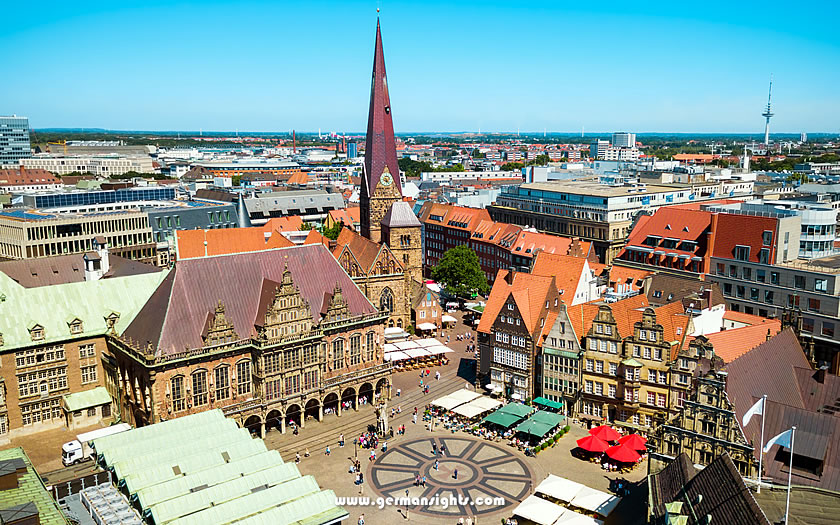
View of Bremen city centre
The city’s compact centre makes it ideal for independent travellers. You can stroll between landmarks on foot, taking in the medieval market square, the iconic Roland statue and the picturesque Schnoor quarter, all of which are within minutes of each other.
Bremen is the kind of place where you can lose yourself for a day and still feel like you’ve experienced something special. Whether you're stopping by on a longer trip or planning a short city break, the city's size ensures a rewarding visit without the hustle and bustle of larger destinations.
Bremen occupies a unique position on Germany's political map. It functions as its own federal state - the smallest in the country - and is completely surrounded by the state of Lower Saxony.
This city-state status dates back to Bremen's days as a free imperial city and trading powerhouse, a distinction it has maintained through centuries of German political reorganisation. This means that Bremen is able to govern itself independently despite being landlocked within another state.
The city is located in northwestern Germany, on the banks of the Weser River, approximately 60 kilometres inland from its confluence with the North Sea. Despite being well away from the coast, the city's entire history as a maritime trading hub has been shaped by its connection to this river.
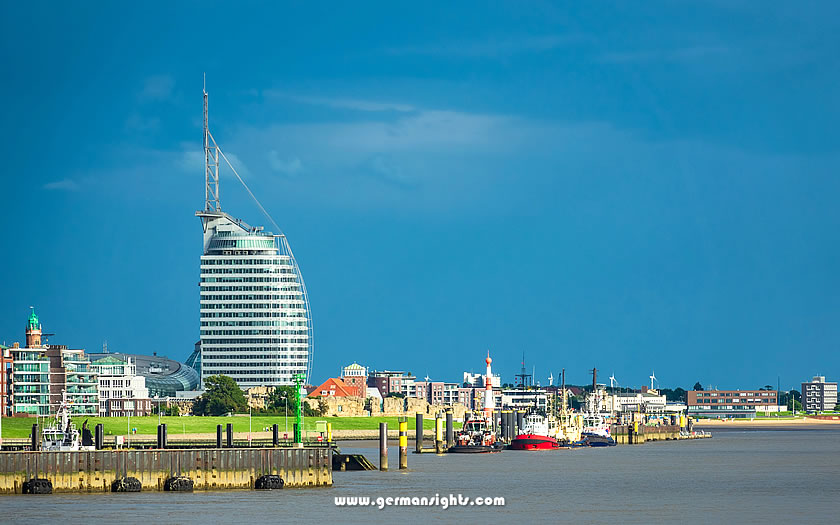
View of Bremerhaven harbour
The port district of Bremerhaven, which is part of the city-state of Bremen, is located at the river's mouth and handles the deep-sea shipping that the main city cannot accommodate.
Thanks to its location, Bremen is an ideal stopover on the way to destinations in western Germany or the Netherlands from Hamburg. However, it is not located on the main north-south routes connecting Berlin to Frankfurt or Munich, which is one reason why it receives fewer international visitors than its UNESCO-listed market square might otherwise attract.
In terms of convenience, Bremen Airport (BRE) punches above its weight. Located just 3.5 kilometres south of the city centre, it boasts one of the shortest distances between an airport and the city centre in Germany.
Tram Line 6 runs directly from the terminal to the Hauptbahnhof and the city centre, with the journey taking just 10–15 minutes. Tickets cost the standard public transport fare, and trams run frequently throughout the day.
The airport primarily handles domestic flights and connections to European cities. Lufthansa serves major German hubs, while budget carriers cover holiday destinations. While it won't replace Hamburg's larger airport for international connections, if your route works, Bremen's proximity makes it remarkably hassle-free.
Distance to Hannover Airport: 119km
Distance to Hamburg Airport: 136km
Distance to Düsseldorf Airport: 293km
Hamburg is probably going to be the best choice for those looking for a variety of carriers or who are travelling in from another continent.
Bremen Hauptbahnhof is the city's main railway station and a major node in the rail network of northern Germany. Direct ICE and IC trains connect Bremen to Hamburg in under an hour, Hanover in about an hour, and cities throughout the Ruhr region. Regional trains link Bremen to Oldenburg, Osnabrück and other smaller towns in Lower Saxony.
The Hauptbahnhof is located just northeast of the city centre, a 10–15 minute walk from the Marktplatz, or a short tram ride if you're carrying luggage. Its central location makes it particularly convenient for independent travellers planning to explore on foot.
Bremen is located at the intersection of two major autobahns. The A1 runs from north to south, connecting Hamburg to the Ruhr region and beyond. The A27 runs from northwest to southeast, linking Bremerhaven and the coast with Hanover. These routes make Bremen easily accessible by car from across northern and western Germany.
Parking tip: The historic centre of the old town (Altstadt) is largely pedestrianised, so driving into the centre isn't practical or permitted in most areas. The best option is to use one of the parking garages on the edge of the pedestrian zone.
Alternatively, consider using one of Bremen's Park & Ride facilities on the outskirts of the city, and then taking the tram into town. This saves money and eliminates the frustration of navigating narrow streets that weren't designed for modern traffic.
Altstadt (Old Town)
The historic heart of Bremen, the Altstadt, is perfect for travellers who love being surrounded by centuries-old architecture and major landmarks. Stay here and you'll be just steps away from the Marktplatz, the Roland Statue, the Bremen Town Musicians and the Schnoor quarter. The area is ideal for exploring on foot and there are plenty of restaurants, cafés and boutique shops nearby. Although accommodation options are slightly pricier, the convenience and charm are unbeatable.
Ostertor/Steintor (The "Viertel")
Known simply as 'Das Viertel' (The Quarter), these lively districts are popular with locals and travellers alike. Trendy and artistic, this area is full of character and offers a mix of cosy guesthouses, independent hotels, and Airbnb-style accommodation. You'll find vibrant nightlife, diverse dining options and small galleries here, all within walking distance of the Altstadt or a short tram ride away. It's perfect for those seeking a more local and bohemian vibe.
Schwachhausen
Those who prefer a quieter, greener option will enjoy Schwachhausen, with its peaceful streets lined with grand villas and leafy parks. The accommodation here often comprises mid-range and upscale hotels that provide a relaxing retreat away from the hustle and bustle of the city centre. However, major attractions are just a short tram ride away. Active travellers will love the nearby sprawling green space of the Bürgerpark, which is perfect for long strolls or early morning jogs.
If you know when you are planning to go but haven't decided on accommodation, then use the map below to get an idea of which properties are available and to compare prices during the period you wish to travel.
Enter your proposed dates and use the '+' to zoom in on a location and reveal more properties. Click on the price above a property to see more information.
(Please note that this selection will also include some guesthouses, pensions and self-catering apartments for those who are interested in that form of accommodation!)
The story of Bremen begins in the early Middle Ages. The settlement emerged along a sandy ridge beside the Weser River, one of the few places where the marshy terrain provided stable ground on which to build.
In the late 8th century, Charlemagne recognised the site's strategic value, establishing a bishopric here in 787 as part of his campaign to Christianise the Saxon territories he had recently conquered.
The appointment of Saint Willehad as the first bishop of Bremen marked the city's formal entry into recorded history. Following Willehad's death, his successor Ansgar dramatically expanded Bremen's influence in the 9th century, earning the title 'Apostle of the North' for his missionary work in Scandinavia.
In 845, Bremen became an archbishopric, granting it ecclesiastical authority over a vast territory stretching from the Weser to Scandinavia — an extraordinary reach for a settlement that was still modest in size.
This early religious significance paved the way for Bremen's subsequent development. The presence of the archbishop attracted craftsmen, merchants and settlers. A market emerged. The river brought trade.
By the 11th century, Bremen had grown from a missionary outpost into a thriving medieval town. However, the tension between the city's increasingly wealthy merchant class and the archbishop's temporal authority simmered for centuries, ultimately exploding into the fierce independence that has come to define Bremen's character.
Bremen's golden age began when it joined the Hanseatic League, a powerful medieval trading alliance that dominated commerce across the Baltic and North Seas from the 13th to the 17th century.
As one of the League's most important cities, Bremen grew wealthy by trading wool, grain, fish and, later, luxury goods with Scandinavia, England, the Low Countries and the German interior. The magnificent buildings that line the Marktplatz today, such as the Gothic town hall and the guild houses, stand as physical testimony to the prosperity that this maritime trade generated.
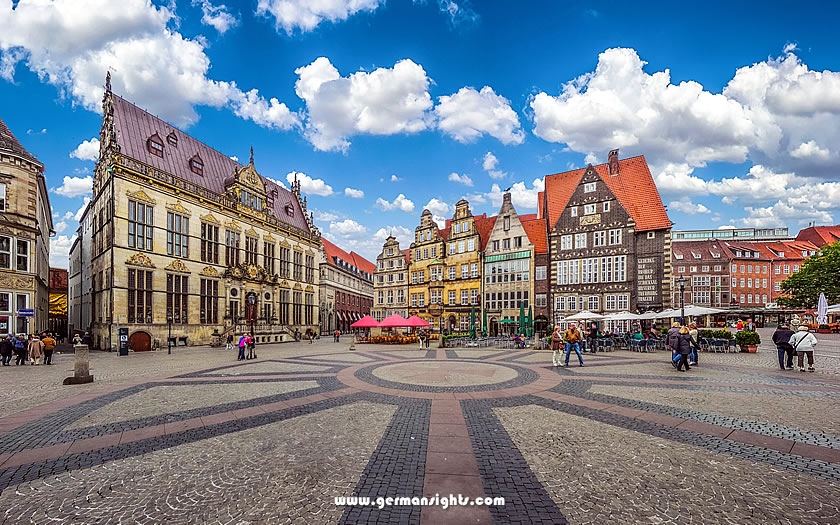
The Marktplatz in Bremen
The Hanseatic merchants accumulated considerable wealth and political power. They negotiated directly with kings and emperors, secured trading privileges across Europe and maintained their own fleets to protect their interests.
Bremen fought tenaciously to maintain its autonomy throughout the Middle Ages and beyond. Emperor Frederick I granted the city special privileges in 1186, and by 1646 Bremen had achieved the status of a Free Imperial City, answering directly to the Holy Roman Emperor rather than any regional prince or ecclesiastical authority. This independence meant that Bremen could control its own laws, taxes and trade policies.
The towering statue of Roland that dominates the Marktplatz, erected in 1404, symbolises this very freedom. Roland represents the city's market rights and liberation from church rule - a bold statement carved in stone at a time when bishops held great temporal power.
Bremen citizens believed that as long as Roland stood, the city would remain free. (During World War II, when the statue was threatened by Allied bombing, citizens built a protective bunker around it. The legend held firm.)
The Weser River shaped Bremen. This vital waterway connected the North Sea to the German hinterland, enabling the flow of goods in both directions and establishing Bremen as a major port despite its inland location 60 kilometres from the coast. For centuries, ships sailed up the Weser to Bremen's harbours, where they would load and unload cargo before returning to the open sea.
But rivers change. By the early 19th century, the Weser began silting up, and ships grew larger. Bremen faced a crisis: vessels drawing deeper water couldn't reach the city's docks.
The solution implemented in 1827 was audacious: Bremen purchased land at the mouth of the Weser and founded Bremerhaven (literally "Bremen's harbour"). This new deep-water port handled oceangoing vessels, while smaller craft shuttled goods up and down the river.
The arrangement worked brilliantly. Bremerhaven became one of Europe's busiest ports, particularly for passenger traffic—millions of European emigrants departed from its docks for America between the 1830s and 1930s.
Today, both cities form the unified city-state of Bremen, maintaining the maritime tradition that has defined this corner of northern Germany for a millennium.
Bremen's compact historic centre is a paradise for walkers. Nearly everything worth seeing is within a fifteen-minute walk, so it's easy to experience the city's highlights in a day without needing to use public transport.
The most logical route starts at the Hauptbahnhof (main train station) and naturally loops through the old town, taking you from green parkland and UNESCO-listed squares to hidden Art Deco lanes and medieval alleyways that seem frozen in time.
This walking route is more than just convenient - it reveals Bremen's history through a series of chronological layers, from the defensive moat that once protected the city to the fairy-tale streets where its oldest buildings still stand.
As you step out of the train station, you will immediately encounter the Wallanlagen, a lush ribbon of parkland encircling the historic city centre. This tranquil green space follows the line of Bremen's former city fortifications - the moat and ramparts that defended the Free City for centuries.
When the city demolished its walls in the early 19th century, it transformed the defensive perimeter into public gardens instead of selling the land for development.
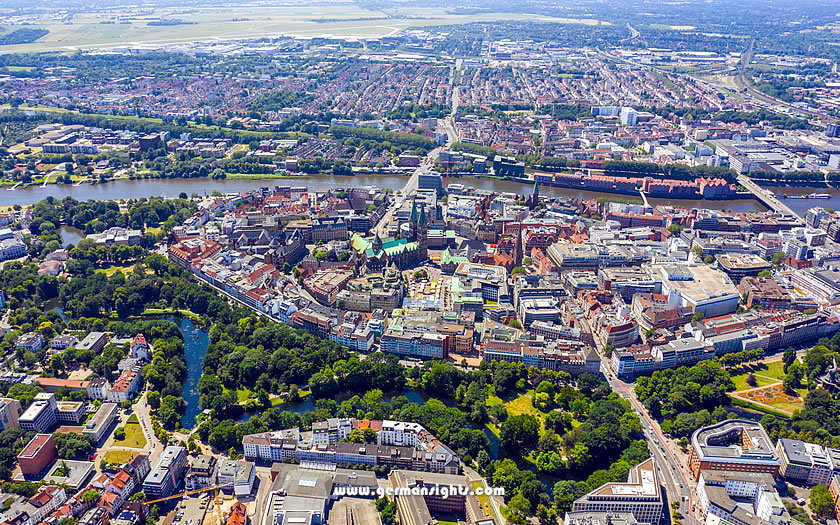
The 'green belt' around Bremen city centre
Today, the Wallanlagen provide a pleasant buffer between the modern city and the historic centre. Locals jog along its paths, students sprawl on the grass in summer and visitors pause to take photos of the traditional Dutch-style windmill, which stands as a reminder of Bremen's trading connections with the Low Countries.
Walking through the Wallanlagen takes only five minutes, but provides a gentle transition - a breath of fresh air before reaching Marktplatz.
As you emerge from the Wallanlagen, you will find yourself in one of Germany's most magnificent medieval squares. The Marktplatz is where Bremen's wealth, power and civic pride are embodied in stone and bronze. UNESCO recognised this ensemble as a World Heritage Site in 2004, acknowledging its status as a unique testament to civic autonomy and market rights within the Holy Roman Empire.
The Gothic masterpiece of the Bremen Town Hall dominates the square's western side. Built between 1405 and 1410, it features an ornate Weser Renaissance façade added in the early 17th century. The building's elaborate stonework features statues of Charlemagne, the seven Electors, and various prophets and philosophers, proclaiming Bremen's status and sophistication.
The town hall still functions as the seat of Bremen's government, making it one of the oldest continuously operating city halls in Europe.
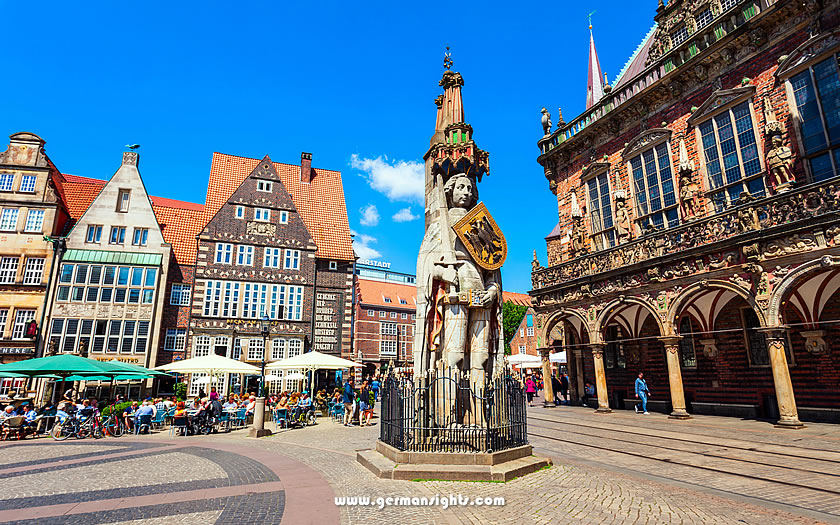
The statue of Roland in front of Bremen city hall in the Market Square
The Roland Statue, which was erected in 1404, stands guard in front of the town hall. Standing at 5.5 metres tall (10 metres including the base), this stone knight symbolises Bremen's market rights and freedom from feudal and ecclesiastical control.
The "Bremen Elle", a standard unit of length used by merchants in the market, is hidden in the measurement of his knees.
The statue's significance to Bremen's identity cannot be overstated: locals say that as long as Roland stands, Bremen will remain free.
The bronze statue of the Bremen Town Musicians, depicting the donkey, dog, cat and rooster from the Brothers Grimm fairy tale, sits at the western corner of the town hall.
Created by Gerhard Marcks in 1953, the statue has become Bremen's most beloved icon and the city's most photographed spot. According to local tradition, touching the donkey's front legs while making a wish brings good luck.
The Marktplatz hosts Bremen's atmospheric Christmas market every December, when it is transformed into a world of wooden stalls, mulled wine and twinkling lights - one of the finest holiday markets in northern Germany.
Böttcherstraße, a narrow street tucked between the Marktplatz and the river, looks medieval at first glance, but reveals itself to be something far stranger and more fascinating.
This 100-metre-long lane is a 1920s fantasy, an extraordinary example of brick expressionism and art deco architecture, commissioned by Ludwig Roselius, a Bremen coffee merchant who invented decaffeinated coffee and made his fortune from it.
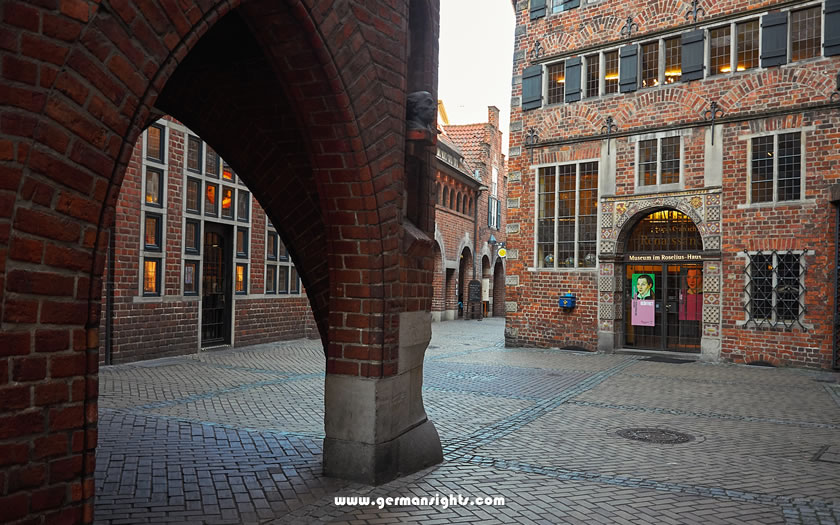
Böttcherstrasse in Bremen
Between 1922 and 1931, Roselius transformed this former cooper's alley — Böttcher means 'cooper' or 'barrel-maker' — into a total work of art. He commissioned avant-garde architects and artists to design a distinctive architectural ensemble blending medieval references with modernist experimentation.
The result is utterly distinctive, featuring brick façades adorned with golden reliefs and hidden courtyards, as well as a carillon that plays three times daily.
The Nazis despised Böttcherstraße, condemning it as "degenerate art," but it survived the war largely intact. Today it's protected as a historic monument and remains one of Bremen's most unusual attractions.
Just steps from Böttcherstraße is Bremen's historic harbour promenade, the Schlachte, which runs alongside the Weser River. The name comes from the wooden stakes (Schlachten) that once reinforced the medieval harbour.
For centuries, this was Bremen's working waterfront, where Hanseatic ships would tie up and cargo would be loaded and unloaded while merchants conducted their business.
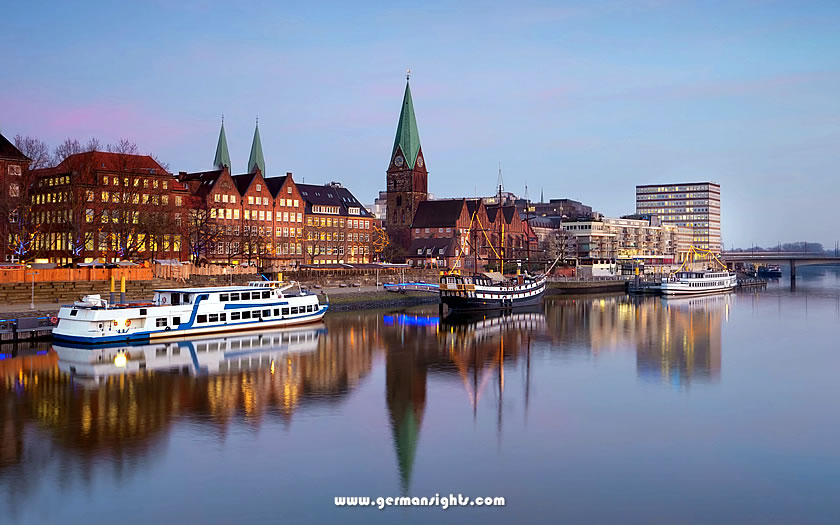
The Schlachte embankment in Bremen
Today, the Schlachte is Bremen's most popular leisure zone. The 600-metre-long promenade is lined with beer gardens, restaurants and cafés where you can sit outdoors (weather permitting) and watch the river traffic drift past. Several historic ships are moored along the quay, including the Alexander von Humboldt, a three-masted barque which once served as a training vessel and now operates as a floating restaurant.
The atmosphere here changes with the seasons. In summer, the outdoor tables are filled with locals nursing tall glasses of Beck's, which has been brewed in Bremen since 1873, and visitors sampling northern German specialities such as Labskaus or fresh fish.
Winter sees the Schlachte host a maritime-themed Christmas market with stalls built to resemble ship cabins and where mulled wine is served in ceramic mugs.
Your walking route ends in Bremen's oldest and most enchanting neighbourhood, the Schnoorviertel ('Schnoor Quarter'). Situated southeast of the Marktplatz, this maze of narrow lanes retains the medieval street layout and architecture that once characterised the entire city.
The name 'Schnoor' probably comes from the Low German word for 'string' ('Snoor'), referring to the way the houses line up along the alleyways like beads on a string - or possibly it refers to the rope makers who once worked here.
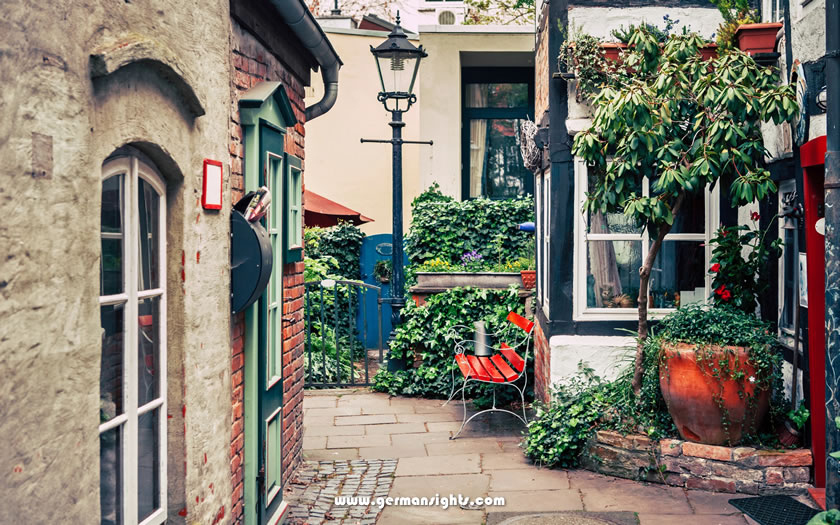
The Schnoorviertel in Bremen
The buildings in the Schnoor district date primarily from the 15th to 18th centuries. They are half-timbered structures that lean at precarious angles, with upper storeys that jut out over cobblestone lanes barely wide enough for two people to pass.
These were working-class dwellings, home to fishermen, craftsmen and labourers — a stark contrast to the grand merchant houses around the Marktplatz. By the mid-20th century, the quarter had fallen into severe disrepair and was facing demolition, but it was saved by preservation efforts in the 1950s and '60s.
Exploring the Schnoor district doesn't require a map or plan - simply follow your curiosity down whichever lane looks most intriguing. You'll discover tiny squares, hidden courtyards, artisan workshops and cafés nestled within centuries-old buildings.
The Schnoor is particularly magical in the early morning or evening, when the day-trippers have left and you can experience its quiet, almost fairy-tale-like atmosphere without any crowds.
Key spots include the Schifferhaus (Shipper's House), one of the oldest buildings in the area, and St. Johann's Church, a striking Gothic brick structure which dominates the quarter.
However, the Schnoor's appeal lies more in its overall ambience than in specific sights - the sense of stepping back into a Bremen that existed long before the modern city grew up around it.
Bremen's central location in northern Germany makes it an excellent base for exploring the surrounding region.
Hamburg, Germany's second-largest city, is just an hour away by train. It boasts a massive harbour, the striking Elbphilharmonie concert hall, and a distinctly different urban character.
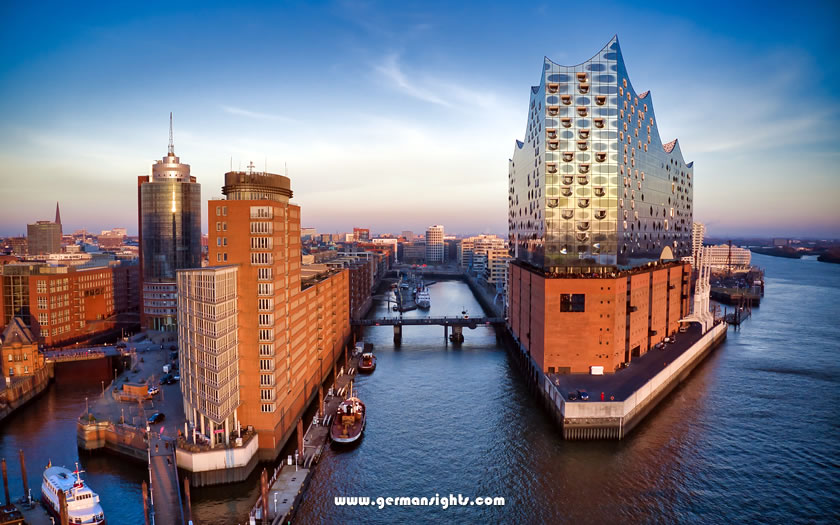
The iconic Elphilharmonie concert hall in Hamburg
Just 40 minutes away by regional train, Oldenburg is a charming university town with an elegant palace and a quiet atmosphere.
Those interested in maritime history will enjoy Bremerhaven, which is technically part of the city-state of Bremen but is located 60 kilometres north at the mouth of the Weser.
The town is home to extraordinary museums, including the German Emigration Centre and the German Maritime Museum, which document the millions who departed these shores for new lives across the Atlantic.
Each destination offers a different perspective on northern Germany's culture and history, and all are easily accessible for anyone staying in Bremen. We explore these options in detail, including practical transport information and what makes each trip worthwhile, in our dedicated article about day trips from Bremen.
The Bremen Tourist Office is centrally located in Böttcherstrasse (in the 'Glockenspiel House'). The office is open seven days a week, with slightly shorter opening times on the weekends.
Website: www.bremen.eu