
The Taunus Mountains are located directly north of Frankfurt, close enough that you can see their ridge from the city's tower blocks.
It takes just 30 minutes on the suburban train to find yourself walking through dense beech forests with stunning views stretching south across the Rhine-Main plain.
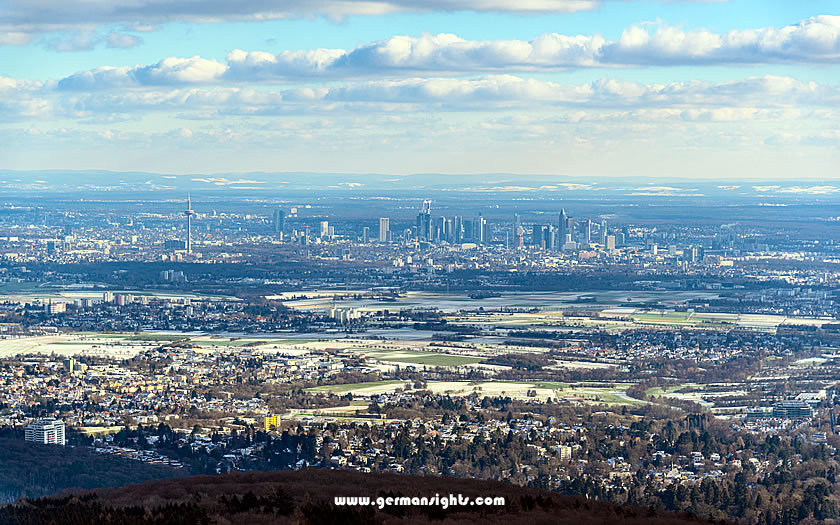
View of Frankfurt from the Taunus mountains
The Taunus is a low mountain range and not an Alpine destination. Its highest peak, the Großer Feldberg, reaches just 878 metres.
The terrain is accessible and varied, and has an interesting history, making it a genuinely appealing destination for independent travellers rather than just a convenient green escape from Frankfurt
The southern Taunus ridge is heavily forested and much cooler than the city of Frankfurt below. The Hochtaunus area near the main Taunus ridge has a rougher feel, with narrow valley paths, mossy rock formations, and long, open views from the ridge top.
The northern Hintertaunus region is calmer and more agricultural, with wider valleys and small market towns, offering a landscape that more closely resembles the traditional image of the German countryside.
An early start to a day trip from Frankfurt allows enough time to see both Großer Feldberg and Bad Homburg in a single day.
A two- or three-night stay will allow a visitor to reach the western edge of the Rheingau, walk a section of the Limes hiking trail and explore Königstein or Weilburg at a relaxed pace.
Those who want to use the Taunus as a base rather than just a day trip can find accommodation and good train links back to Frankfurt in Bad Homburg, Kronberg, and Königstein.
The Taunus is part of the broader upland system of the Rhenish Slate Mountains, which stretches across central-western Germany.
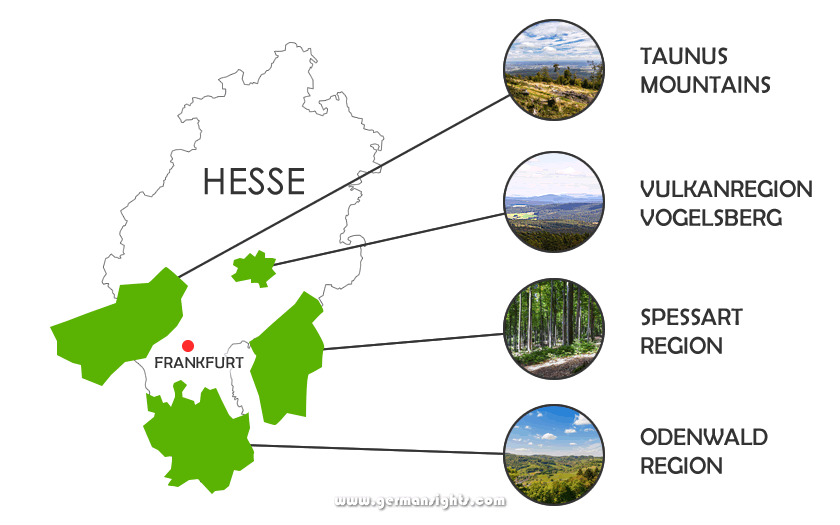
Four hiking areas around Frankfurt
Its southern boundary is marked by the Main River and the Main-Taunus foothills, with towns such as Bad Homburg vor der Höhe and Wiesbaden located on its edge.
The Upper Middle Rhine Valley borders the range to the west, separating it from the Hunsrück hills.
The Lahn Valley and the Limburg Basin form a sharp northern boundary, beyond which the landscape transitions to the Westerwald.
To the east, the Wetterau lowlands and the Rheingau slopes complete the perimeter. The Rheingau-Taunus section, in the south-west, drops steeply to the Rhine River, with vineyards covering its lower slopes.
The Frankfurt S-Bahn network provides direct access to several Taunus towns.
Tickets operate within the RMV (Rhein-Main-Verkehrsverbund) fare system, and a day ticket covering Frankfurt and the surrounding Taunus towns is usually the most cost-effective option.
Evidence of Bronze Age hillforts has been found in the Taunus region, while Celtic communities used the Taunus hills from at least the Iron Age.
The Romans advanced into the Taunus in the 1st century AD as the Roman Empire expanded its control to the northeast of the Rhine and Main rivers. The geothermal springs that would later make Bad Homburg and Bad Nauheim famous were already in use during the Roman period.
The Upper Germanic-Rhaetian Limes, a system of Roman frontier fortifications, ran directly through the Taunus Mountains and is now a UNESCO World Heritage Site. The Saalburg, near Bad Homburg, is the best-preserved Roman fort on the German Limes. It was reconstructed in the early 20th century and now functions as a museum.
The Taunus was home to around 100 castles at its medieval peak. Most of these are now in ruins, but Burg Königstein and Falkenstein Castle are well worth a visit. Burg Königstein, one of the largest fortresses in the Holy Roman Empire, still dominates the town below with its impressive ruins.
The 19th century saw a different kind of development. The mineral springs at Bad Homburg, Bad Nauheim and other locations attracted European royalty and wealthy visitors.
This period left behind a legacy of grand spa architecture, formal parks and a resort atmosphere which still defines these towns today.
The combination of Roman history, medieval ruins, ridge walking, and spa town culture means that the Taunus has enough variety to fill several days without repeating the same type of activity.
Bad Homburg vor der Höhe is the most accessible and refined of the Taunus spa towns. The Kurpark is well-maintained and worth exploring, even if you're not interested in taking the waters. The Landgrave's Palace (Schloss Bad Homburg) is open to visitors and showcases the town's direct royal connections.

The Kaiser Wilhelms Bad in Bad Homburg
Bad Nauheim, on the eastern edge of the Taunus, has exceptional Jugendstil architecture around its Kurpark and is less busy than Bad Homburg.
Bad Schwalbach in the western Hintertaunus is quieter still and suits travellers who prefer places without a tourist polish.
Großer Feldberg is the practical starting point for any serious walking in the Taunus. A telecommunications tower sits on the summit, which is not atmospheric, but the 360-degree views on clear days extend to Frankfurt, the Rhine, and on good days the Odenwald.
Altkönig, slightly lower at 798 metres, is a more satisfying destination for walkers because it carries the remains of an Iron Age hillfort and feels less developed.
The Taunus Nature Park maintains over 200 hiking trails; the ridge walk connecting Feldberg, Kleiner Feldberg, and Altkönig is a solid half-day route with consistent views and manageable terrain.

The Taunus mountains in Hesse
The Saalburg Roman fort near Bad Homburg is the most complete Roman site in the Taunus and one of the better Roman museum experiences in Germany. The reconstructed fort complex includes granaries, barracks, and a bath section.
The Limes hiking trail follows the route of the Roman frontier through the Taunus, with sections marked by information boards and visible earthwork remains. The trail is part of the broader European cultural route, but in the Taunus it stays practical and walkable rather than ceremonial.

Saalburg Roman Fort near Bad Homburg
Rüdesheim and Lorch are located at the southwestern tip of the Taunus, where the Rheingau slopes meet the river Rhine. The Niederwald Monument, above Rüdesheim, marks the end of the ridge and overlooks the Upper Middle Rhine Valley.
The Rheingau vineyards below the Taunus produce Riesling grapes, and the Rheinsteig long-distance path runs along this section of the ridge.

Vineyards near Rüdesheim above the Rhine river
Naturpark Taunus (Taunus Nature Park) : naturpark-taunus.de