
The Odenwald is located between three German states, is not particularly well-known, and is often overlooked by visitors heading to Heidelberg or Frankfurt. This is precisely why it is worth spending time there.
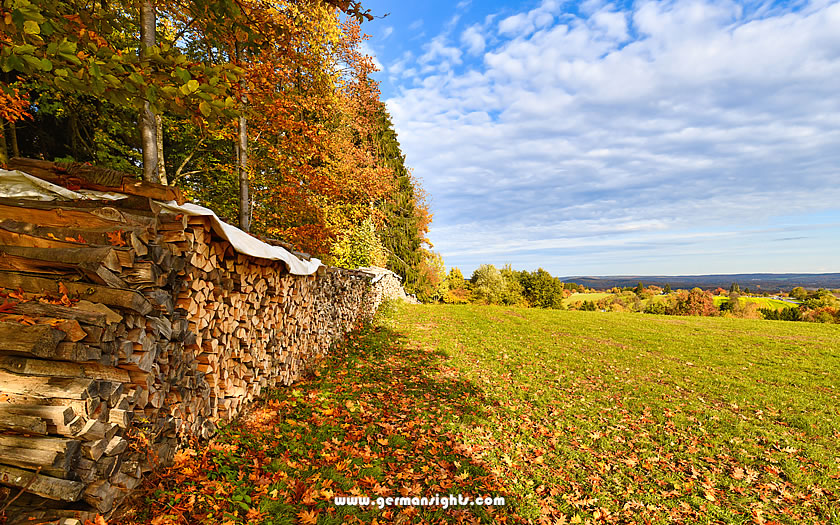
Meadows and woods in the Odenwald region
This low, forested hill range is perfect for travellers who prefer quiet valleys, old market towns and walking paths to crowds and coach tours. Half-timbered buildings, Roman frontier remains, castle ruins and geological curiosities can all be found here within an hour or two of Frankfurt Airport.
The region is not a well-established tourist destination. Some villages have no English-language information whatsoever. The roads are narrow, the signage is sparse and the public transport options are limited once you leave the main routes. Manage expectations accordingly and the experience will be much more enjoyable.
The Odenwald is a wooded hilly area covering roughly 2,500 square kilometres, with small towns and river valleys spread across parts of the German states of Hesse, Bavaria and Baden-Württemberg. The highest point is the 626-metre-high Katzenbuckel, so the landscape is gentle rather than dramatic.
The western edge of the region, along the Bergstraße, is close to the Rhine plain and has a mild climate. Fruit trees and vineyards flourish here.
Move east into the forested interior, however, and the landscape shifts to denser woodland, red sandstone outcrops and narrower valleys.
The eastern Odenwald extends into Lower Franconia, offering a different character: a quieter, more agricultural landscape.
What sets the region apart from better-known areas is its combination of genuine historic towns, accessible nature and low tourist numbers. Michelstadt, Erbach and Miltenberg are all well worth a visit, and none of them feel overrun.
The Odenwald occupies a position that many travellers pass close to without realising it. Frankfurt lies roughly 50 kilometres to the north, Darmstadt sits just off the western edge, and Heidelberg anchors the southwestern corner.
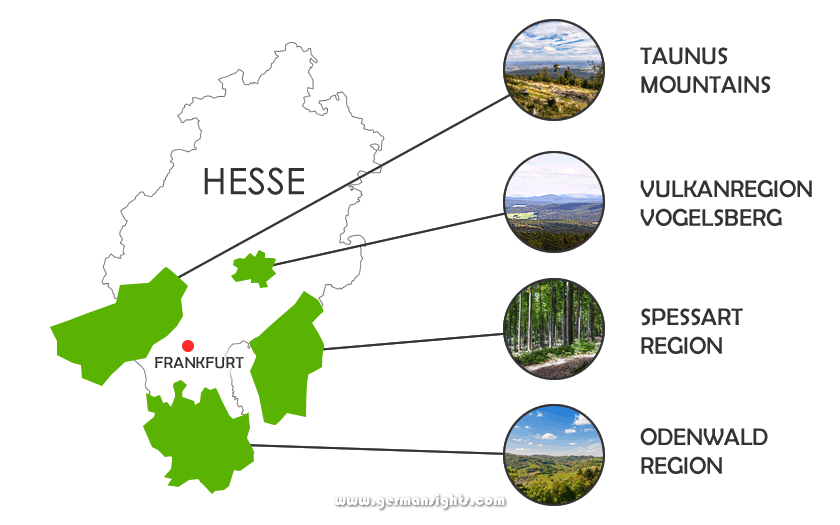
Four hiking areas around Frankfurt
Thanks to its location, the Odenwald is a great place to use as a base for day trips to any of these cities, or as a place to stop off on the way to them.
Most of the Odenwald is located in the state of Hesse (Hessen), covering the northern and central regions. The southern part extends into Baden-Württemberg, while a smaller section in the north-east reaches into Bavaria's Lower Franconia region.
The state boundaries do not follow any obvious geographical lines, so it is useful to be aware of this when looking at regional tourist information.
The main entry points from the west are the towns of the Bergstraße: Weinheim, Heppenheim and Schriesheim, which provide access to the forested Odenwald hills via the roads.
From the north, the Main River corridor leads in via the A3 autobahn towards Miltenberg.
From the south, the clearest route in is via Heidelberg and the Neckar Valley along the B37.
The western slopes descend fairly steeply towards the Rhine Plain and the Bergstraße. Further east, the terrain opens up to reveal broader valleys and forested ridges.
The Weschnitz Valley, which cuts through the central Odenwald, is one of the more accessible routes into the region's interior. The Neckar Valley forms the southern border of the region and is home to one of the main road and rail routes.
The land flattens into the Bauland to the east of the forested core. This is a more agricultural, less wooded landscape with different soil and a different character.
There are direct train services running from Frankfurt and Darmstadt to several towns in the Odenwald region. The Odenwaldbahn line runs from Darmstadt to Erbach and on into the wider region. There are connections from Heidelberg via Mannheim and the Rhine-Neckar network to the southern edge of the region.
The S-Bahn services from Mannheim and Heidelberg serve Weinheim and Heppenheim on the Bergstraße, making them useful starting points for exploring on foot. Miltenberg can be reached by rail from Aschaffenburg.
If relying entirely on public transport, focus any itinerary on the towns along the main rail lines: Erbach, Michelstadt, and the Bergstraße edge.
Bear in mind that frequencies drop off in the evenings and on Sundays throughout the region.
The A5 Autobahn runs along the western edge of the Odenwald, connecting Frankfurt, Darmstadt, Heidelberg and Mannheim. Various Bundesstraßen lead east from the A5 into the hills.
The A3 provides access from the north via Aschaffenburg towards Miltenberg. The B38, B47 and B460 are the main cross-regional roads within the Odenwald.
The Odenwald has a long history, stretching from prehistoric settlements and Roman occupation to Frankish colonisation and medieval castle building. Much of this history is still visible in the landscape and towns today.
The earliest evidence of settlement in the Odenwald region dates to around 2500 BC, with traces found along the northern and southern edges. Celts moved into the area around 400 BC, although the Odenwald itself remained largely forested and uninhabited at its core.
The Romans built the first Odenwald line of the Neckar-Odenwald Limes around AD 100, under Emperor Trajan. This frontier stretched northwards from the Neckar, passing through a series of forts and connecting Neckarburken and Oberscheidental before reaching the Main at Fort Wörth.
Roman control collapsed in 260 AD, allowing the Alamanni to move in. The line of old forts can still be traced across the landscape today, and several of the sites are open to visitors. They were followed by the Franks.
Irish, Scottish and Anglo-Saxon monks began the process of Christianising the area in the 7th and 8th centuries. Benedictine monasteries, including Lorsch Abbey in the west and Amorbach Monastery in the east, were tasked with opening up the forested interior for settlement.
The medieval Odenwald region was divided between competing episcopal and aristocratic powers.
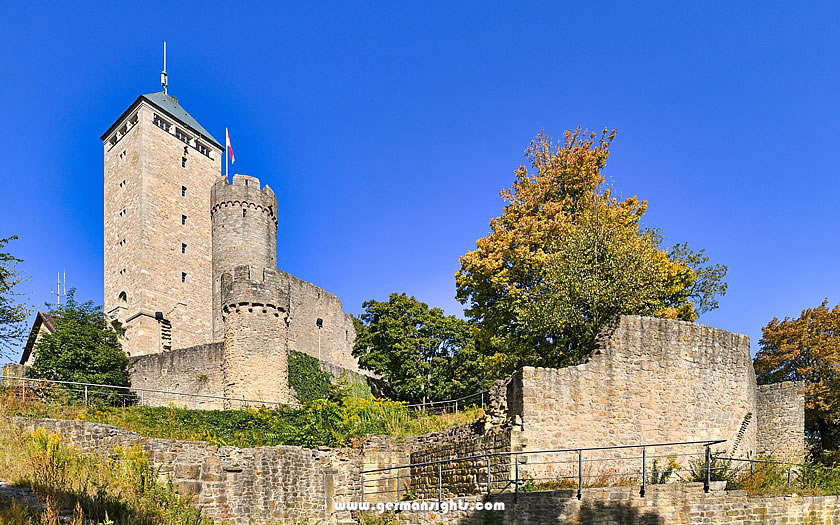
Starkenburg castle above Heppenheim
Heppenheim emerged as an important centre on the western edge of the region, while Miltenberg developed into a significant market town and crossing point on the River Main.
Castle construction intensified across the region from the 11th century onwards. Many of these fortifications survive in various states of ruin or restoration, perched on ridges and valley edges throughout the hills.
The Odenwald region is closely associated with the Nibelungen saga, a medieval German epic which later formed the basis of Wagner's Ring Cycle.
According to legend, the hero Siegfried was killed at a spring in the Odenwald, which is sometimes identified as either the Siegfriedsbrunnen near the ruins of Rodenstein or the Lindelbrunnen.
The ruins of Rodenstein Castle, which are connected in local tradition to a ghostly rider who appears before times of war, add another layer to the region's folklore.
The Odenwald is not a region with headline attractions. What it offers instead is a variety of rewarding places that visitors can explore at their own pace. The towns along the western edge of the region and in the Main valley are of the most historic interest, while the forested interior is better suited to hikers.
Michelstadt is the most visited town in the Hessian Odenwald, and rightly so. The 15th-century town hall, with its distinctive half-timbered façade raised on wooden pillars above an open ground floor, is one of the region's most photographed buildings. The surrounding market square is well-preserved and genuinely attractive, rather than being a reconstruction.
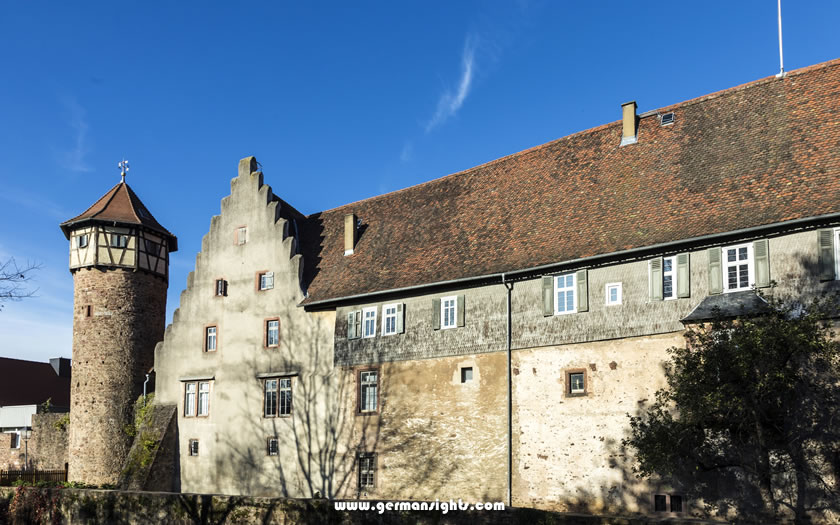
The old city walls of Michelstadt
A few kilometres away, Erbach is known for its ivory carving tradition and the castle of the Counts of Erbach, which houses a substantial collection of armour and antiques. The two towns are close enough together to visit both on the same day without feeling rushed.
Miltenberg, where the Odenwald meets the Main River, is well worth a visit. The main street, Schnatterloch, is lined with some of the best-preserved half-timbered buildings in the region. The town has a lived-in quality alongside its historic appearance.

Timber-framed houses in Miltenberg
The position at the edge of the Main Valley also makes Miltenberg a useful base for reaching the northeastern Odenwald, with the river providing a scenic backdrop.
The Felsenmeer (roughly translated as 'sea of rocks') is a large field of granite boulders near Lautertal-Reichenbach in the central Odenwald region. Some of the boulders are enormous and were quarried by the Romans, who left several unfinished columns on site.
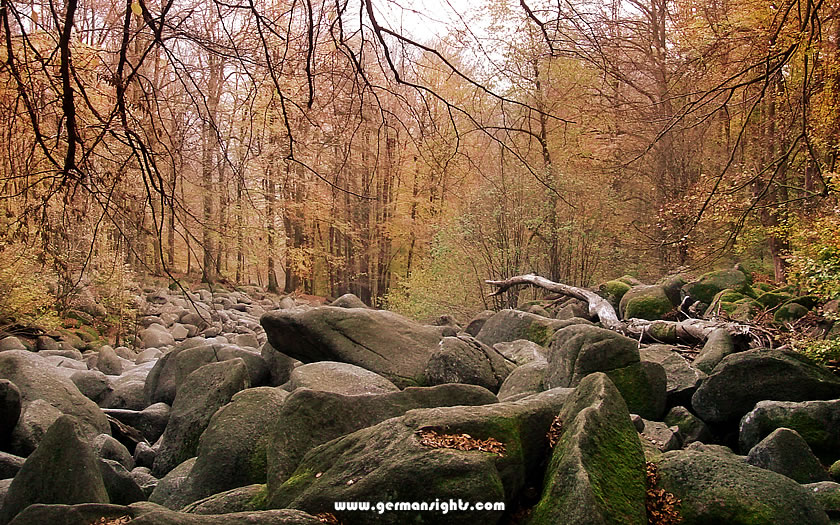
Some of the rocks of the Felsenmeer in the Odenwald
Depending on your route, the walk through and around the boulders takes between one and two hours. It is one of southwest Germany's more unusual natural sites and rivals better-known geological curiosities.
The Felsenmeer is accessible by road, has a car park and is particularly popular with German families at weekends.
The Tromm is a forested plateau in the heart of the Odenwald, offering pleasant walks along clearly marked trails with stunning vistas of the surrounding area.
The Felsberg, near Mörlenbach, features a ruined castle and exposed granite outcrops. Both areas are ideal for walkers seeking moderate terrain without any technical difficulty.
The extensive trail network across the Odenwald is generally well signposted. The Nibelungensteig long-distance hiking trail runs from west to east through the region and is a good option for those wanting a structured multi-day walk.
Rodenstein Castle, which is associated with local legend and the Nibelungen saga, can be reached on foot from the village of Fränkisch-Crumbach. The ruins are located in a wooded area and require a short walk to reach.
The Bergstraße, which runs along the western edge of the Odenwald from Weinheim to the north through Schriesheim and Heppenheim, is a scenic route that should be enjoyed at a leisurely pace. Wine estates and orchards are nestled at the foot of the hills, and several short paths lead from the road up to the forest edge above.
Michelstadt and Erbach are ideal places to stay overnight in the Hessian Odenwald. Miltenberg is a good option for those interested in the Main Valley and the north-eastern part of the region. Visitors who want a larger town with easy access to the region may prefer Heidelberg, which is located to the southwest, although it is outside the Odenwald proper and has considerably more tourist traffic.
The Bergstraße towns of Weinheim and Heppenheim are underrated as bases for exploring the western area. Located closer to the Rhine plain, they offer better transport links while still being within easy reach of the forested interior.