
Celle is a picture-perfect German town that feels like stepping into a fairy tale. Its cobbled streets are lined with over 400 half-timbered houses, forming one of the world's largest collections of Fachwerk architecture.
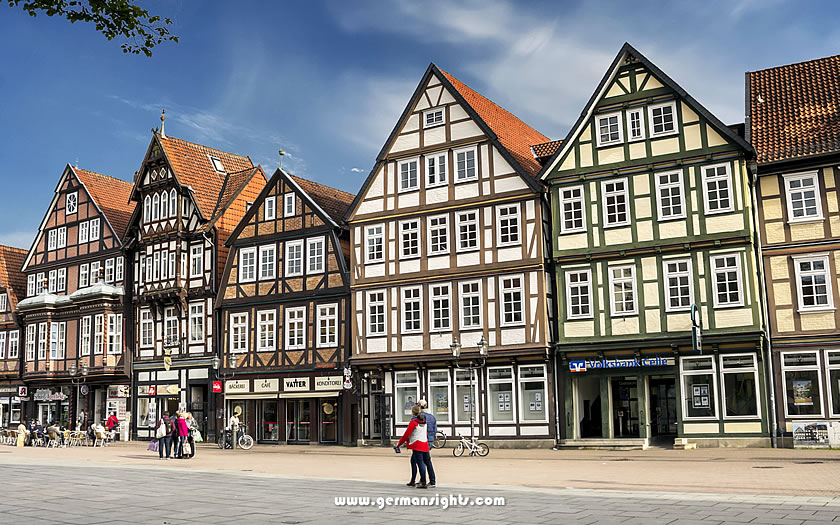
Timber-framed houses in Celle
What sets Celle apart is its authenticity. While other towns may feel as though they have been preserved for tourists, Celle remains a living city.
Celle has much more to offer than just its town centre. It’s an ideal base for travellers exploring Lower Saxony and a convenient and rewarding day trip from Hanover. Whether you're a history lover or a slow traveller, Celle encourages you to take your time and soak in its charm.
Celle is located in the north of Germany, in the state of Lower Saxony (Niedersachsen). The town sits on the banks of the Aller River and is easily accessible by car or train, making it an ideal destination for a day trip.
Celle also borders the southern edge of the Lüneburg Heath, a vast area of moorland and woodlands that is perfect for outdoor adventures.
Hannover Airport (HAJ) is by far the closest, located just about 40 km away (a 35-40 minute drive or a quick train ride via Hanover main station).
Other airports near Celle:
Bremen Airport (BRE) - approx. 115 km
Hamburg Airport (HAM) - approx. 135 km
Celle Bahnhof is located on the major north-south railway line between Hanover and Hamburg. It is served by high-speed ICE trains, regional trains, and the Hanover S-Bahn (S6/S7).
Walking distance: It’s about a 20 minute walk from the station to the historic Old Town (Altstadt), or a very short bus/taxi ride.
Celle is not directly on a motorway, which helps preserve its character. The closest Autobahn is the A7 (Hanover to Hamburg route) - drivers usually take the Großburgwedel or Mellendorf exits. The B3, B191, and B214 federal roads intersect in the city.
Parking tip: There is a large parking area at the Schützenplatz just outside the immediate historic centre, plus several inner-city parking garages.
If you know when you are planning to go but haven't decided on accommodation, then use the map below to get an idea of which properties are available and to compare prices during the period you wish to travel.
Enter your proposed dates and use the '+' to zoom in on a location and reveal more properties. Click on the price above a property to see more information.
(Please note that this selection will also include some guesthouses, pensions and self-catering apartments for those who are interested in that form of accommodation!)
Celle's story begins in the 10th century, when it was first mentioned as "Kellu." The inhabitants were ordered by Duke Otto the Strict to move to the new town of Celle in 1292, which was situated about 3 km to the north-west. This new settlement developed into a trading centre at a ford across the River Aller. A fortified tower had already been built there in the 12th century, and this was later expanded to form Celle Castle.
This was the period during which Celle truly flourished. It served as the residence of the Dukes of Brunswick-Lüneburg from 1378 to 1705, during which time it transformed into a centre of power and culture.
The dukes expanded Celle Castle, turning it into a magnificent Renaissance residence, and funded the construction of the elaborate half-timbered houses that define the town to this day.
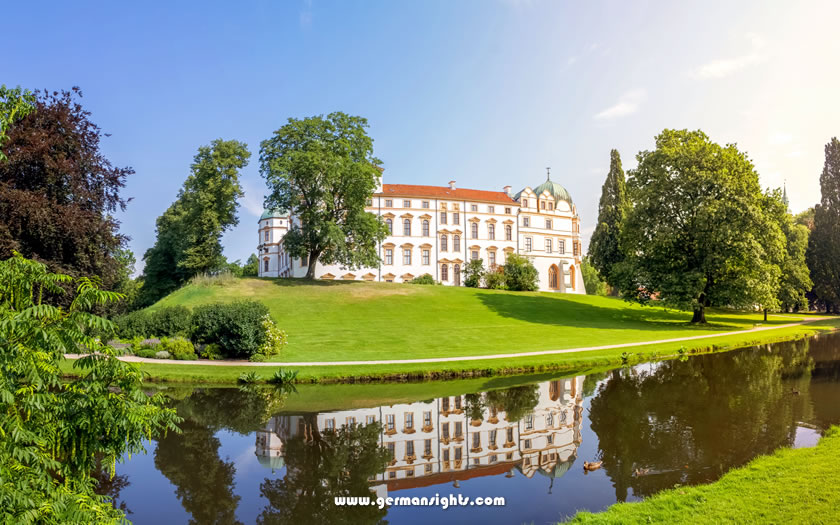
Celle castle in Lower Saxony
Celle became a leading city of the Reformation in 1524 when Duke Ernst I introduced Lutheranism there, making it the second city after Wittenberg to fully embrace the movement. His son, Duke Wilhelm, continued this legacy by building the stunning castle chapel, which was consecrated in 1585.
Celle's golden age occurred between 1665 and 1705 under the reign of Duke Georg Wilhelm, who transformed the medieval castle into an impressive, four-winged, Baroque palace.
His French wife, Eleonore d'Olbreuse, invited Huguenot refugees and Italian architects to the town, resulting in the creation of elegant French and Italian gardens, as well as a Baroque palace theatre. Around 300 Huguenots settled here, establishing one of the few remaining Huguenot churches in north-west Germany in 1700, and contributing to the local economy as tailors, carpenters, glove makers and wig makers.
Following the death of Duke Georg Wilhelm in 1705, Celle passed to his nephew, Georg Ludwig (who would later become King George I of England), and became part of the Electorate of Brunswick-Lüneburg.
Although it lost its status as a royal residence, the city gained important administrative institutions. This transformation established Celle as a city of civil servants and legal professionals, a role it continues to fulfil today with courts such as the Higher Regional Court serving much of Lower Saxony.
The town continued to exist quietly throughout the centuries, but its greatest stroke of luck came during World War II. Celle suffered almost no bomb damage. Thanks to this miraculous preservation, the stunning sixteenth-century architecture visitors see today, with its intricate timber frames, painted facades and cobblestone lanes, remains completely intact.
Celle Castle, the oldest building in the city, began life as a 13th-century fortress before evolving into a stunning blend of Renaissance and Baroque architecture. Explore the Residenzmuseum to glimpse life as a duke, and be sure to visit the 16th-century palace chapel, which is one of the finest examples of Renaissance ecclesiastical art in northern Germany.
Simply wandering through the old town is an experience in itself. Over 400 meticulously restored half-timbered houses line the cobblestone streets, each one unique. The crown jewel is the Hoppener Haus, built in 1532 and famous for its incredibly intricate carvings and ornate façade. It's a photographer's dream and a testament to the era's craftsmanship.
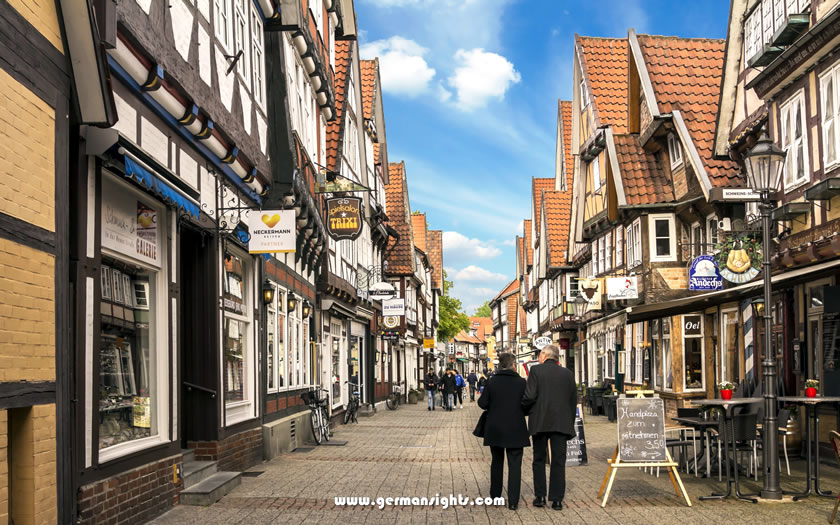
Pedestrians in Celle old town
This masterpiece of Weser Renaissance architecture dominates the pedestrian zone. With its elaborate gables and decorative details, it is one of the most striking buildings in the town, perfect for stopping to take photos or simply admiring from a nearby café.
This historic church is the final resting place of the Dukes of Celle. Climb the white tower to enjoy sweeping panoramic views of the town's red rooftops and timber-framed buildings. A traditional trumpeter still plays from the tower twice daily.

The Stadtkirche in Celle
This beautiful public park, laid out by French landscape gardeners in the 17th century, is located just south of the Altstadt. With its peaceful atmosphere, it's the perfect place to enjoy a stroll, a picnic or simply unwind after exploring the historic streets.
The Celle tourist information office is located in the centre of the town opposite the church on the Markt. The tourist office is closed on Sundays and has shorter opening hours on the Saturdays.
Website: www.celle-tourismus.de