
Hamelin is a town where medieval architecture meets one of Europe's most enduring legends. Visitors have been drawn to the tale of the Pied Piper for centuries, but this is just one of many things that make this destination compelling.
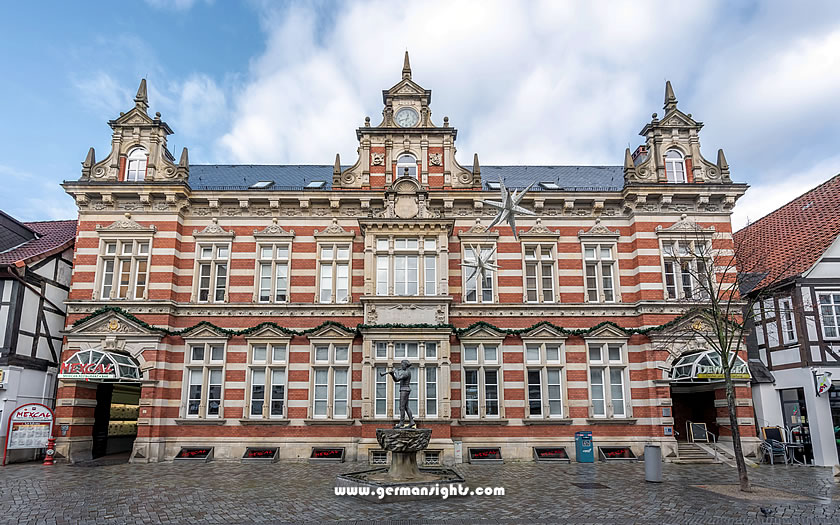
The statue of the Pied Piper in Hamelin
The town centre boasts an exceptional collection of Weser Renaissance buildings, with their ornate facades displaying the wealth that flowed through this trading hub during the 16th and 17th centuries.
The town can be enjoyed as a standalone destination or as a base for exploring the Weserbergland region.
The Weser Cycle Route passes directly through the town, making Hamelin a natural stopping point for cyclists following this 500-kilometre route from the river's source to the North Sea.
Hamelin attracts a particular type of traveller.
Families come for the Pied Piper connection, which the town celebrates through street performances, museums and themed walking routes, rather than theme park theatrics.
Architecture enthusiasts will be impressed by the concentration of Weser Renaissance buildings, particularly since many other German cities lost their historic centres during World War II.
Hamelin is located in the Weserbergland region of Lower Saxony, around 45 kilometres southwest of Hanover. The town is located on both sides of the Weser River, although most of the historic centre and tourist infrastructure are on the western side.
Hamelin's location makes it accessible from several major German cities, while it retains its character as a regional centre rather than a metropolitan satellite.
This means that Hamelin receives a steady flow of domestic German tourists, but remains off the standard international tourist routes connecting Frankfurt, Munich and Berlin.
The closest major airport is Hannover Airport (HAJ), located about 65 kilometres northeast of Hamelin. Hannover Airport serves a range of European destinations, including regular direct flights from cities like London, Amsterdam, and Paris. It is connected to Hanover by the S5 S-Bahn line to the main train station.
Other alternatives really depend on which airlines and destinations they serve. Hamburg Airport, Düsseldorf Airport and Cologne-Bonn Airport probably have the widest choice of flights, while visitors on intercontinental flights will probably arrive into Berlin or Frankfurt.
Hannover Airport (HAJ) - approx. 70 km
Bremen Airport (BRE) - approx. 150 km
Dortmund Airport (DTM) - approx. 170km
Hamburg Airport (HAM) - approx. 225 km
Düsseldorf Airport (DUS) - approx. 245km
Cologne-Bonn Airport (CGN) - approx. 265 km
Hameln Bahnhof is located around 20 minutes walk east of the historic centre. (Buses also leave frequently for the city centre.) The train station is a stop on the S5 Hannover Airport to Paderborn service. Regional services also connect to Hildesheim.
The A2 motorway, one of the busiest in Germany, is the closest connection into the German Autobahn network. It runs from east to west across northern Germany and connects Berlin to the Ruhr area, as well as providing access to Hanover.
Parking can be difficult in the Hamelin historic centre and it is best to use one of the multi-storey car parks near the ring road around the old town.
If you know when you are planning to go but haven't decided on accommodation, then use the map below to get an idea of which properties are available and to compare prices during the period you wish to travel.
Enter your proposed dates and use the '+' to zoom in on a location and reveal more properties. Click on the price above a property to see more information.
(Please note that this selection will also include some guesthouses, pensions and self-catering apartments for those who are interested in that form of accommodation!)
The documented history of Hamelin begins in 851, when a Benedictine monastery was established on the site. The monastery attracted craftsmen, merchants and farmers, who settled nearby and created the nucleus of what would become a significant medieval trading town.
The town gained its charter by 1200 and began its transition to an independent urban centre by constructing defensive walls.
The town prospered throughout the 13th and 14th centuries after joining the Hanseatic League, a powerful network of trading cities that dominated commerce across northern Europe.
Hamelin's location on the Weser River provided merchants with access to markets ranging from inland regions to North Sea ports. The town specialised in the trade of grain, milling and brewing, and wealthy merchant families built the elaborate half-timbered houses that still characterise the old town.
This economic success funded the construction of St Nicolai Church and the expansion of civic buildings. The architectural legacy from this period represents Hamelin's golden age, when the town was one of the most important commercial centres in Lower Saxony.
The Pied Piper legend emerged during the medieval period. The earliest tangible mention of the legend appeared in a Hamelin church window dating from around 1300, which was destroyed in 1660.
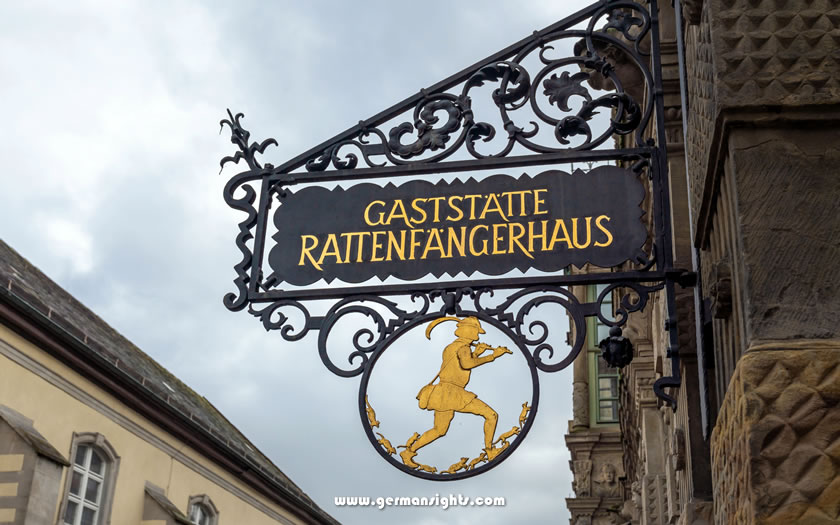
Restaurant sign showing the Pied Piper in Hamelin
Various theories attempt to explain the origins of the legend. Some suggest that it commemorates either a children's crusade or the emigration of young people to Eastern European settlements, while other think there may be connections to a plague outbreak or a tragic accident.
The Thirty Years' War brought an abrupt end to Hamelin's prosperity. The conflict devastated much of Germany between 1618 and 1648, with Hamelin suffering occupation, siege and economic collapse. The town's population halved as disease, starvation and military violence took their toll.
The town never regained its Hanseatic prominence and instead became a modest provincial centre. While this decline was economically damaging, it had the unintended benefit of preserving medieval architecture that wealthier cities later demolished during periods of modernisation.
Hamelin became part of the Kingdom of Hanover in 1866, when Prussia annexed the region following the Austro-Prussian War. Hamelin remained primarily a market town, serving the surrounding agricultural areas.
Hamelin was affected less severely by the two world wars than many other German cities. Its lack of major industry meant that it held little strategic value as a bombing target.
British forces occupied Hamelin in April 1945 as the war in Europe was coming to an end. They maintained a significant military presence in the town throughout the Cold War, establishing barracks and facilities that employed local civilians and influenced the local economy. The British garrison finally withdrew in 2014, bringing to an end nearly 70 years of military presence.
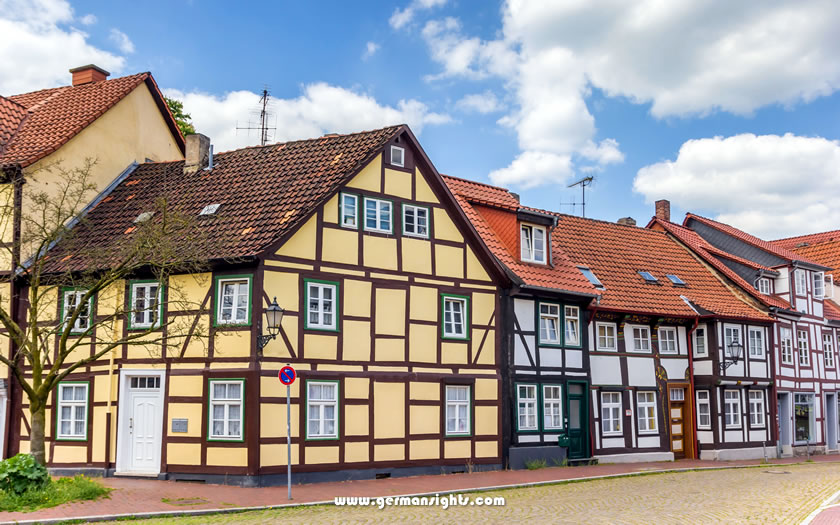
Historic half-timbered houses in Hamelin
Post-war reconstruction focused on preserving Hamelin's medieval character. Restoration work on half-timbered houses accelerated during the 1970s and 1980s and the Pied Piper legend, which had remained part of local tradition, became the foundation for organized tourism marketing.
The historic old town is at the heart of any visit to Hamelin, and walking its streets reveals the architecture that was created during the town's medieval period of prosperity.
The Market Square is the perfect place to start, dominated by the Wedding House, completed in 1617. Originally used to host civic celebrations, this Renaissance building now houses city offices, but it is the exterior that provides the main attraction.
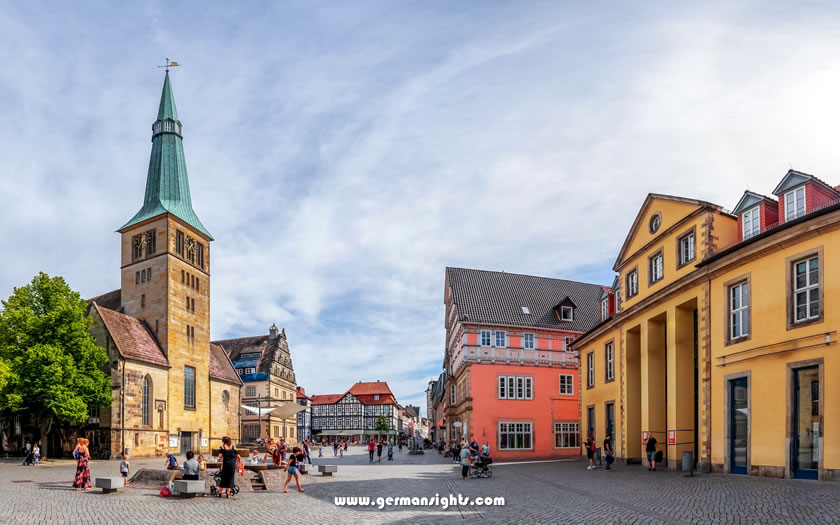
The Market and St Nicolai church in Hamelin
The mechanical Pied Piper clock on the façade performs three times daily at 13.05, 15.35 and 17.35, drawing crowds who gather to watch the figures parade across the display. The performance lasts only a few minutes and offers more historical curiosity than any spectacular entertainment.
The Rattenfängerhaus (Rat Catcher's House) on Osterstrasse is one of Hamelin's most photographed buildings. Built in 1602, it boasts an elaborate facade adorned with intricate stone carvings and an inscription mentioning the Pied Piper legend.
St. Nicolai Church is Hamelin's most significant religious building. Construction began in the 13th century, with additions and modifications continuing for several hundred years to create a blend of Gothic and later architectural styles.
The Hamelin Museum is housed in two historic buildings on Osterstrasse and offers the most comprehensive insight into local history and the Pied Piper legend. The permanent collection includes medieval artefacts and period furniture, as well as detailed explanations of how the town developed from a monastic settlement into a modern regional centre.
A section dedicated to the Pied Piper story presents various historical theories and illustrates how the legend has evolved over time.
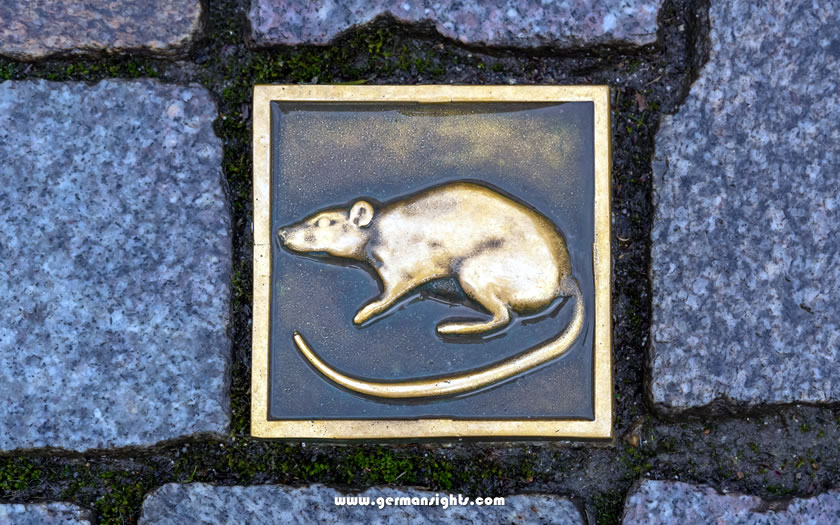
One of the rat symbols on the Pied Piper Trail in Hamelin
The Pied Piper Trail is a route marked by rat symbols embedded in the pavement throughout the old town, connecting sites associated with the legend. The trail takes approximately 45 minutes to complete at a leisurely pace and does not require a guide, as the route is self-explanatory. Information plaques in multiple languages are located along the way.
The Hamelin tourist information office is located on the ring road on the edge of the old town. The tourist office is closed on Sundays and holidays and has different opening hours on the Saturdays.
Website: www.hameln.de