
Hanover is a city that balances tradition and modernity, inviting visitors to discover both its historical roots and contemporary charm. Known in German as "Hannover", this destination is often underrated in favor of larger cities like Berlin or Munich.
What sets Hanover apart is its ability to serve as both a relaxing retreat and an active urban hub.
The city is home to the magnificent Herrenhausen Gardens, one of Europe's finest Baroque parks, offering peace and elegance. Art lovers will enjoy the impressive collection of 20th-century art housed in the Sprengel Museum.
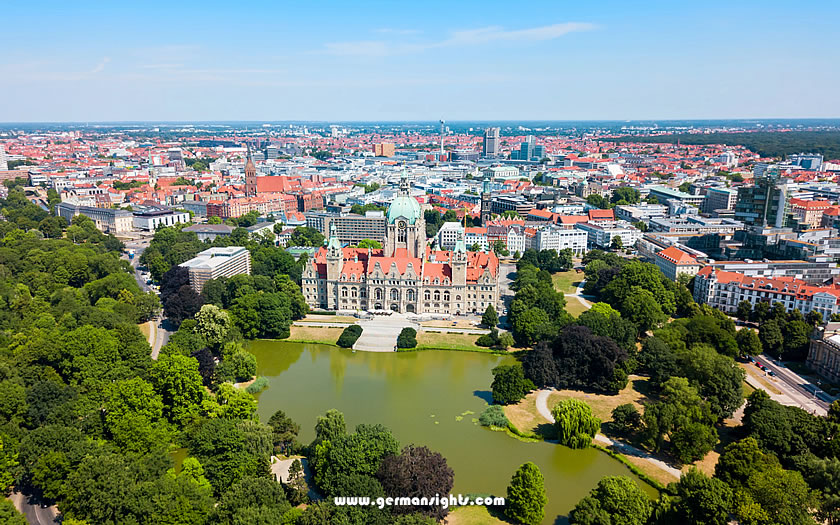
View over Hanover city centre
Hanover’s status as a major trade fair destination attracts global visitors each year, giving the city a surprisingly cosmopolitan feel despite its reputation for being more subdued than Germany’s other major cities.
Hanover is also appealing for its accessibility — it’s not overwhelming in size, yet large enough to offer plenty of things to do.
Whether you're strolling along the Mittelland Canal, wandering through the charming old town with its half-timbered buildings, or enjoying live music in a converted industrial space, you're likely to experience an authentic side of Germany rather than an overly polished one.
Hanover is located in the centre of northern Germany on the banks of the River Leine.
Geographically and logistically, it sits at a major crossroads in the country. It lies right in the middle of the important north-south route between Hamburg and Munich, as well as the east-west corridor between Berlin and the industrial Ruhr area.
This central location makes Hanover an ideal base for exploring Lower Saxony and the surrounding regions.
Hannover Airport (HAJ) is located in Langenhagen, just 11 kilometres north of the city centre. It is an international airport with flights to major European hubs and leisure destinations. Getting into the city is extremely straightforward: the S-Bahn suburban train (Line S5) departs directly from the terminal beneath the airport and takes about 18 minutes to reach Hanover Hauptbahnhof in the city centre.
Given Hanover's excellent rail connections, flying into other northern or eastern German airports is a viable option:
As a major railway hub, Hanover benefits from frequent and reliable train services. It is connected to Germany's high-speed rail network, with ICE (Intercity-Express) trains providing links to major cities such as Berlin, Hamburg, Frankfurt and Munich.
The main station, Hannover Hauptbahnhof, is central and easy to navigate, with English signage available for travellers who are not familiar with the German language.
Regional trains also link Hanover to smaller towns and scenic areas in Lower Saxony, such as Celle and Goslar.
Hanover is as well-connected by road as it is by rail. It is located near the intersection of two of Germany's most important motorways: the A7, which runs north to south, and the A2, which runs east to west.
Those driving should be aware that Hanover's city centre is designated an environmental zone (Umweltzone), meaning your vehicle will require a green emissions sticker to enter.
As the city centre is heavily pedestrianised and parking can be expensive, drivers are often better off using the Park & Ride facilities on the outskirts and taking the tram into the city centre, or ensuring their accommodation offers dedicated parking.
If you know when you are planning to go but haven't decided on accommodation, then use the map below to get an idea of which properties are available and to compare prices during the period you wish to travel.
Enter your proposed dates and use the '+' to zoom in on a location and reveal more properties. Click on the price above a property to see more information.
(Please note that this selection will also include some guesthouses, pensions and self-catering apartments for those who are interested in that form of accommodation!)
Hanover's origins can be traced back to medieval times, when a small village of ferrymen and fishermen was established on a high bank above the River Leine. In fact, the city's name is believed to derive from the phrase Am Höhen Ufer ('on the high bank').
By the 13th century, the village had grown into a prosperous town and received its town privileges, eventually joining the powerful Hanseatic League. Its location on the river and near major trade routes helped it to flourish as a centre for commerce.
English-speaking visitors will find Hanover's history particularly intriguing in the early 18th century.
First, in 1692, the local rulers were elevated to the status of Electors within the Holy Roman Empire. Then, in 1714, Elector George Louis ascended to the British throne as King George I.
This created a 'personal union' between Great Britain and Hanover that lasted for over a century. During this time, the British monarchs were also rulers of Hanover.
However, the union came to an end in 1837 when Queen Victoria took the British throne, as Hanoverian law did not permit a woman to inherit the crown. The title therefore passed to her uncle, Ernest Augustus.
Hanover was elevated to the status of an independent kingdom at the Congress of Vienna in 1814. However, this independence was relatively short-lived.
During the Austro-Prussian War of 1866, Hanover backed the losing Austrian side. As a result, the victorious Prussians annexed the kingdom, stripping the royal family of their power and reducing Hanover to the status of a Prussian province.
The 19th century saw industrialisation and expansion. As factories, railways and new residential districts emerged, Hanover grew beyond its medieval walls. The city became a manufacturing hub, particularly for machinery and rubber production. The population increased rapidly and Hanover evolved from a royal residence into a modern industrial centre.
Hanover was the target of heavy Allied bombing during World War II. By the end of the war, most of the city centre had been completely destroyed.
In the post-war era, city planners took a radical approach to reconstruction. Rather than rebuilding the city exactly as it was, they embraced the concept of the 'autogerechte Stadt' (the 'car-friendly city'), creating wide boulevards and ring roads to accommodate modern traffic.
While this gave much of central Hanover a distinctly modern, mid-century appearance, planners did salvage surviving historic buildings from across the city and relocate them to the area around the Marktkirche. This created the concentrated 'Old Town' that visitors explore today.
Hanover offers a variety of attractions, including reconstructed historic sites, green spaces, museums, and cultural venues. While it may not have the overwhelming tourist attractions of larger German cities, there is still plenty to keep visitors occupied.
The Herrenhausen Gardens, located a short tram ride from the city centre, are a world-class attraction.
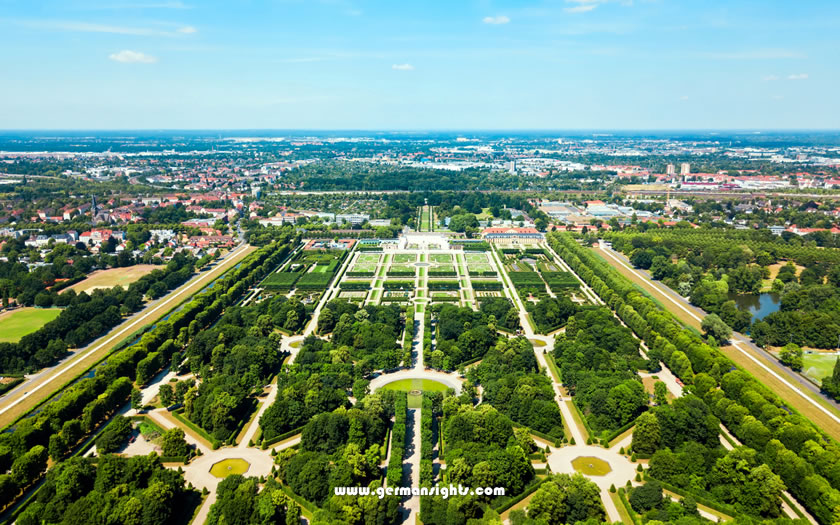
View over Hanover city centre
The centrepiece is the Great Garden (Großer Garten), which is considered to be one of the most distinguished Baroque gardens in Europe. It was originally created by Electress Sophia in the late 17th century.
The complex also comprises the reconstructed Herrenhausen Palace, the Berggarten botanical garden and an imaginative modern grotto.
Hanover's Old Town was meticulously rebuilt after the war using salvaged materials and historical records. The result is a collection of half-timbered buildings that look historic but are actually replicas.
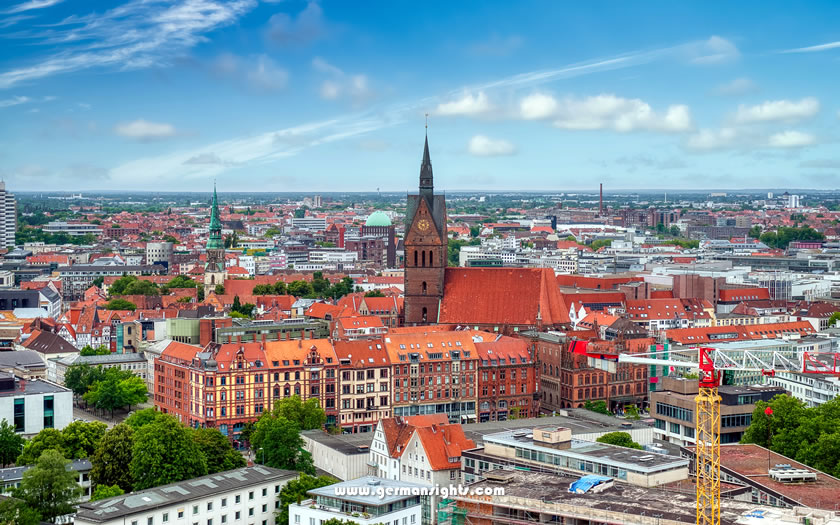
Hanover's 'old town'
The Marktkirche, a 14th-century brick Gothic church, is one of the few old structures that remain. It was rebuilt after sustaining bomb damage.
While it is pleasant to stroll around for an hour or so, visitors should not expect the authentic medieval atmosphere found in cities that escaped wartime destruction.
Despite its name and magnificent castle-like appearance, the New Town Hall was completed in 1913. Set beautifully on the edge of the Maschpark, it is arguably Hanover's most impressive building. Inside the main hall, there are four fascinating scale models showing the city at different points in its history, including its devastation following World War II.
One of the highlights of a visit is taking the unique curved lift (Bogenaufzug) up to the dome's viewing platform. This elevator travels at an angle to follow the curve of the roof, and the observation deck offers stunning panoramic views of the city and the nearby lake.
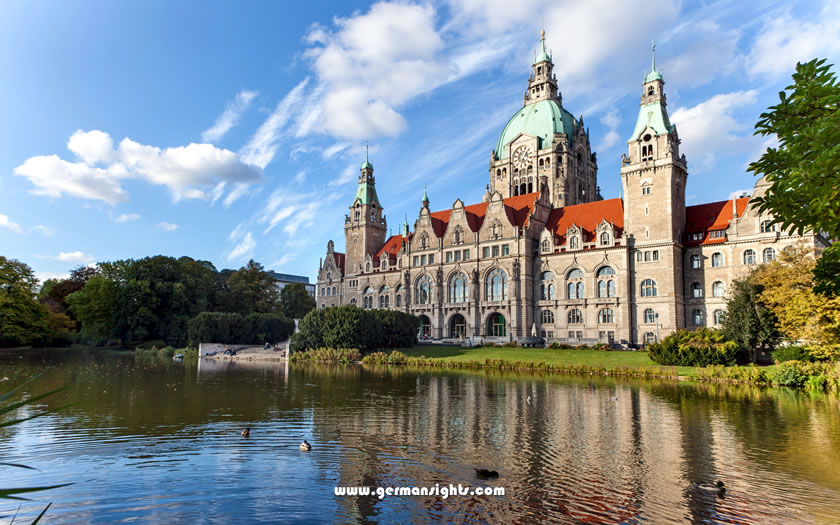
Hanover city hall
The Maschsee, a large artificial lake created in the 1930s, lies just behind the New Town Hall. It is the recreational heart of Hanover. On sunny days, the paths around the lake are filled with walkers, joggers and cyclists, while sailboats and rented pedal boats dot the water. The beer gardens and cafés along the northern shore are the perfect place to unwind after a day of sightseeing.
This modern art museum boasts one of the most significant collections of 20th- and 21st-century art in Germany. The galleries are filled with works by Picasso, Klee, Nolde and Beckmann, as well as extensive holdings of German Expressionism. The museum also showcases photography, sculptures and contemporary installations.
A red line (or 'thread') painted on the pavements connects 36 of Hanover's main attractions and forms a 4.2-kilometre walking route. Following the line provides a self-guided tour of the city centre, taking in all the main sights, and eliminating the need for a map or guide. The route takes about two hours to walk continuously, longer if you stop to explore. It's a practical way to find your bearings on your first day, although the attractions themselves vary in significance.
Hanover is an ideal base for exploring the wider region thanks to its location at the crossroads of Germany's major rail lines. The regional trains and the cost-effective Niedersachsen-Ticket make it easy to reach medieval towns, historic castles and even the edge of the mountains in under two hours.
You can explore the half-timbered houses of Goslar in the Harz Mountains, visit the impressive Marienburg Castle or head north to the Hanseatic city of Bremen.
👉 Find out more about the best day trips from Hanover
The main Hanover Tourist Office is located opposite the central train station. The office is open six days a week, with slightly shorter opening times on Saturdays. An information counter is also opened during the summer months in the new town hall.
Website: www.visit-hannover.com