
North Rhine-Westphalia is the largest German state in terms of population and its industrial powerhouse. The Rhine-Ruhr area is one of the largest urban zones in Europe.
The state is located in western Germany and borders the Netherlands and Belgium, as well as the states of Lower Saxony, Hesse and Rhineland-Palatinate. Geographically, it extends from the flatlands of the Netherlands in the north to the forested hills of the Sauerland and Eifel in the south.
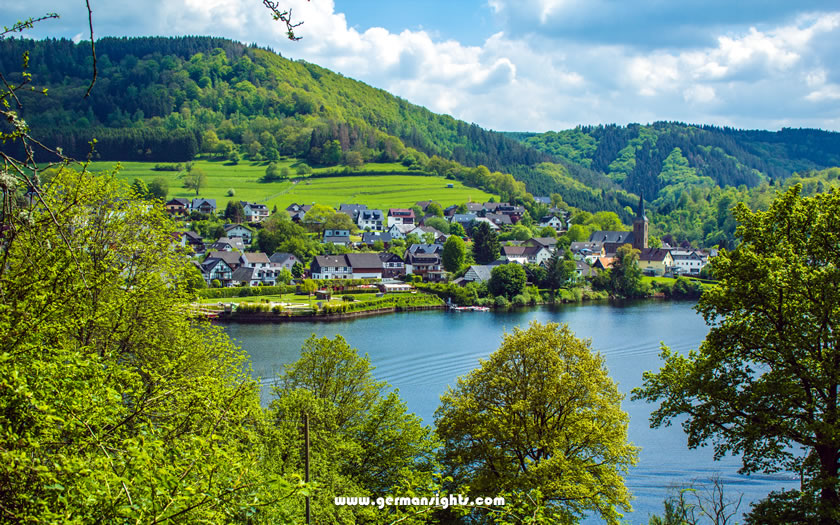
Lake Rursee in the Eifel Mountains
Visitors come to Cologne to see the cathedral, to Düsseldorf to shop and to the romantic Rhine Gorge. These are all valid reasons. Yet the state has much more to offer.
Aachen was the capital of Charlemagne's empire in the 8th century. Cologne preserves 2,000 years of Roman history. The Ruhr cities showcase Germany's industrial transformation.
A surprising abundance of nature lies beyond the urban sprawl. The Eifel region boasts volcanic lakes, hiking trails and medieval castles. The Sauerland has forests and reservoirs. While these areas require more effort to reach, they reward those who make the trip.
Cologne, the state's largest city, is a practical base. It has excellent rail connections to the rest of the state and beyond. Most major sites are under two hours away by day trip.
Cologne Cathedral dominates the city's skyline. Construction began in 1248 and took over 600 years to complete. Its twin spires reach 157 metres, making it the tallest cathedral in Germany. Inside is the Shrine of the Three Kings, which supposedly holds the relics of the Magi.
Aachen Cathedral is older and equally significant. Charlemagne built his palace chapel here around 800 AD. Although he was crowned Holy Roman Emperor in Rome, he chose Aachen as his capital. Thirty German kings were later crowned in the cathedral. The octagonal core of the building dates back to this time.
The Ruhr region was instrumental in Germany's industrial development. Coal mines and steel mills once dominated the landscape. However, most of these sites closed in the late 20th century. Instead of demolishing everything, several sites were converted into museums and cultural spaces.
The most famous example is Zollverein in Essen. This former coal mine is now a UNESCO World Heritage Site. Its industrial architecture has been preserved, and the site now hosts museums, exhibitions, and events. Its aesthetic might not be for everyone but it appeals to visitors interested in industrial history, rather than traditional German tourism.
The Rhine flows through the western part of the state. The section between Bonn and Koblenz marks the start of the famous Romantic Rhine, with its castles, vineyards and steep valley sides. Several cities in the state offer river cruises.
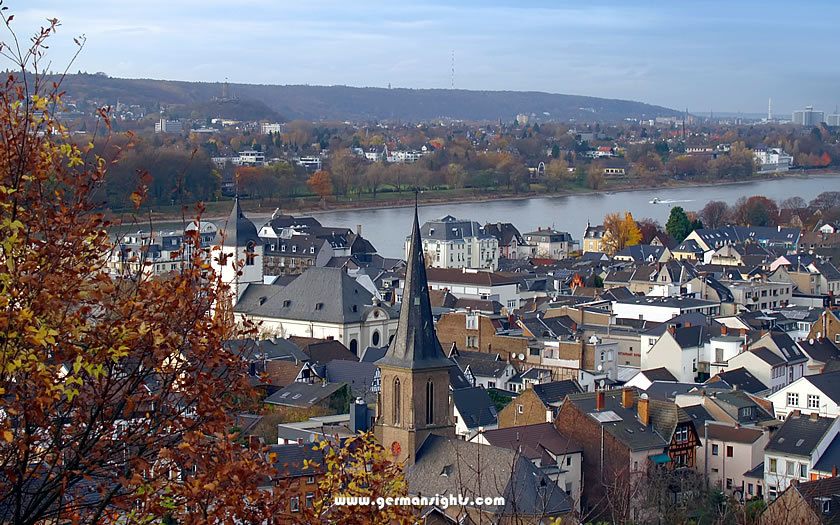
The Rhine river at Bonn
North Rhine-Westphalia boasts Germany's most extensive transport network. Frequent train services connect all major cities. Both Cologne and Düsseldorf have international airports. The state borders Belgium and the Netherlands, making it easy to combine trips to neighbouring countries.
👉 Find out more about how to get to and around the state on our North Rhine-Westphalia travel page...
These destinations form the core of most visits to the state. All of them can be reached by train, except for the Eifel region, which is better suited to drivers.
The cathedral is the obvious starting point. Climbing the 533 steps to the viewing platform of the south tower is challenging, but the effort is rewarded with stunning views of the city and the Rhine.
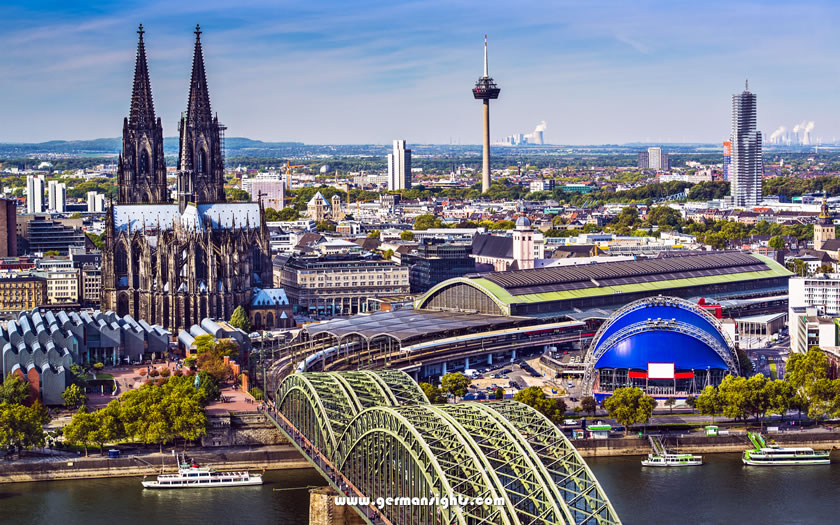
View over the centre of Cologne
The Old Town (Altstadt) stretches along the banks of the Rhine. Much of it was rebuilt after bombing during World War II, but the layout still follows medieval patterns. Narrow lanes are home to traditional breweries (Brauhäuser) serving Kölsch, the local beer.
The Romano-Germanic Museum is located right next to the cathedral. It displays artefacts from Cologne's 2,000-year history, including the Dionysus mosaic discovered during construction work in 1941.
👉 Find out more about the city of Cologne
Aachen is located near the borders of Belgium and the Netherlands. Charlemagne made it his imperial capital in the late 8th century. The cathedral remains the main attraction. The octagonal Palatine Chapel is one of the finest examples of Carolingian architecture in Europe. Charlemagne's marble throne is located in the upper gallery.
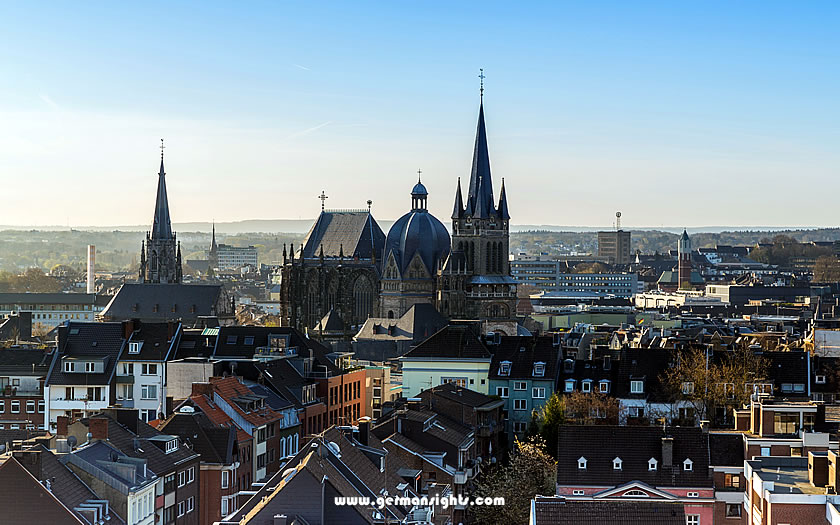
View of Aachen cathedral
Aachen has been a spa town since the days of the Roman Empire. The Carolus Thermen offers thermal baths fed by hot springs. The water reaches 74°C at the source and has a high mineral content.
The city centre is compact and easy to explore on foot. The town hall, or Rathaus, was built on the site of Charlemagne's palace. Upstairs, the coronation hall displays replicas of the imperial regalia.
👉 Discover more about the city of Aachen
Bonn was the capital of West Germany from 1949 to 1990. Although most ministries moved to Berlin after reunification, several government buildings remain. The former parliament building now hosts conferences and exhibitions.
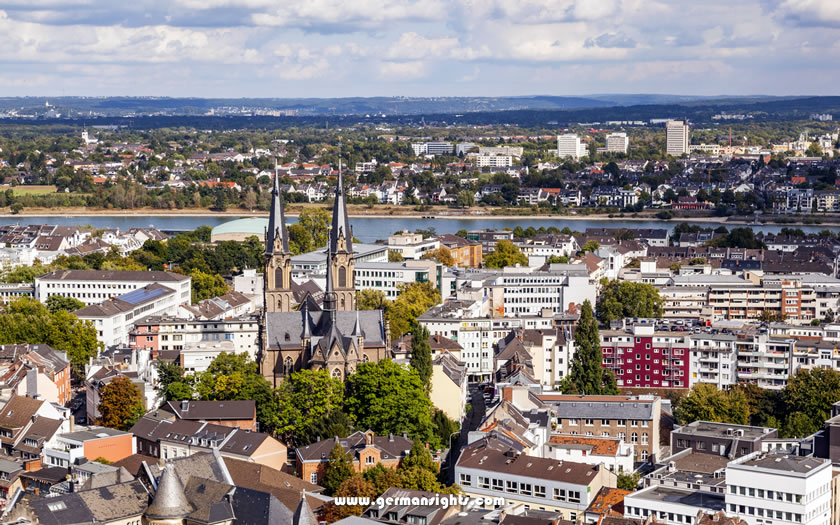
View over Bonn
Ludwig van Beethoven was born in this house in 1770. His birthplace on Bonngasse now houses a museum displaying his manuscripts, instruments, and personal items.
The Bundeskunsthalle and the Kunstmuseum Bonn are part of the Museumsmeile (Museum Mile) along the Rhine. Both venues host exhibitions of modern and contemporary art.
Bonn is located at the southernmost point of the state, where the Rhine Valley begins to narrow. The city is the starting point for river cruises along the Romantic Rhine.
This city is the state capital and a centre for fashion, advertising and finance. The Königsallee, known as the "Kö", is Germany's most expensive shopping street. Even if you're not planning on buying anything, the tree-lined boulevard and canal are pleasant places to walk.
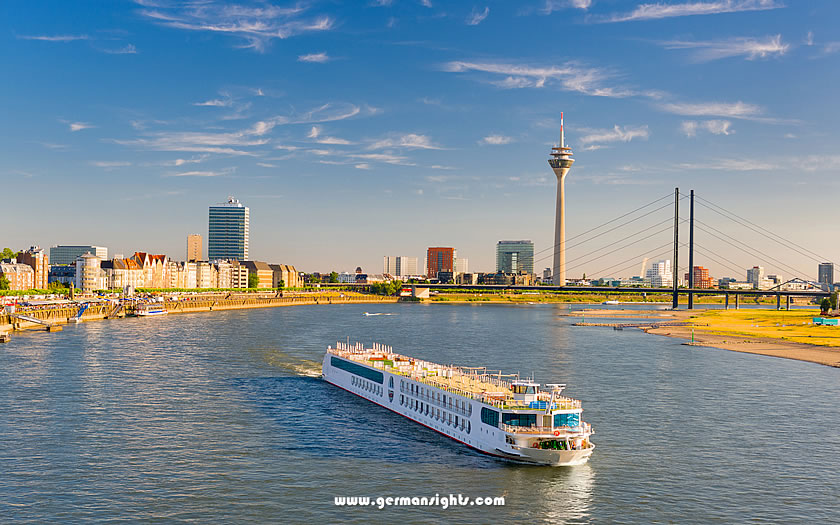
The Rhine river at Düsseldorf
The Old Town (Altstadt) is said to be "the longest bar in the world" thanks to the high concentration of pubs in such a small area. The local beer is Altbier, which is darker and more bitter than Cologne's Kölsch. There is a genuine rivalry between the two cities over their own beer.
The Kunstsammlung Nordrhein-Westfalen operates three venues across the city. K20 specialises in 20th-century classics, such as works by Picasso, Klee and Kandinsky. K21 exhibits contemporary art in a converted parliament building. Its modern art collection is one of the best in Germany.
The MedienHafen (Media Harbour) showcases postmodern architecture by Frank Gehry and others. In the 1990s, former industrial docks were converted into offices, apartments and restaurants.
The Eifel is a low mountain range in south-west Germany, extending into Belgium. Though it is a volcanic region, the last eruption occurred around 11,000 years ago. Circular lakes formed in the volcanic craters, known as Maare.
This area is ideal for drivers. Although public transport exists, it is limited. The landscape comprises forests, hiking trails and small towns. While it may not be dramatic mountain scenery, it provides a welcome contrast to the urban density found elsewhere in the state.
👉 Find out more about the Eifel National Park

The town of Monschau in the Eifel region
Monschau is the most popular town in the Eifel region of Germany. Narrow streets lined with half-timbered houses run alongside the Rur river. The town is nestled in a valley, with wooded hills rising on either side. While it is picturesque, it gets crowded at weekends and on public holidays.
👉 Discover more about the town of Monschau
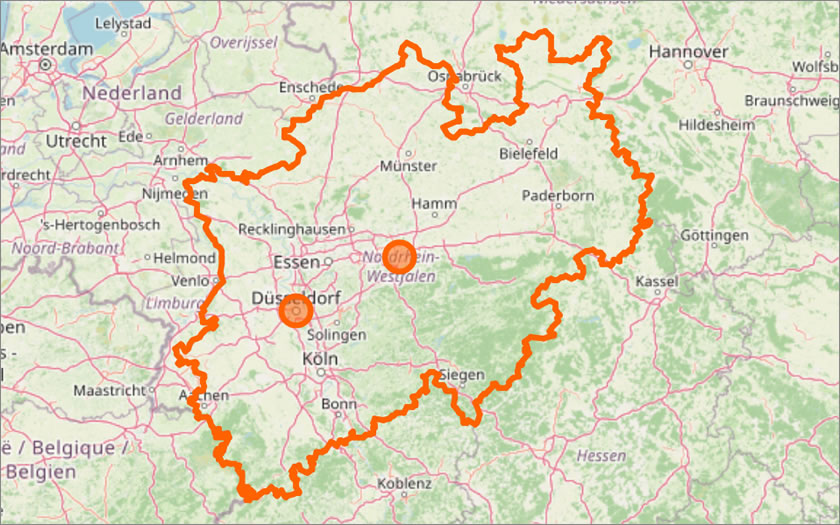
Map of North Rhine-Westphalia
(courtesy of OpenStreetMap)