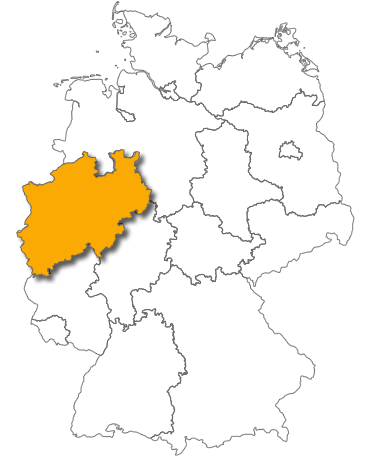
North Rhine-Westphalia is located in the west of Germany, bordering Belgium and the Netherlands.
The state borders Lower Saxony to the north and north-east, Hesse to the east, and the state of Rhineland-Palatinate to the south.
The region was formed in 1946 by the merger of the northern Rhineland and the former Prussian province of Westphalia with the small state of Lippe.
With just over one million residents, Cologne is the state's largest city. The state capital, Düsseldorf, has a population of around 620,000.
The Rhine River flows through the western part of the state, passing major cities such as Cologne, Düsseldorf and Bonn. The Ruhr area, once the industrial heartland of Europe, now focuses on culture and technology rather than coal and steel, and is home to cities such as Essen, Dortmund, and Duisburg.
Düsseldorf Airport (DUS) is the largest airport in North Rhine-Westphalia and the third busiest in Germany. It connects to over 200 destinations worldwide and handles around 25 million passengers each year. Located seven kilometres north of Düsseldorf's city centre, it offers direct train links to most major cities in the state.
Cologne Bonn Airport (CGN), located 15 kilometres southeast of Cologne and 16 kilometres northeast of Bonn, is the state's second-largest airport. It offers connections throughout Europe and on select long-haul routes. A number of budget airlines operate services from this airport.
Dortmund Airport (DTM) primarily serves European destinations and low-cost carriers. The airport is located 10 kilometres east of the city centre. Its route network caters more to leisure travellers than business passengers.
Straddling the border between North Rhine-Westphalia and Lower Saxony, Münster Osnabrück Airport (FMO) is located approximately 25 kilometres from both Münster and Osnabrück. The airport operates a limited schedule of European flights, primarily with budget airlines.
Weeze Airport (NRN), which is marketed as Düsseldorf Weeze, is located 70 kilometres northwest of Düsseldorf, near the Dutch border. Reaching Düsseldorf requires significant travel time, despite its marketing name. The airport is used by budget airlines flying to European destinations.
Frankfurt Airport (FRA) in neighbouring Hesse provides the most comprehensive international connections for visitors to southern North Rhine-Westphalia. Direct trains reach Cologne in one hour and Düsseldorf in 90 minutes.
North Rhine-Westphalia has the country's most extensive rail network, with several major lines crossing the state. The main north-south route runs from Hamburg via Dortmund and Cologne to Frankfurt. The main east-west corridor extends from the Dutch border through the cities of the Ruhr region to Hanover and Berlin.
InterCity (IC) and InterCity Express (ICE) trains serve all major cities with frequent departures. High-speed trains run every 20 to 30 minutes between Cologne and Düsseldorf, taking just 25 minutes. The journey from Cologne to Dortmund takes about one hour.
Regional trains (RE and RB) create an extensive network connecting smaller towns and cities. These include routes through the scenic Rhine Valley, the Sauerland mountains, and the Eifel region. The Ruhr area benefits from particularly dense regional service with trains running every 15 to 30 minutes on major routes.
S-Bahn networks operate in the Rhine-Ruhr region and around Cologne, providing metro-style service with frequent stops. These urban rail systems integrate with regional services.
The state's main rail hubs are:
One of the best rail bargains in any state is the day pass for the (slower) regional services. In North Rhine-Westphalia's case this is called the NRW-Ticket and works slightly differently from the other states. It offers unlimited travel on local services for 24 hours from the start of use.
The single price is reasonable (around 40 Euros at the time of writing) but the real bargain is the 5-person ticket. Thus up to five people can have unlimited regional rail travel for 24 hours in North Rhine-Westphalia for approximately 60 Euros. (Note that Intercity services are not included.)
Website: www.bahn.de
North Rhine-Westphalia boasts one of Germany's most extensive motorway networks, ensuring smooth road travel across the state and to neighbouring regions. The main routes are:
The A1 ("Hansalinie") runs from north to south through the western part of the state. It connects Münster, Dortmund, Cologne and the Eifel region, and then continues to Trier and Luxembourg. This route is vital for travelling between the Ruhr area and Cologne.
The A2 motorway traverses the central Ruhr area, linking Oberhausen, Dortmund and Hamm with Hanover and Berlin in the east. It is a key route for travelling from west to east across North Rhine-Westphalia.
The A3 cuts through the Rhine Valley, connecting Cologne and Düsseldorf with Frankfurt in the south and the Netherlands in the north-west. It is part of Germany's busiest highway corridor and often experiences significant traffic.
The A4 connects Cologne with Aachen, near the Belgian border, and serves as a major route towards the Netherlands and France. To the east, it extends towards Dresden and Poland.
The A40, known locally as the 'Ruhr Expressway', is an east-west route that serves the heart of the Ruhr area. It passes through cities such as Duisburg, Essen and Dortmund.
The A44 runs partially through the state. It connects Düsseldorf to Kassel and further east, which makes it essential for travel across central Germany.
Tourist destinations throughout the state are also accessible via well-maintained federal highways (Bundesstraßen). Notable roads include the B9, which follows the scenic Rhine River, and the B54, which connects Münster and southern NRW areas like Siegen. Routes through the Eifel and Sauerland offer picturesque views for drivers exploring mountainous regions.
Although North Rhine-Westphalia experiences heavy traffic compared to other German states, particularly during rush hour, its motorway network is highly efficient. Visitors should nevertheless allow extra time for their journeys during peak travel periods, particularly in the Ruhr area and around Cologne and Düsseldorf.
The German automobile club is called ADAC and it offers information on traffic and road conditions on its website (German only):
Website: www.adac.de
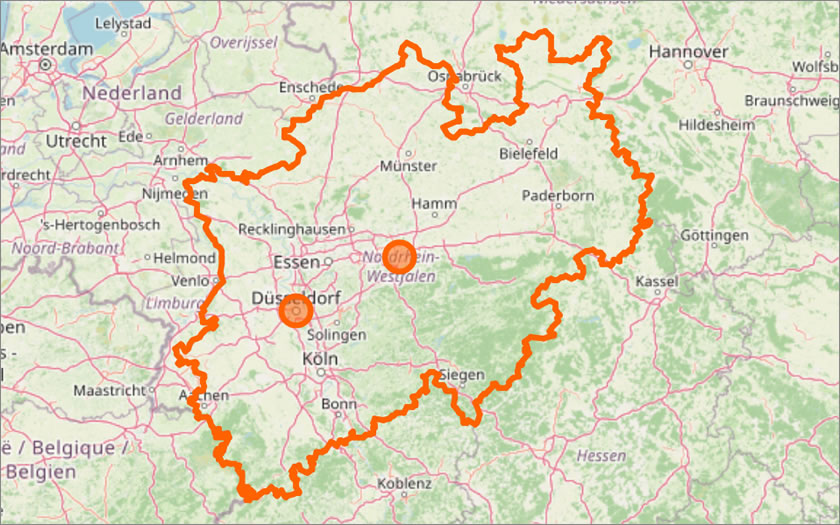
Map of North Rhine-Westphalia
(courtesy of OpenStreetMap)