
Kitzingen sits quietly beside the River Main in northern Bavaria, offering visitors an authentic taste of Franconian wine country, away from the crowds that flock to more popular destinations.
This medieval town of 21,000 people has perfected the art of unhurried living, blending centuries-old wine traditions seamlessly with modern German efficiency.
The town centre has remained largely unchanged since the Middle Ages, with its half-timbered houses leaning over cobblestone streets and ancient church spires piercing the skyline.
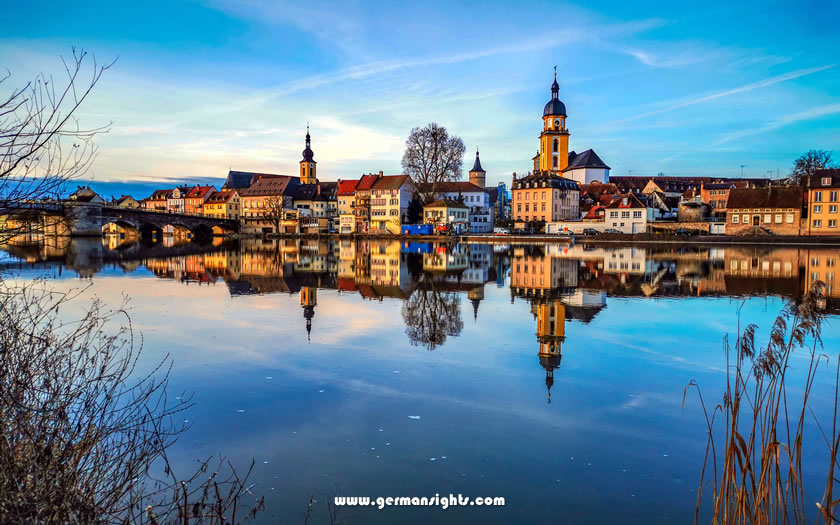
View across the River Main to Kitzingen
Wine defines Kitzingen's character more than any other single element.
The surrounding hills produce some of Franconia's finest Silvaner and Müller-Thurgau wines, served in traditional bocksbeutel bottles that locals have used for generations. Visitors can walk directly from their hotel into working vineyards, sample wines in family-run cellars that date back 400 years, and dine in restaurants where the chef's great-grandmother likely served similar regional dishes.
The town serves as an excellent base for exploring Franconia's wine route. Its compact size means visitors can walk everywhere, yet its location provides easy access to Würzburg, Bamberg, and other regional highlights.
Hotels cost significantly less than in major tourist centres, restaurants serve generous portions of authentic Franconian cuisine, and locals genuinely welcome visitors rather than merely tolerating them.
Kitzingen is located in the Franconia region of northern Bavaria, approximately 20 kilometres southeast of Würzburg.
The town lies at the heart of the Mainfranken wine-growing area and is surrounded by gentle, vineyard-covered hills stretching towards the horizon in every direction.
The Main River curves around the historic centre of Kitzingen, creating a natural boundary that has shaped the town's development for over a millennium.
Kitzingen is located within easy reach of several major German destinations.
Nuremberg, one of Germany's most significant medieval cities, lies 90 kilometres to the southeast and is accessible for day trips.
Frankfurt is located 135 kilometres to the west and offers access to the Rhine Valley via its international airport. Munich, the capital of Bavaria, is 250 kilometres south, but is still within reasonable driving distance for longer trips.
Kitzingen's location on the Main River connects it to Germany's extensive inland waterway system. River cruise ships regularly dock at the town's port, bringing visitors who explore the historic centre during brief stops.

Aschaffenburg is a delightful town rich in history, known for its impressive baroque and rococo architecture. Often called the "Bavarian Nice" due to its mild climate, it features the stunning Johannisburg Castle, beautiful parks, and a charming old town.

Miltenberg is a picturesque town famous for its beautifully preserved timber-framed houses and charming medieval streets. It offers a scenic old town with historic market squares and the impressive Mildenburg Castle overlooking the area.
The airport at Nuremberg is the closest for those wanting to fly in as close as possible to Kitzingen but it does have a restricted range of airlines and destinations.
Distance to Nuremberg Airport: 90km
Distance to Frankfurt Airport: 140km
Distance to Stuttgart Airport: 182km
Distance to Munich Airport: 250km
The massive choice of flights available at Frankfurt Airport makes sense for those looking for a good deal or who are wanting international connections. Stuttgart Airport and Munich Airport are just a little further away but both have good rail and road links to Kitzingen.
The train station in Kitzingen is around 15 minutes' walk from the historic centre and the Main River, with its great view of the town from the opposite bank. The station in on the line which runs between Nuremberg and Würzburg.
If you know when you are planning to go but haven't decided on accommodation, then use the map below to get an idea of which properties are available and to compare prices during the period you wish to travel.
Enter your proposed dates and use the '+' to zoom in on a location and reveal more properties. Click on the price above a property to see more information.
(Please note that this selection will also include some guesthouses, pensions and self-catering apartments for those who are interested in that form of accommodation!)
Kitzingen's origins can be traced back to 745 AD, when the Frankish noblewoman Hadeloga founded a Benedictine convent on the site of the current town centre.
According to local legend, Hadeloga threw her veil into the River Main, vowing to establish a religious community wherever it came to rest. It supposedly caught on a shepherd's staff, giving the settlement its name, "Chiez am Goezeheim", meaning "goats' home".
While historians debate this colourful tale, archaeological evidence confirms continuous settlement in the area since the 8th century.
The convent grew in importance throughout the medieval period, attracting pilgrims and establishing Kitzingen as a regional religious centre.
By the year 1000, a market town had developed around the monastery, benefiting from its strategic location on the trade route along the River Main.
The settlement was granted official town status in 1256 by the Würzburg bishops, who ruled the area as part of their ecclesiastical territory. These rights included the permission to hold weekly markets, collect tolls from river traffic and build defensive walls around the growing community.
Kitzingen's medieval prosperity was largely due to wine production and river commerce. Monks cultivated the surrounding hillsides and developed viticultural techniques that established the region's reputation for quality wines.
The Main River was a vital transport route for goods travelling between the Rhine valley and eastern German territories, and Kitzingen was an important stopping point for merchants and their cargo. The town's location at a river bend gave it natural advantages for controlling water traffic and collecting customs duties.
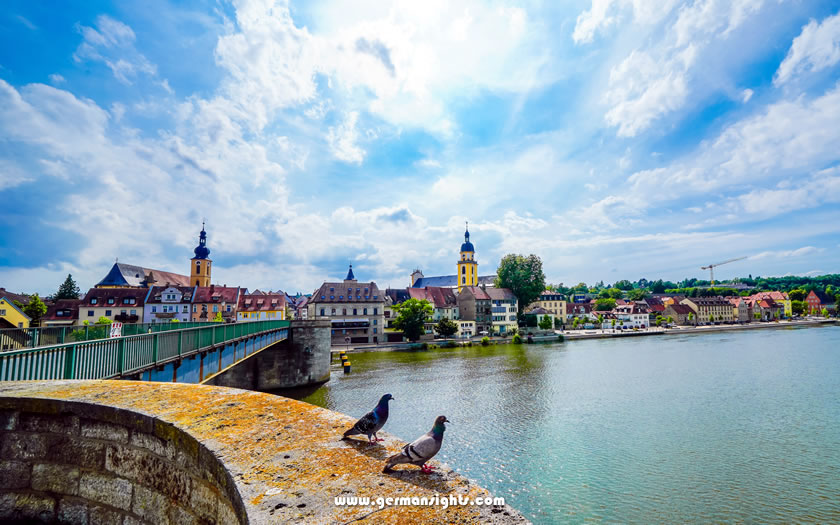
The Main river with the Old Main Bridge
The Protestant Reformation reached Kitzingen in the 1520s, leading to tensions between the Catholic convent and the increasingly Protestant townspeople.
Margrave Albrecht Alcibiades of Brandenburg-Kulmbach seized control of the town in 1544, dissolving the convent and converting its buildings for secular use. This marked the end of almost 800 years of religious rule, and Kitzingen's integration into the wider political struggles of the Holy Roman Empire began.
Kitzingen was devastated by the Thirty Years' War between 1618 and 1648, as competing armies repeatedly occupied the town. Swedish, Imperial and French forces alternately controlled the area, demanding tribute and quartering soldiers among the civilian population.
The town's population fell from around 3,000 to fewer than 800 by the end of the war. Recovery was slow, taking nearly a century to restore pre-war population levels and economic activity.
Bavarian rule began in 1814, when the Congress of Vienna assigned Franconia to the Kingdom of Bavaria after Napoleon's defeat. This political change brought administrative reforms and improved infrastructure, including better roads connecting Kitzingen to regional markets.
The arrival of the railway in 1879 further accelerated economic development by enabling the faster transport of local wines to distant cities and bringing the first significant number of tourists to the area.
Two world wars disrupted normal life, though Kitzingen suffered less physical damage than many other German cities. American forces occupied Kitzingen in 1945 and established a military base there which operated until 2006.
Kitzingen's historic centre is ideal for visitors who appreciate architectural details and unhurried exploration rather than major tourist attractions.
The Old Town Hall dominates the market square with its distinctive Renaissance façade and astronomical clock, which puts on a short mechanical show at noon and 18.00 every day.
The building houses a small museum displaying local artefacts and winemaking equipment, though the exhibits are in German with limited English translations.
The adjacent market square hosts weekly farmers' markets on Saturdays, where local vendors sell regional produce, flowers and handicrafts.
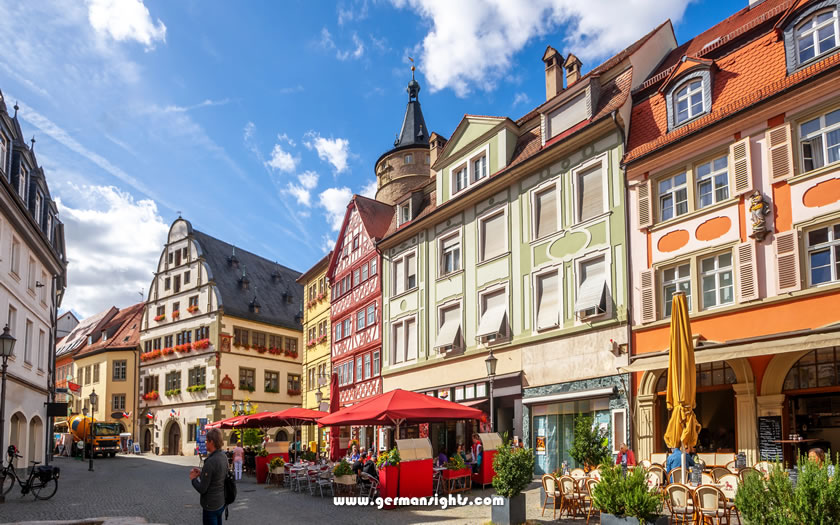
The msrket square in Kitzingen
St. John's Church is Kitzingen's most significant example of religious architecture. It features Gothic stonework and medieval stained glass windows that have survived various historical upheavals.
Kitzingen's most recognisable landmark is the 52-metre-high Falterturm, a medieval watchtower which appears on countless postcards and wine labels. Built in the 13th century as part of the town's defensive walls, it now houses a small exhibition about medieval fortifications and offers visitors another elevated viewpoint.
The surrounding park has pleasant walking paths and benches where visitors can rest and enjoy views of the tower and the historic buildings nearby.
The Main Cycle Path passes directly through Kitzingen and connects to an extensive network of marked cycling routes through vineyard-covered hills and neighbouring villages.
The Kitzingen tourist office is located near the river at the Alte Mainbrücke ('the Old Main Bridge'). It is open seven days a week in the summer, with restricted hours on the weekend, and from Monday to Thursday and on Friday mornings outside the summer season:
Website: www.stadt-kitzingen.de