
The town of Bingen am Rhein is located at the confluence of the River Nahe and the Rhine. This marks the point at which the Rhine turns north and enters its famous gorge.
The town marks the southern gateway to the UNESCO World Heritage Site of the Upper Middle Rhine Valley. This 65-kilometre stretch of river landscape runs north to the town of Koblenz and was added to the World Heritage List in 2002.
Rüdesheim sits directly opposite on the far bank and can be reached by passenger ferry in minutes. Together, the two towns form a natural entry point to the Middle Rhine. Bingen, however, tends to attract fewer day-trippers and has a stronger sense of identity than its neighbour across the water.
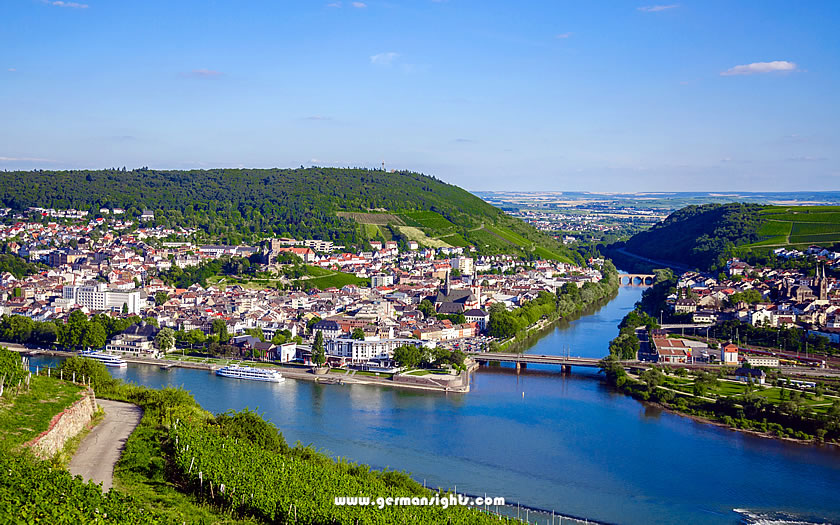
A view of Bingen and the Rhine river
The town is also located at the intersection of two wine regions. To the north and east lies Rheinhessen, one of Germany's largest wine-growing areas. The Rheingau begins on the far bank of the river in Hesse. Bingen itself produces wine on the slopes above the town, and this local industry has shaped the town's character for centuries.
The town is not primarily built around tourism. While visitors will find restaurants, wine bars and a reasonable range of accommodation, Bingen doesn't feel like a resort. That's a good reason to choose it as a base over the more popular stops along the Rhine.
Bingen am Rhein is located in the state of Rhineland-Palatinate, in the district of Mainz-Bingen. The town's location at the confluence of the Nahe and the Rhine has had a significant impact on its geography and history. The Rochusberg hill rises just to the south and is almost entirely surrounded by the town.
The River Nahe flows in from the west and empties into the Rhine at Bingen. This junction made the site strategically important long before the Romans arrived. The confluence created a natural crossing point and defensible position.
Here, the Rhine runs roughly east to west before bending north at Bingen to enter the gorge. This bend, known as the 'Rhine Knee', explains why the gorge begins here rather than further upstream.
Mainz lies roughly 30 kilometres to the east along the Rhine, offering a larger city with good transport connections.
Bingen am Rhein is located equidistant from Frankfurt's two (at least in name) airports.
Hahn Airport, sometimes referred to as 'Frankfurt Hahn Airport' by certain operators despite being far from the city, is primarily used by budget airlines and is a good option for travellers on a budget.
Frankfurt Airport is probably the best option for most travellers. It offers a wide range of flights from around the world and has good transport connections to the Rhine river region.
Distance to Frankfurt Hahn Airport: 62km
Distance to Frankfurt Airport: 62km
This distinction can be confusing for visitors. Bingen (Rhein) Hauptbahnhof is the main station. It is located on the MittelrheinBahn line, a short walk from the town centre and the riverside. Most long-distance and regional services stop here. This is the station to aim for.
As well as regional services, it is a stop on high-speed IC or ICE services between major cities like Frankfurt, Cologne, Bremen and Hamburg.
Bingen Stadt is a smaller stop closer to the town centre geographically but served by fewer services. It is not the same station, and booking to the wrong one adds unnecessary complications to any arrival.
It offers regional services on the MittelrheinBahn (like the Hauptbahnhof) and is also a stop on the RheinhessenBahn service to Worms.
The MittelrheinBahn runs along the left bank of the Rhine from Bingen (Rhein) Hauptbahnhof northward through the gorge toward Koblenz, stopping at villages and small towns along the route. This line is one of the most scenic rail journeys in Germany and a practical way to explore the Upper Middle Rhine Valley without a car.
Regional services from Mainz to Bingen run frequently and take around 30 minutes. Connections from Frankfurt require a change at Mainz.
The German rail service offers a ticket ('Rheinland-Pfalz/Saarland-Ticket') which includes unlimited travel for a day on regional trains and bus services in the Rhineland-Palatinate and neighbouring Saarland.
The A61 motorway runs from north to south through the state of Rhineland-Palatinate, passing close to Bingen. Take the Bingen exit from the A61 and follow the B9 or regional roads into town. From Frankfurt, take the A67 and then the A60 for a direct westward route via Mainz.
Parking in Bingen is available near the riverside and in the town centre. A car gives you access to the Nahe valley, the Rochusberg, and the wider area, but is not essential for exploring Bingen itself.
The passenger ferry between Bingen and Rüdesheim runs regularly throughout the day during the main tourist season, with a reduced service in winter. The journey takes only a few minutes and connects the two riverbanks for a small fare.
Rhine cruise ships also stop in Bingen as part of longer itineraries through the valley, departing from Mainz, Koblenz and other Rhine ports.
If you know when you are planning to go but haven't decided on accommodation, then use the map below to get an idea of which properties are available and to compare prices during the period you wish to travel.
Enter your proposed dates and use the '+' to zoom in on a location and reveal more properties. Click on the price above a property to see more information.
(Please note that this selection will also include some guesthouses, pensions and self-catering apartments for those who are interested in that form of accommodation!)
The original settlement was Celtic, known as Binge, a word possibly meaning "rift" and likely referring to the rocky shoal in the Rhine now called the Binger Loch. Roman troops arrived in the early first century AD and rendered the name as Bingium. They built a wooden bridge across the Nahe, established a bridgehead fort, and connected the site to Trier via the Via Ausonia military road.
Following the collapse of the Roman frontier, Bingen came under Frankish control before eventually falling under the authority of the Archbishop of Mainz in 983. Burg Klopp was built in the mid-13th century as the town sought greater independence. This tension led to a period of destruction from 1165 onwards, which continued through the German Peasants' War in 1525.
Hildegard von Bingen, a 12th-century abbess, mystic and composer, is the town's most notable historical figure. She was not born in Bingen itself, but founded the Rupertsberg Abbey here in 1150, on a hill above the confluence of the Nahe and Rhine rivers. The abbey was destroyed in the Thirty Years' War, yet Hildegard remains central to the town's identity. A riverside museum is largely devoted to her life and work.
Her extraordinary output included medical and scientific texts, religious visions, music and correspondence with popes and emperors. Pope Benedict XVI formally recognised her as a Doctor of the Church in 2012.
The Mäuseturm (Mouse Tower) stands on a small island in the Rhine below Bingen, and is one of the river's most photographed landmarks.
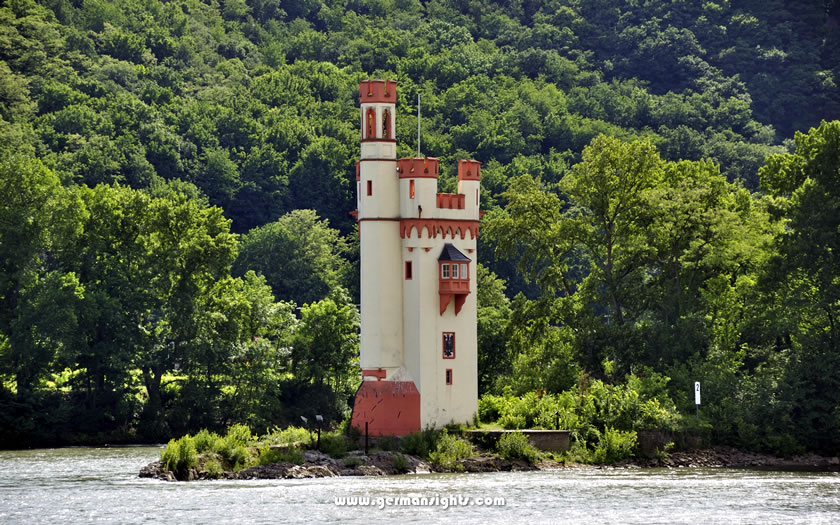
The Mouse Tower at Bingen
The legend attached to it is grim. The story goes that Archbishop Hatto I of Mainz refused to share grain with starving peasants during a famine, locking them in a barn and setting it on fire. He was subsequently devoured by a plague of mice as divine retribution. It is said that the Mouse Tower is where he fled and where the mice caught up with him.
The tower's actual purpose was likely as a toll station and signal post for river traffic through the Binger Loch. It passed into Prussian control in the 19th century and was restored in the 1850s.
Bingen's main sights are compact enough to cover on foot in a day, but the river, the wine culture, and the surrounding landscape justify a longer stay.
Burg Klopp is located on a hill directly above the town centre, offering clear views of both the Nahe and the Rhine. The castle, as it stands today, largely dates from the 19th century. The hilltop is now home to a hotel, as well as the local history museum. The climb from the town centre only takes a few minutes.
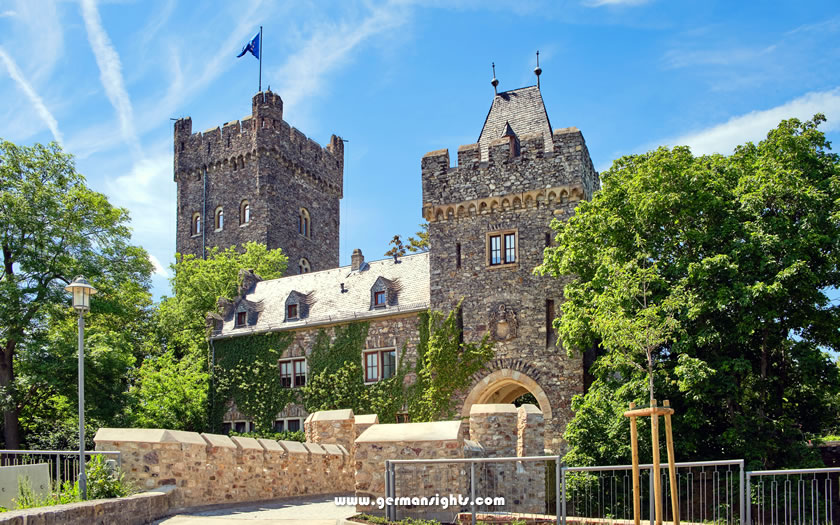
Klopp castle above Bingen am Rhein
The castle terrace offers the clearest view of Bingen and its surroundings. Looking down, visitors can see the Mouse Tower on its island, the confluence of the Nahe and the vineyards climbing the slopes on both banks.
The Mäuseturm is located on a small, rocky island in the middle of the Rhine, a short distance downstream from the confluence. Although you cannot enter the tower, it looks impressive from the riverside or from a passing boat. The structure dates back to the medieval period, although it was rebuilt in the 1850s during the Prussian era.
Its purpose was probably practical rather than punitive. The nearby dangerous rocky shoal, the Binger Loch, required skilled navigation, and the tower served as a signal and toll point.
The dark legend surrounding Archbishop Hatto I adds an element of medieval drama to the tower that has ensured its place in travel writing for centuries.
The riverside promenade, known as the Kulturufer in its cultural section, was substantially redesigned and landscaped for the 2008 State Garden Show. Running along the Rhine bank through the town, it provides a clean, open walking space with direct views of the Rheingau slopes on the Hesse side.
The Kulturufer hosts outdoor events in the summer, including the Bingen Swingt jazz festival and the Winzerfest wine festival.
The Hildegard Museum, located on the riverbank, is Bingen's main indoor attraction. It covers Hildegard's life, writings and music, as well as the broader cultural history of the Rhine Gorge. It is well worth a visit, even if you know little about Hildegard.
The St. Rochus Chapel is located on the Rochusberg, overlooking the town. The current structure dates from the 19th century and was built after an earlier chapel was destroyed during the French Revolution. The walk up through the vineyards is pleasant, and the view at the top makes the climb worthwhile.
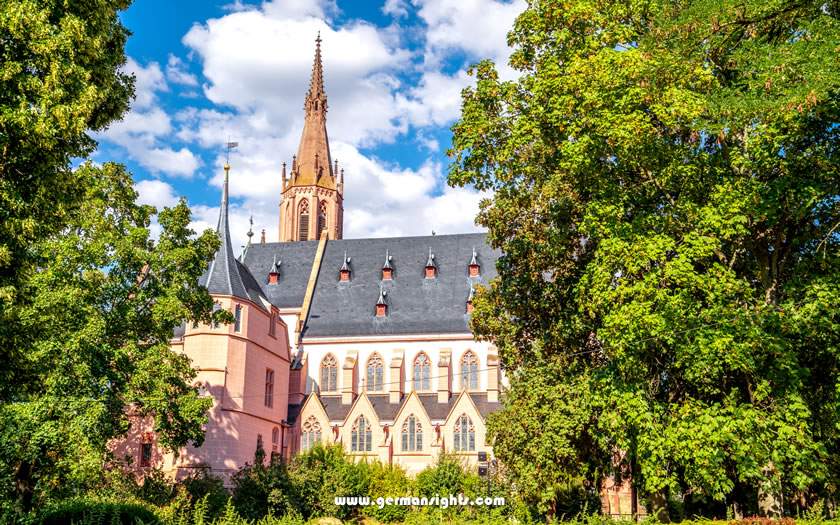
St. Rochus chapel above Bingen am Rhein
The passenger ferry to Rüdesheim departs frequently from the riverside in Bingen during the main season. The crossing takes around five minutes.
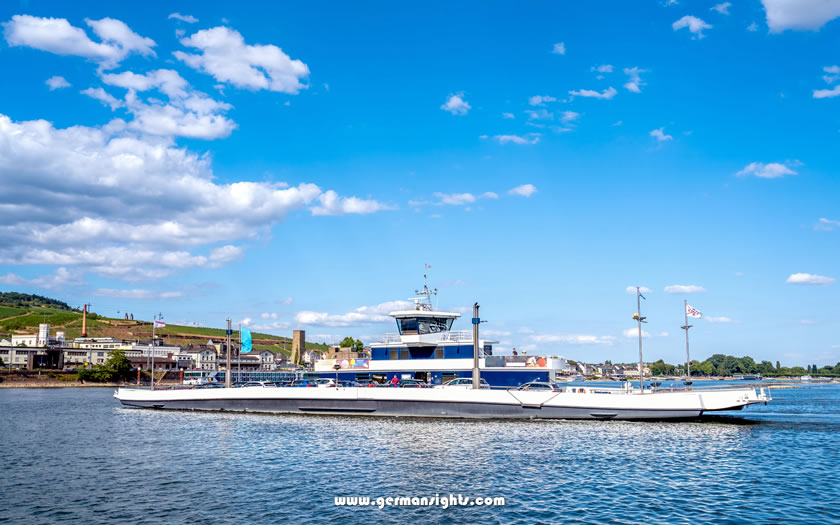
The ferry across the Rhine between Bingen and Rüdesheim
Rüdesheim is well worth a visit for the Niederwalddenkmal monument above the town, the cable car that takes you there, and the Rheingau wine culture. Its centre is considerably more tourist-focused than Bingen's.
Scheduled Rhine cruise boats also depart from Bingen, travelling north through the gorge. The stretch between Bingen and Koblenz has the greatest number of riverside castles in the world and forms the heart of the UNESCO World Heritage Site, the Middle Rhine Valley.
Taking the train back along the west bank is a practical way to finish the journey without retracing your steps.
Bingen is within easy reach of two wine regions, and local producers hold tastings throughout the summer and autumn. The vineyards on the Rochusberg and the slopes to the south of the town produce white wines, primarily Riesling and Müller-Thurgau varieties.
The Winzerfest, held in late summer, is the most significant local wine event, attracting producers from across the region. It takes place near the river and combines wine sales with live music and food.
The tourist information office in Bingen am Rhein is located a short walk from the Bingen Stadt train station on Rheinkai. It is open Monday-Friday all year round and on Saturdays (with slightly reduced opening hours) in the summer months.
Tourist Office: www.dein-bingen.de