
Cologne is located on the banks of the Rhine in western Germany and is home just over a million people. Despite being the country's fourth-largest city, it doesn't feel like it.
Life here moves at a slower pace than in Frankfurt or Munich. Locals call this attitude 'rheinische Frohsinn' - a kind of Rhine cheerfulness that is evident in beer halls, carnival celebrations and the way strangers strike up conversations at bar counters.
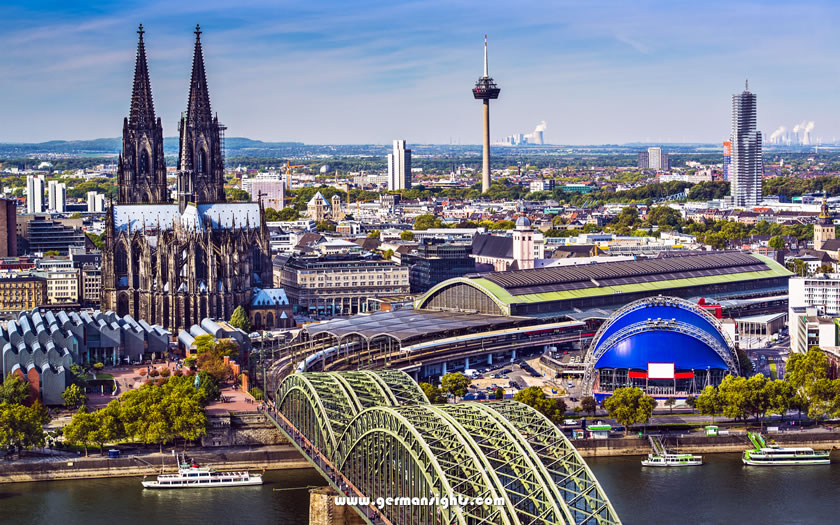
View over the centre of Cologne
The city was rebuilt after roughly 90% of its centre was destroyed in World War II. What emerged was a modern, practical city built around medieval foundations. The cathedral survived the bombing and still dominates the skyline. Surrounding it are Roman ruins, Romanesque churches and post-war architecture ranging from the functional to the brutal.
Cologne attracts visitors for two main reasons: its Gothic cathedral and its week-long Carnival in February. Both events attract large crowds that can overwhelm the compact old town.
However, the city has more to offer than just these headline attractions. The culture of Kölsch beer runs deep here - small breweries serve their own pale ale in slim 200ml glasses, and servers replace your empty glass without asking.
The city is ideal for independent travellers. Most of the sights are within walking distance of the cathedral. The public transport system efficiently connects to neighbourhoods beyond the centre.
Cologne's main train station (Hauptbahnhof) provides direct links to Brussels, Amsterdam, Paris and Berlin, as well as dozens of other German cities. Day trips to Bonn, Düsseldorf, Aachen and the Rhine Valley take less than an hour by regional train.
Cologne is located in North Rhine-Westphalia, which is Germany's biggest state in terms of population. The city is located on the banks of the Rhine River, approximately 550 kilometres west of Berlin and 180 kilometres north of Frankfurt. The Belgian border is 80 kilometres to the west and the Dutch border is 75 kilometres to the northwest.
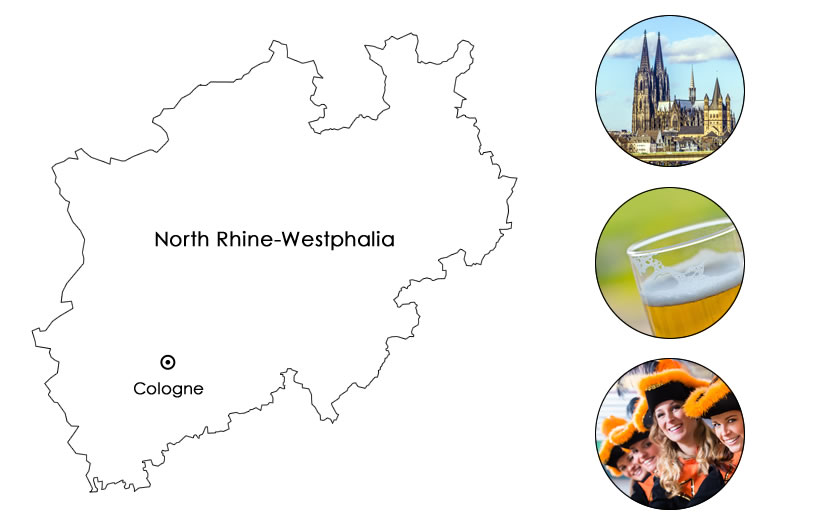
Where is Cologne?
The Rhine river splits Cologne into two unequal parts. The old town, cathedral and most tourist infrastructure are located on the left bank (west side). The right bank was developed later and is home to residential neighbourhoods such as Deutz and Mülheim. Seven bridges connect the two sides, carrying road, rail and pedestrian traffic.
The river itself remains a working waterway. Cargo barges carrying goods between Rotterdam and Basel pass through Cologne every day.
Thanks to its location, Cologne has been a trading hub for 2,000 years. Roman merchants used it as a crossing point for the Rhine. Medieval traders transported goods between northern and southern Europe via its markets.
Today, its central location makes the city a perfect base for exploring western Germany, the Rhineland wine regions and neighbouring countries.
Cologne Bonn Airport (CGN) is the city's main airport and is located 15 kilometres southeast of the city centre. The S13 S-Bahn line connects the airport terminal directly to Cologne's main station in around 15 minutes. Trains run every 20 minutes throughout the day. The airport handles flights from across Europe, with strong connections to London, Mediterranean destinations and Eastern European cities.
Düsseldorf Airport (DUS) is located 45 kilometres north and provides access to a wider range of international destinations, including long-haul flights to North America and Asia. Regional trains (RE and S-Bahn) run directly from Düsseldorf Airport to Cologne Hauptbahnhof in around 45 minutes. Trains depart every 20–30 minutes during peak hours.
Frankfurt Airport (FRA) is Germany's largest airport and often offers the best international flight options, particularly from North America, Asia and the Middle East. Despite being 170 kilometres away, high-speed ICE trains connect the airport's long-distance train station directly to Cologne in under an hour. Trains run every 30–60 minutes. International travellers may find flying into Frankfurt and taking the train is faster and easier than connecting through smaller airports.
Köln Hauptbahnhof is right next to the cathedral, so you can see the twin spires as you exit the platforms. It serves as a crucial hub on the European rail network, connecting Cologne to other major European cities with high-speed rail links.
High-speed connections include:
Cologne is an ideal base for day trips thanks to the regional trains that connect it to dozens of cities across western Germany. The station can feel overwhelming during peak hours, with crowds funnelling through the cathedral-side exit and the platforms filling up. Allow extra time if you're changing trains.
The major autobahns A1 (from the north), A3 (from the south and east) and A4 (from the west) converge on Cologne. Traffic around the city is heavy, particularly during rush hour and on Friday afternoons, when the routes are clogged with weekend travellers.
The city centre operates a strict environmental zone (Umweltzone). Access is restricted to vehicles displaying a green environmental badge. Foreign vehicles must purchase this badge in advance to avoid fines. Parking spaces near tourist areas fill quickly.
Park & Ride facilities offer a better option. There are several P+R car parks on the edge of the city near U-Bahn and S-Bahn stations. Major P+R locations include Weiden West, Chorweiler and Porz Markt. This approach saves money, avoids emission zone complications and eliminates the stress of navigating Cologne's congested streets and confusing one-way systems.
Thanks to Cologne's compact city centre, most visitors stay within walking distance of the cathedral. The Altstadt (Old Town) is the area closest to the major sights, but it is also the most expensive and crowded.
The Belgisches Viertel (Belgian Quarter), a 15-minute walk southwest of the cathedral, offers a more local feel, with independent shops, cafés and restaurants.
Across the river, Deutz offers cheaper accommodation with direct views of the cathedral and Old Town - you're just one bridge away from the action.
Ehrenfeld, to the west of the centre, attracts a younger crowd with its alternative bars, street art and nightlife, although it is further from the main sights.
If you know when you are planning to go but haven't decided on accommodation, then use the map below to get an idea of which properties are available and to compare prices during the period you wish to travel.
Enter your proposed dates and use the '+' to zoom in on a location and reveal more properties. Click on the price above a property to see more information.
(Please note that this selection will also include some guesthouses, pensions and self-catering apartments for those who are interested in that form of accommodation!)
Cologne began as Colonia Claudia Ara Agrippinensium in 50 AD, named after Agrippina the Younger, who was born in the Roman settlement and later became empress.
The Romans selected this location on the Rhine for its strategic value; it controlled trade routes and defended the northern frontier of the empire. The settlement grew wealthy from commerce and the military presence during its time as the capital of the province of Germania Inferior.
The Roman walls enclosed an area of about 97 hectares, making it one of the largest cities north of the Alps. A garrison of 10,000 soldiers was stationed here, which brought money, demand for goods, and construction projects.
The Romans built temples, bathhouses, an amphitheater, and a harbor on the Rhine. Today, when you walk through Cologne, you're often walking on Roman foundations.
The ruins of the Praetorium sit beneath the town hall. Sections of the Roman wall remain near the cathedral. The Romano-Germanic Museum displays mosaics that were found during construction and remain in their original positions.
Medieval Cologne was one of the largest and richest cities in Europe, rivaling Paris and Constantinople in population. About 40,000 people lived within its walls by the 14th century.
Things had begun to change in 1164 when Archbishop Rainald von Dassel brought the relics of the Three Kings from Milan. The bones, which were said to belong to the Magi who visited the infant Jesus, transformed Cologne into one of the major destinations for Christian pilgrimages.
The existing cathedral could not handle the crowds, so construction began on a new Gothic cathedral designed to be the largest in Northern Europe.
The project took 632 years. Work stopped in 1473 when funding ran out. The cathedral was left half-finished, with a wooden crane sitting atop the south tower. The crane remained a city landmark for four centuries. Construction only resumed in the 1840s and the cathedral was finally completed in 1880.
Medieval Cologne became a centre of Catholic learning, and the Romanesque churches visitors see today, such as St Gereon, St Maria im Kapitol and Groß St Martin, date from this golden age.
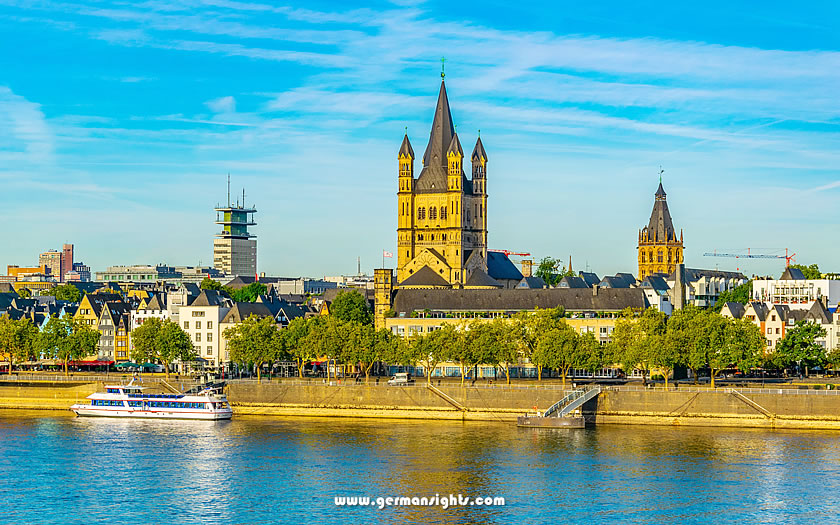
Groß St Martin church in Cologne
French Revolutionary armies occupied Cologne in 1794, bringing to an end over 450 years of rule by prince-archbishops. The French secularised the city, dissolved the monasteries and introduced their own administrative system.
They also introduced house numbering. An Italian perfumer named Giovanni Maria Farina had been producing a light, citrus-based fragrance in Cologne since 1709. When the French mandated street numbers, his shop was given the number 4711 on Glockengasse. The perfume became known as Eau de Cologne 4711, and this name has endured even after the French left.
The Congress of Vienna awarded Cologne to Prussia in 1815. The Prussians viewed the Rhineland as a vital defensive position and invested heavily in infrastructure. They completed the cathedral as a symbol of German unity and Catholic-Protestant cooperation.
Railways arrived in the 1840s, connecting Cologne to the growing industrial regions of the Ruhr area and the Belgian ports. The city's population exploded, growing from 50,000 in 1815 to 372,000 by 1900.
World War II nearly wiped Cologne off the map. On the night of 30–31 May 1942, the RAF launched Operation Millennium — the first 'thousand-bomber raid' in history. Over 1,000 aircraft dropped incendiary bombs on the city centre, creating a firestorm that killed 500 people and left 45,000 homeless.
This was just the beginning. By the end of the war, Cologne had endured 262 air raids. Allied bombers destroyed roughly 90% of the inner city. Of the 768,000 residents before the war, only 40,000 remained when American troops arrived in March 1945.
The cathedral survived, despite taking 70 direct hits. Its Gothic stone construction proved to be more resilient than that of the surrounding buildings. Photographs taken in 1945 show the twin spires rising above a landscape of rubble, the cathedral being the only major structure still standing.
Post-war reconstruction took decades.
The city has rebuilt its economy around media and culture. WDR (Westdeutscher Rundfunk), one of Germany's largest broadcasters, established its headquarters in Cologne. Publishing houses, advertising agencies and, later, internet companies followed suit.
Today, Cologne is Germany's fourth-largest city, with a population of 1.1 million. The city hosts major trade fairs and the university has over 50,000 students.
The cathedral dominates the landscape. Its twin spires rise to a height of 157 metres, making it the tallest church in Germany and the second-tallest structure in Cologne (after a radio tower). Construction began in 1248 and was completed in 1880, resulting in a Gothic masterpiece that attracts six million visitors every year.
The exterior is impressive in its sheer scale and attention to detail, with thousands of carved figures adorning the façade. The Shrine of the Three Kings, a golden reliquary holding the bones that made medieval Cologne a pilgrimage destination, sits behind the high altar inside. The stained glass windows span eight centuries, from medieval originals to a controversial 2007 abstract window.
Climbing the 533 steps to the viewing platform of the south tower requires stamina, but the effort is rewarded with stunning views of the Rhine and the city.
Cologne's Altstadt stretches along the west bank of the Rhine, with a mixture of reconstructed medieval buildings and modern structures filling the gaps left by wartime bombing.
While the colourful, narrow houses you see today are not original - most date from the 1950s and '60s - they recreate the old town's character using surviving photographs and plans.
The Fischmarkt and Alter Markt form the social heart of the old town. Traditional Brauhäuser (brewhouses) line these squares, serving Kölsch beer in the traditional 200 ml glasses.
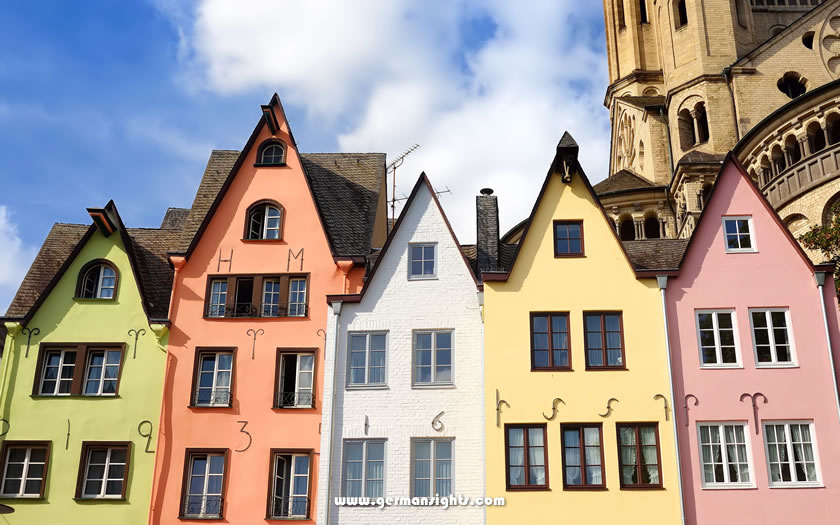
Houses in the historic Fish Market area of Cologne
The Rhine promenade runs for several kilometres along the riverbank. Locals gather on the stepped embankments on warm days and evenings to drink, talk and watch the river traffic.
The Hohenzollern Bridge carries trains and pedestrians across the Rhine, passing the cathedral on the way. It takes about ten minutes to walk across. The view of the cathedral and old town improves with every step.
The Köln Triangle tower on the east bank offers the best panoramic view of Cologne from its 100-metre-high observation deck. The glass-walled platform provides 360-degree views. Visit at sunset to see the cathedral's lights switch on and the city lights begin to glow.
The Romano-Germanic Museum, built around the Dionysus Mosaic discovered during construction work in 1941, stands directly beside the cathedral. This mosaic can be seen in its original Roman position in the basement of the museum. The upstairs collection covers Cologne's Roman period through artefacts, glassware, jewellery, and funerary monuments.
The Chocolate Museum occupies a modern building jutting into the Rhine, to the south of the old town. The exhibits trace chocolate's history from Aztec ceremonies to modern production. The museum attracts families and tour groups, so visit early or late to avoid the worst of the crowds.
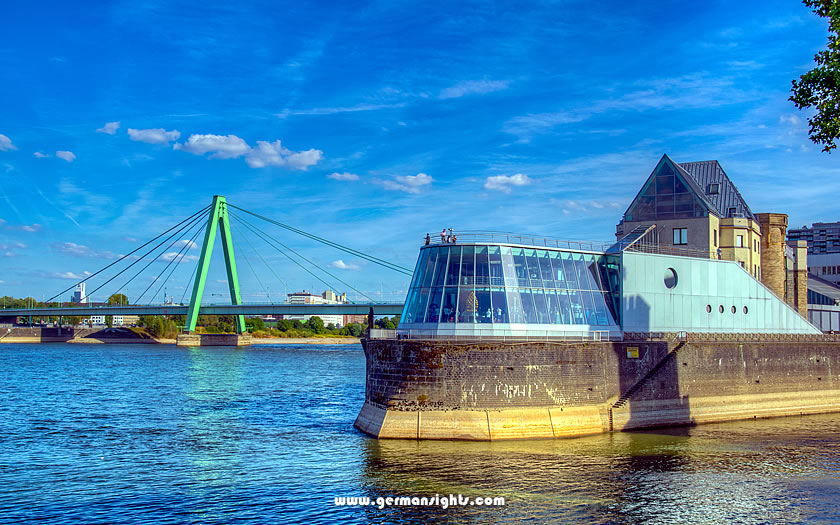
The popular Cologne Chocolate Museum on the Rhine
The Museum Ludwig houses one of Europe's finest modern art collections, with particular strengths in Pop Art, Expressionism and contemporary photography. Works by Warhol, Lichtenstein and Picasso feature prominently. The museum is located next to the cathedral, but often goes unnoticed by tourists who head straight to the Dom.
The Farina Fragrance Museum occupies the building where Giovanni Maria Farina first created Eau de Cologne in 1709. His original formula revolutionised perfumery by providing an alternative to the heavy musk scents that were popular at the time. Napoleon reportedly used 60 bottles per month.
The museum displays historical bottles and distillation equipment, as well as documents tracing the history of the fragrance. Guided tours explain the production process and allow visitors to sample various scents.
Cologne comes alive in late November when its Christmas markets open. The city hosts seven major markets, each with its own unique character. The market in front of the cathedral is one of the largest in Germany, with over 160 stalls selling decorations, food and mulled wine beneath the illuminated spires.
👉 Discover more information about Cologne's Christmas markets.
Cologne is an ideal base for exploring western Germany and neighbouring regions. Regional trains can reach dozens of destinations within an hour.
Bonn, Germany's former capital, is located just 30 minutes south. Beethoven's birthplace, its museums and the Rhine promenade make it worth a half-day visit.
Aachen, 50 minutes west, is home to Charlemagne's cathedral and a historic city centre near the Belgian and Dutch borders.
Düsseldorf, 40 minutes north, offers upscale shopping, a vibrant old town and modern architecture along the harbour.
The Rhine Valley begins south of Bonn, where the river winds its way through steep, vineyard-covered hillsides. Medieval castles crown the hilltops and wine villages line the riverbanks. Day trips can reach Koblenz, the Lorelei rock and the wine towns of Rüdesheim and Bacharach.
👉 Read our complete guide to day trips from Cologne for itineraries, train connections, and what to see in each destination.
Cologne takes Carnival very seriously. Locals call it the 'fifth season', and for six days in February or March, the city is transformed into one big street party, attracting over a million visitors.
The Carnival season officially begins on 11 November at 11.11, when the Carnival Prince and his court are announced. However, the real action happens during the six days leading up to Ash Wednesday.
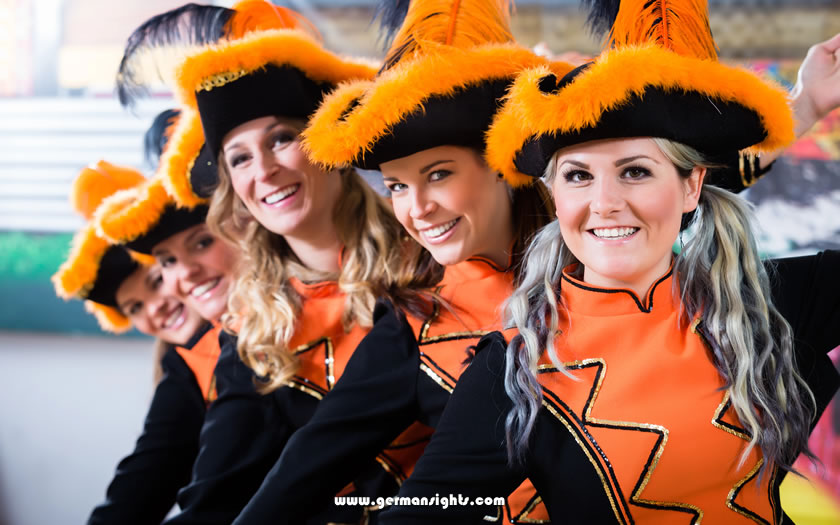
Traditional Carnival dance costumes
Weiberfastnacht marks the start of the street festivities. Women traditionally storm the town hall at 11.11 and symbolically take control of the city. They also cut off men's ties with scissors! The Old Town fills with costumed revellers drinking Kölsch and singing Carnival songs. Bars stay open all night, and the party doesn't stop until dawn.
The main event takes place on Rosenmontag (Rose Monday), when a huge parade winds through the city centre for four hours. Elaborate floats satirise politicians and current events, while marching bands play traditional Carnival music and costumed groups throw sweets, flowers and small bottles of Eau de Cologne to the crowds.
Experiencing the Cologne Carnival offers a unique insight into German culture at its most uninhibited. However, it requires careful planning and realistic expectations.
Hotels tend to be fully booked six to twelve months in advance for the main Carnival days. Prices can be triple or quadruple the normal rate. Once October arrives, it becomes increasingly difficult to find accommodation within 30 kilometres of the city centre at reasonable prices.
The city effectively shuts down during the peak days. Museums close, restaurants operate reduced opening hours or close entirely, and public transport runs on a modified schedule (though it is still very busy). Visitors in Cologne primarily to sightsee should avoid Carnival week entirely.
A costume is expected if you plan to join the street festivities. You don't need an elaborate outfit, but wearing normal clothes will make you stand out as a tourist. Simple costumes are fine - many locals just wear wigs or hats, or dress up with friends in matching outfits.
Safety generally remains good, despite the large crowds and alcohol consumption. Pickpockets work the crowds, so keep your valuables secure. The bigger challenge is simply navigating the crowded streets and finding a toilet. Public facilities quickly become overwhelmed.
The weather in February can be brutal, with cold rain, wind and temperatures hovering around freezing. Parade spectators have to stand outside for hours. Make sure you dress warmly and wear waterproof clothing, even if it ruins the look of your costume.
The Cologne tourist office is located near the cathedral at Kardinal-Höffner-Platz 1. It can be extremely busy in high season. It is closed on Sundays and public holidays and has slightly shorter opening hours on Saturdays.
Website: www.cologne-tourism.com