
Perched on the edge of the Harz Mountains, Goslar is a living museum that has never ceased to be a functioning town. Its medieval centre survived World War II intact, leaving behind more than 1,500 half-timbered houses on narrow, cobbled streets.
UNESCO recognised this in 1992 by designating the town a World Heritage Site, but this hasn't turned Goslar into a theme park. People still live in these ancient buildings, shop in the ground-floor stores, and go about their daily lives, while tourists photograph the same walls that their ancestors built.
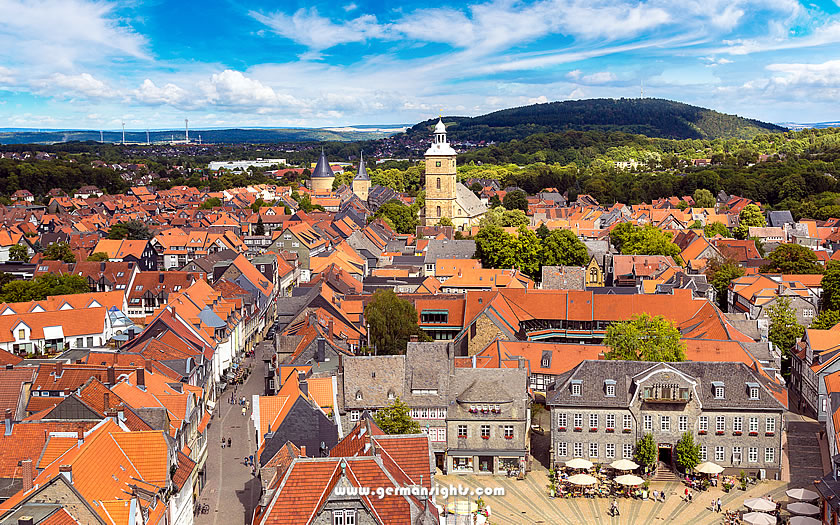
View over Goslar in the Harz region
The town is ideal for travellers who want a concentrated dose of history away from the crowds of Rothenburg or Heidelberg.
Although the old town can be walked in twenty minutes, you'll want several days to properly explore the museums, churches, and surrounding mountain trails. The town is just the right size. You won't spend hours navigating public transport or fighting through tour groups at every attraction.
Goslar is also an ideal base for exploring the Harz region. A narrow-gauge steam railway departs from nearby towns and climbs through forests to reach the summit of Brocken Mountain. Hiking trails also lead directly from the edge of the town into the mountains.
Goslar is located on the northern edge of the Harz Mountains in Lower Saxony, around 90 kilometres south of Hanover and 45 kilometres south of Brunswick. The town marks the point where the flat North German Plain begins to rise into the forested highlands.
Goslar is the main gateway to the northern Harz, while towns such as Wernigerode and Quedlinburg offer access from the east. The mountains once formed the border between East and West Germany, meaning the eastern Harz towns were less developed for tourism until reunification in 1990.
Goslar doesn't fit neatly into the standard tourist circuits connecting Frankfurt, Munich and Berlin, which partly explains why it receives fewer international visitors than its UNESCO status might suggest.
Reaching Goslar is straightforward thanks to its central location in northern Germany. While not directly served by major airports or high-speed rail lines, the town connects well to nearby transport hubs, making it accessible by train, car, or regional buses.
The closest airport is Hanover Airport (HAJ), which is located about 90 kilometres north of Goslar. Hanover offers flights to and from various European cities, as well as some intercontinental destinations. Regional train services connect Hannover Airport to Goslar. This journey requires a change at Hanover's central station (Hauptbahnhof) or Hildesheim and takes around 2 hours and 30 minutes in total.
Travellers arriving from more distant international airports, such as Hamburg, Frankfurt or Berlin, will need to take long-distance trains before switching to regional services for the final leg to Goslar.
Distance to Hannover Airport: 105km
Distance to Hamburg Airport: 258km
Distance to Berlin-Brandenburg Airport: 276km
Distance to Frankfurt Airport: 302km
Goslar train station is located about a kilometre north of the town centre and is within easy walking distance.
It is part of Germany’s regional rail network and is well-connected to major hubs like Hanover, Brunswick (Braunschweig) and Göttingen. Travel times are around 90 minutes from Hanover, 50 minutes from Brunswick and just over an hour from Göttingen.
If you’re arriving from elsewhere in Germany, such as Berlin or Frankfurt, you’ll first need to take an InterCity Express (ICE) or InterCity (IC) train to a nearby hub; common transfer points are Brunswick and Göttingen.
Another practical option is to drive to Goslar, especially if you are planning to explore the surrounding Harz region more extensively.
The town is located near major motorways, including the north-south running A7 autobahn through central Germany. From Hanover, take the A7 south, then switch to the B6 expressway, which leads directly to Goslar. This journey takes around 1 hour and 15 minutes. From Brunswick, the A36 and B82 provide a similarly straightforward route with a driving time of around 40 minutes.
There is parking available in and around the old town, with several paid car parks and garages conveniently located near key attractions.
If you know when you are planning to go but haven't decided on accommodation, then use the map below to get an idea of which properties are available and to compare prices during the period you wish to travel.
Enter your proposed dates and use the '+' to zoom in on a location and reveal more properties. Click on the price above a property to see more information.
(Please note that this selection will also include some guesthouses, pensions and self-catering apartments for those who are interested in that form of accommodation!)
Goslar's story begins with silver. The discovery of rich ore deposits in the Rammelsberg Mountain in the 10th century transformed the area from a small village into one of the most important towns in medieval Germany.
Recognising the strategic and economic value of these mines, Emperor Otto I established an imperial palace here around 1005. His successor, Henry II, expanded the palace complex, establishing Goslar as a favoured residence for Holy Roman Emperors.
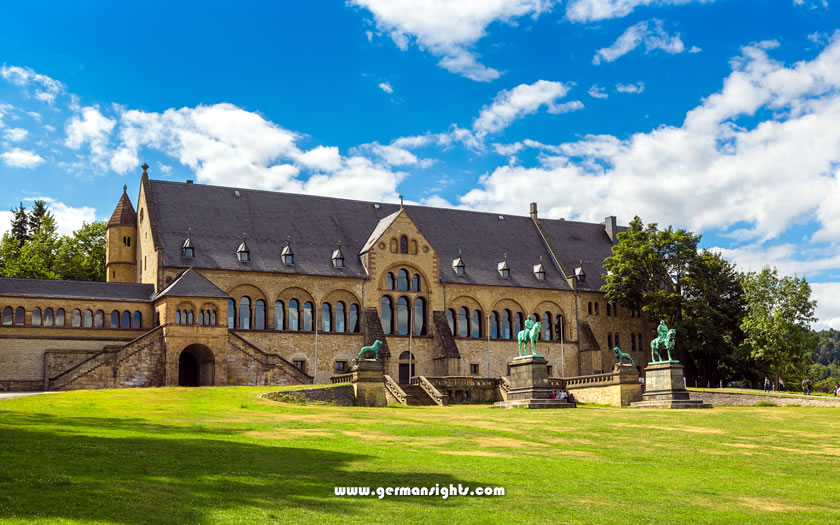
The Imperial Palace in Goslar
The combination of mineral wealth and imperial patronage laid the foundations for the town's prosperity over the next several centuries.
Mining operations at Rammelsberg proved to be highly productive. Miners extracted silver, copper, lead and zinc from the mountain's complex ore bodies.
These metals fuelled trade across medieval Europe and filled the imperial treasury. By the 12th century, Goslar had become one of the wealthiest towns in the empire. Emperors regularly held court here, and the Imperial Diet convened in Goslar multiple times.
Many churches and civic buildings were constructed during this period, and they still define the town's character today. The Romanesque architecture of this period reflects the town's wealth and political importance.
Goslar's relationship with imperial authority changed during the 13th century. As the power of individual emperors waned and regional princes grew in influence, towns such as Goslar sought greater autonomy.
In 1290, Goslar became a Free Imperial City, answering directly to the Emperor instead of regional nobles. This status granted the city significant self-governance and trading privileges. The town's guilds grew in power, and merchant families amassed considerable wealth.
The 16th century brought religious upheaval and economic challenges. In 1528, Goslar adopted Lutheranism, aligning itself with the Protestant Reformation that was sweeping through northern Germany.
This decision placed the town in opposition to Catholic emperors and neighbouring territories, resulting in periodic conflicts. Meanwhile, technical difficulties emerged in the Rammelsberg mines as the shafts deepened and water infiltration became harder to manage. Production declined, as did Goslar's economic prominence.
The Thirty Years' War (1618–1648) devastated much of Central Europe, and Goslar experienced significant population loss and economic disruption during this period.
Goslar lost its status as a Free Imperial City in 1802, when Napoleon reorganised the German territories and transferred the town to Prussia. This marked the end of its centuries-long independence.
The 19th century saw the introduction of industrialisation to mining operations, with new technologies enabling deeper extraction and more efficient ore processing.
However, Goslar never regained its medieval importance. Instead, it became a regional administrative centre and market town, with the mines supplementing but no longer dominating its economy.
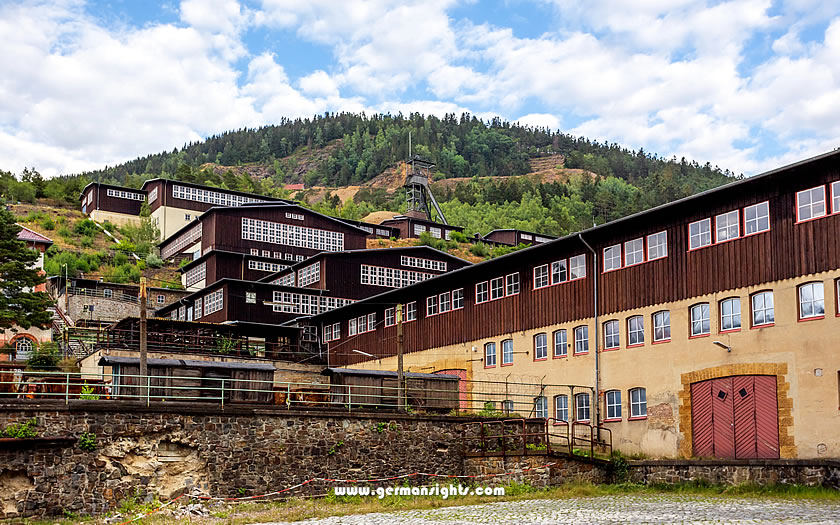
Part of the UNESCO World Heritage site at Rammelsberg mine near Goslar
Although the town escaped major damage during World War I, it suffered economically during the hyperinflation and depression that followed in its wake. World War II had a more direct impact. Although some areas were damaged by Allied bombing, the historic old town survived largely intact, preserving its medieval architecture.
After 1945, Goslar found itself in West Germany, just 20 kilometres from the new border with East Germany. This proximity to the Iron Curtain hindered economic development as traditional trade routes to the east were cut off.
The Rammelsberg mine was in operation until 1988, making it one of the world's longest-running mining sites, with over 1,000 years of continuous extraction. While its closure marked the end of an era, it also opened up new possibilities.
In 1992, both the Goslar old town and the Rammelsberg mine were designated as UNESCO World Heritage Sites in recognition of their historical significance and exceptional state of preservation. This status attracted tourism investment and renewed attention to the town's architectural heritage.
Goslar's charm lies in its ability to transport visitors back in time while offering a variety of experiences. Its UNESCO-listed old town is an architectural marvel, a dense maze of medieval streets lined with half-timbered houses, slate-covered façades and elaborate stonework.
Begin your exploration at the Kaiserpfalz, the Imperial Palace. Commissioned by Emperor Henry III in the 11th century, this Romanesque structure once hosted emperors, high-ranking officials and political assemblies. The grand halls feature mural paintings depicting important moments from Goslar's imperial era.
The adjacent St Ulrich's Chapel, with its simple yet dignified interior, houses a brass reliquary containing the heart of Henry III, serving as a reminder of Goslar's close connection to imperial power.
Next, venture into the heart of the old town and explore the Marktplatz, the central square. Here, you will find the Market Fountain, an ornate, gilded monument topped with a golden imperial eagle, which symbolises the town’s historical allegiance to the Holy Roman Empire.
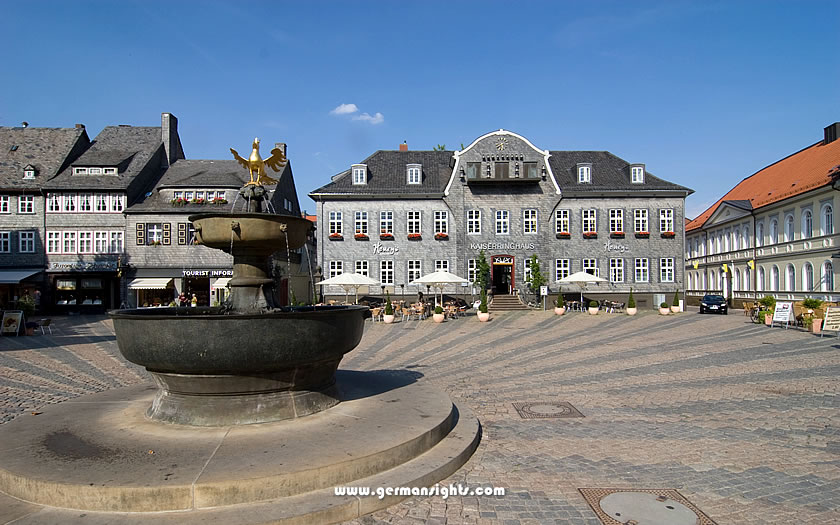
The Market Square and Fountain in Goslar
Nearby, the Marktkirche St. Cosmas und Damian towers over the square, its twin spires visible from most parts of the town. While the church's interior is austere, climb the clock tower for panoramic views of Goslar, the Rammelsberg mountain and the Harz countryside beyond.
One of Goslar’s most intriguing attractions is the Rammelsberg Mining Museum, which is located on the lower slopes of the mountain. The museum offers more than just a display of artefacts; it includes guided tours into the original mine shafts, allowing visitors to experience the centuries-old mining techniques that sustained Goslar’s wealth.
Goslar also rewards those who simply wander around. The town’s residential neighbourhoods boast intricate wood carvings, slate shingle patterns and tranquil courtyards, which are often overlooked on organised tours. Breite Straße, lined with grand merchant houses that highlight Goslar’s wealthy past, is well worth a visit. Similarly, Worthstraße offers a quieter stretch of homes with uniquely decorated doorways featuring coats of arms and inscriptions.
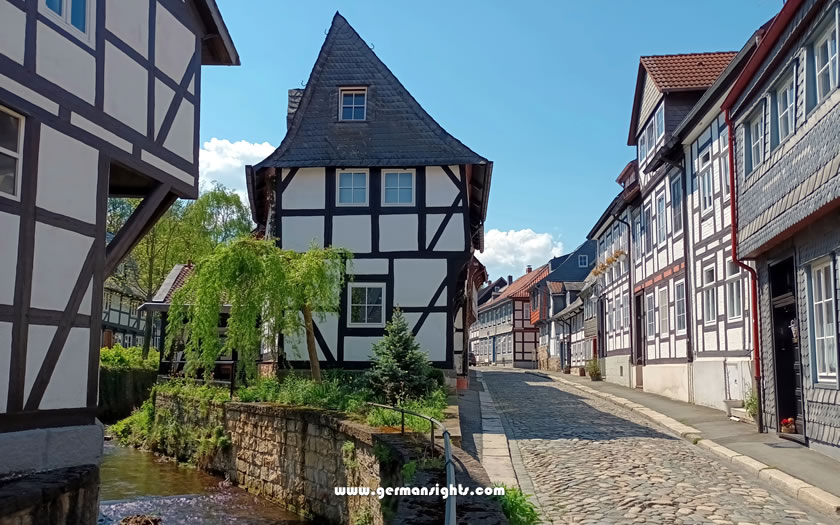
Historic houses in Goslar
Nature lovers and hikers will appreciate Goslar’s proximity to the Harz Mountains, a region of dense forests and rolling peaks. Trails leading into the woods start within walking distance of the town centre, providing an easy way to escape into a world of silence and greenery.
Seasonal highlights include the Goslar Christmas Market, widely regarded as one of the prettiest in northern Germany.
The Goslar tourist information office is situated on the main Market Square in the centre of the town. The tourist office is open seven days a week from April to October (and in December) and closed on Sundays in the quieter winter periods.
Website: www.meingoslar.de