
Braunschweig earned its nickname of 'Lion City' thanks to the bronze statue that has stood in its main square since 1166.
Duke "Henry the Lion" placed this monument there as a symbol of his power and jurisdiction, and it is the oldest free-standing monument north of the Alps. The lion remains the city's emblem to this day, appearing on everything from manhole covers to official documents.
English speakers may be more familiar with the city's anglicised name, Brunswick. The name likely derives from 'Bruno's settlement' or 'Brunonis wik', referring to the Saxon Count Bruno, who settled here in the 9th century.
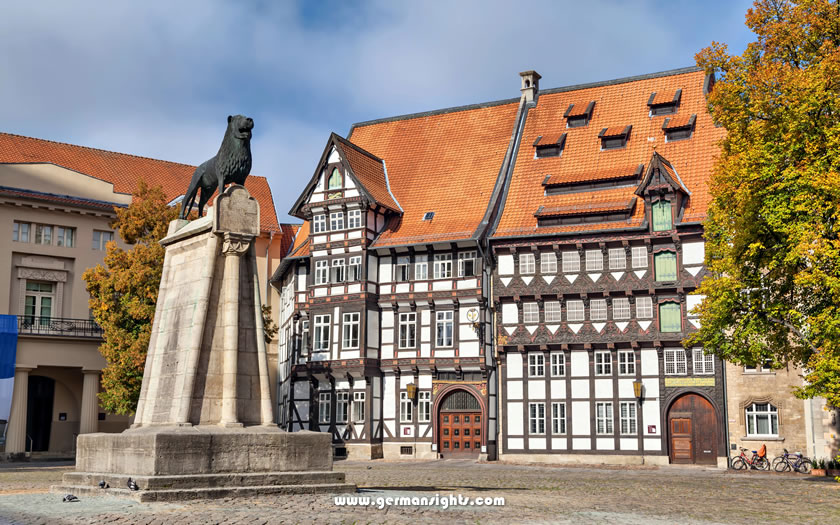
The Lion of Brunswick in Braunschweig
The city was hit hard during World War II. In October 1944, Allied bombing raids destroyed around 90 per cent of the medieval centre.
What you see today is the result of a deliberate reconstruction philosophy that began in the 1990s. City planners created what they call 'Traditionsinseln', or 'traditional islands'.
This approach gives Braunschweig a character that sets it apart from Germany's fully reconstructed old towns. The Oker River forms a horseshoe shape around the historic centre, creating a natural boundary that simplifies navigation. You can walk from one traditional island to another in minutes.
This compact layout is ideal for independent travellers who prefer to explore on foot. Most of the major sights are located within this river loop, with additional attractions just beyond the water.
Braunschweig attracts fewer international tourists than the nearby cities of Hanover and Goslar. This works in the visitor's favour, experiencing a working German city rather than a tourist destination.
Braunschweig is located in Lower Saxony, the north-western German state stretching from the North Sea coast to the Harz Mountains.
The city serves as a regional centre for an area that encompasses Wolfsburg to the north, Salzgitter to the south and Helmstedt near the former East German border to the east. While these industrial cities form part of Braunschweig's economic sphere, they offer little for tourists.
Braunschweig itself has a population of around 250,000, making it the second-largest city in Lower Saxony after Hanover.
Major German cities such as Hamburg and Berlin are within easy reach. This makes Braunschweig an ideal destination for day trips from these larger destinations or a convenient stopover point on longer itineraries through northern Germany.
Hannover Airport (HAJ) serves as the primary air gateway for Braunschweig. The airport handles flights from major European cities including London, Amsterdam, Paris, and Istanbul, and is connected to Hanover by the S-Bahn S5 line to the main train station.
Berlin Brandenburg Airport (BER) connects to destinations worldwide. The connection time to Braunschweig is probably quicker than the closer Hamburg Airport (HAM), which provides another alternative, particularly for flights from Scandinavia or the UK.
Bremen Airport is another option for those flying short-haul.
Hannover Airport (HAJ) - approx. 70 km
Bremen Airport (BRE) - approx. 165 km
Hamburg Airport (HAM) - approx. 175 km
Berlin Brandenburg Airport (BER) - approx. 230 km
The most practical way to reach Braunschweig from other German cities is by train. Braunschweig Hauptbahnhof, the main station, is located south-east of the historic centre and is about a 30-minute walk from the Altstadtmarkt. (Buses also leave frequently for the city centre.)
The station handles both high-speed ICE trains and regional services, offering multiple travel options for most journeys.
Braunschweig’s strategic location at the heart of Germany’s motorway network makes it an ideal destination for travellers by car.
The A2 autobahn, one of the busiest in Germany, runs directly to the north of the city, connecting Berlin and the Ruhr Area, including cities such as Dortmund and Essen.
The A39 provides direct access to southern Lower Saxony, including Wolfsburg and Salzgitter, and the Harz Mountains.
If you know when you are planning to go but haven't decided on accommodation, then use the map below to get an idea of which properties are available and to compare prices during the period you wish to travel.
Enter your proposed dates and use the '+' to zoom in on a location and reveal more properties. Click on the price above a property to see more information.
(Please note that this selection will also include some guesthouses, pensions and self-catering apartments for those who are interested in that form of accommodation!)
Human settlement in the area around Braunschweig dates back long before the city's formal establishment. Scattered farming communities were attracted to the flat, fertile land along the Oker River during Roman times.
The strategic location of the settlement at a ford across the river, which controlled north-south and east-west trade routes, attracted merchants and craftsmen. This growth turned the small trading post into a proper market town by the early 12th century.
Henry the Lion transformed Braunschweig from a regional market town into a major medieval power centre when he chose it as his residence around 1166. He had Dankwarderode Castle built as his palace and founded the Cathedral of St. Blasius as a burial place for himself and his wife.
The bronze lion statue in the Burgplatz became the city's defining emblem. Although Henry lost his power in 1180 and died in exile in 1195, Braunschweig continued to prosper thanks to the economic foundations he had established.
Braunschweig joined the Hanseatic League in the 13th century, which connected its merchants to markets stretching from London to Novgorod. This brought substantial wealth to the city through trade in cloth, beer and metalwork.
The city reached its medieval peak in the 14th and 15th centuries, when its population reached approximately 20,000, making it one of the largest cities in northern Germany. Impressive Gothic houses were built by wealthy merchant families, and churches expanded as parishes competed to demonstrate prosperity.
The Protestant Reformation reached Braunschweig relatively early, with the city council officially adopting Lutheran teachings in 1528. This made it one of the first major German cities to break with Rome.
Religious conflict soon followed, as the Catholic Duke of Braunschweig-Wolfenbüttel attempted to force the Protestant city to convert back to Catholicism.
The Thirty Years' War (1618–1648) brought regional devastation, though the strong fortifications of Braunschweig deterred direct assault. The surrounding countryside suffered from marauding armies and disrupted trade, and the plague spread through the region. Braunschweig was left economically weakened but still independent when the war ended.
During the 17th and 18th centuries, Braunschweig's relationship with the Protestant Dukes of Braunschweig-Wolfenbüttel evolved. Duke Anton Ulrich was an enlightened absolutist who founded the Herzog August Library and established an art collection that would become the Herzog Anton Ulrich Museum.
The Residenzschloss was designed as an urban residence for the dukes, but the palace's yellow façade and formal gardens became a focal point of city life.
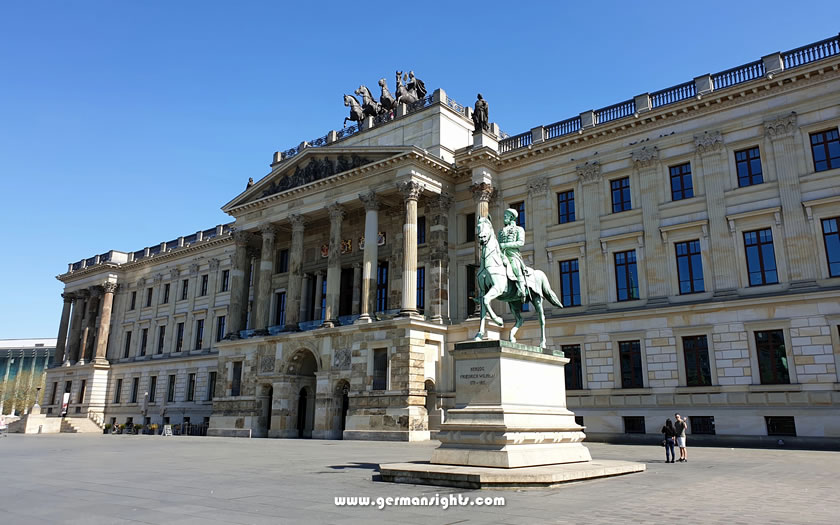
The rebuilt facade of Brunswick Palace
Napoleon's conquest brought dramatic changes to Braunschweig when French troops occupied the city in 1806. The city was then incorporated into the Kingdom of Westphalia, which was ruled by Napoleon's brother Jérôme.
The French introduced reforms to the legal system, including the adoption of the Code Napoléon, and loosened guild restrictions. They also partially demolished the city's fortifications.
Meanwhile, the Black Brunswickers, a volunteer corps led by Duke Frederick William, fought against Napoleon's forces. The duke became a romantic figure in local memory after his death at the Battle of Quatre Bras in 1815.
The Congress of Vienna in 1815 restored the Duchy of Braunschweig as an independent state within the German Confederation, reinstating the city as the duchy's capital. However, many French reforms remained in place, and the experience of occupation had changed political expectations. Citizens increasingly expected efficient administration and legal equality, setting the stage for 19th-century modernisation.
In the 19th century, Braunschweig transformed from a medieval trading city into an industrial centre. The arrival of the railway in 1838 was pivotal, connecting Braunschweig to Hamburg, Berlin, and the Ruhr industrial region.
The population of the city exploded from around 35,000 in 1840 to 150,000 by 1910, putting a strain on infrastructure and housing.
Braunschweig was badly affected by the Second World War. Allied bombing raids in 1944 destroyed around 90 per cent of the medieval city centre. Much of what visitors see today is the result of careful reconstruction, blending restored historic buildings with post-war architecture.
The rebuilding work was uneven. While some areas were faithfully restored, others were replaced with functional structures from the 1950s and 1960s that lack the character of the original buildings.
This history gives the city a layered feel. Walking through Braunschweig involves passing from a reconstructed medieval square to a modernist shopping street in the space of a few hundred metres.
The main attractions in Braunschweig are concentrated within the old town, making it easy to cover them on foot in a single day. The city is best explored at a steady pace rather than rushing from landmark to landmark.
Burgplatz is the perfect place to start. This central square is home to the Brunswick Lion statue, Dankwarderode Castle and the Cathedral of St. Blasius. The cathedral contains the tomb of Henry the Lion, as well as medieval wall paintings that are well worth a closer look.
The Altstadtmarkt is a short walk south. This old town market square features the Gothic Old Town Hall, which has an open arcade, and the Church of St Martin. Each Saturday morning, the square is filled with a weekly market selling regional produce, bread and flowers.
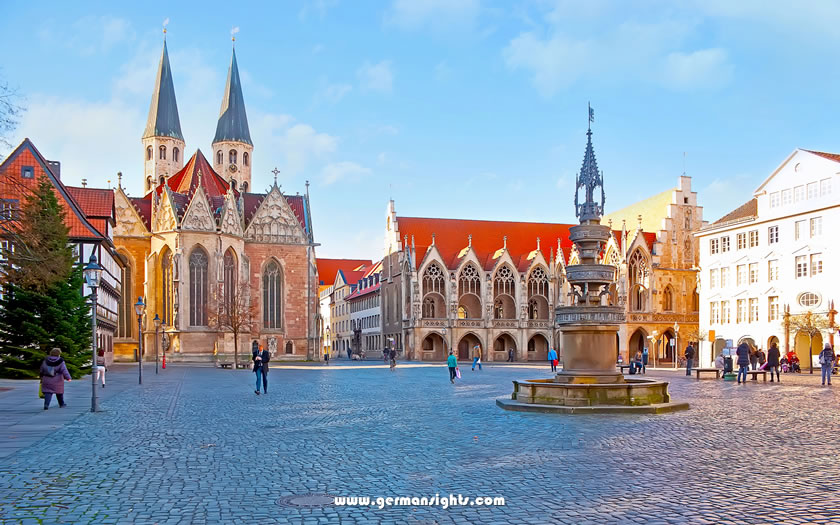
The Altstadtmarkt square in Braunschweig
The Herzog Anton Ulrich Museum houses one of Europe's oldest public art collections, featuring works by Rembrandt, Vermeer and Cranach. It offers a well-curated experience without the queues of larger German museums.
The Magniviertel is the city's best-preserved historic quarter. Its narrow streets are lined with half-timbered houses and lead to small cafés, bookshops and independent stores. The area offers a glimpse into what much of Braunschweig looked like before the war.
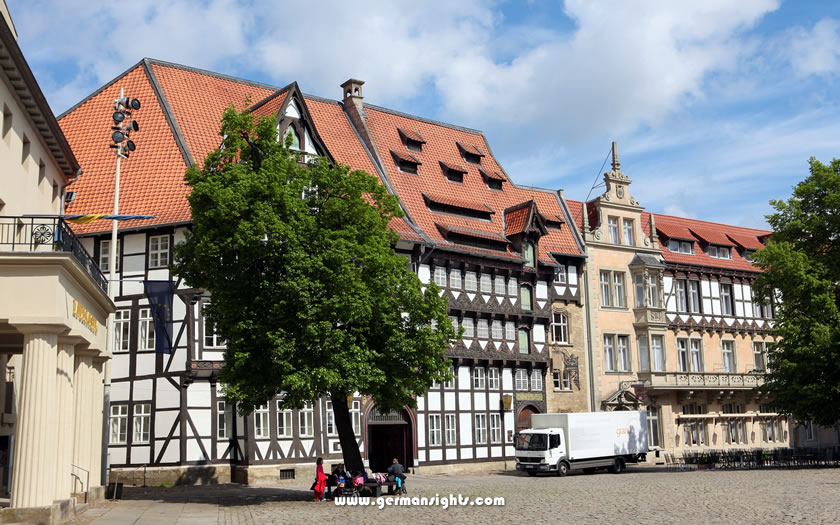
The Magniviertel in Braunschweig
The Oker River winds its way through Braunschweig in a series of channels and branches, forming a network of waterways that were historically used to power mills and facilitate trade. The city has recently developed the riverbanks into attractive promenades and parks, transforming formerly industrial or neglected areas into recreational spaces.
Walking or cycling alongside the river provides a different perspective on the city, revealing green corridors and tranquil spaces that contrast with the bustling commercial centre.
The Braunschweig tourist information office - with its own cafe - is located just a few steps away from Burgplatz. The tourist office is closed on Sundays and has shorter opening hours on the Saturdays.
Website: www.braunschweig.de