
Lüneburg is located 50 kilometres south of Hamburg. The town is often overlooked by international visitors - to their loss.
Lüneburg's wealth arose from its salt deposits, which it controlled for over 1,000 years. The town exploited these vast resources and supplied much of Northern Europe through the trading network of the Hanseatic League. This wealth resulted in the creation of one of Germany's most complete collections of Brick Gothic architecture.
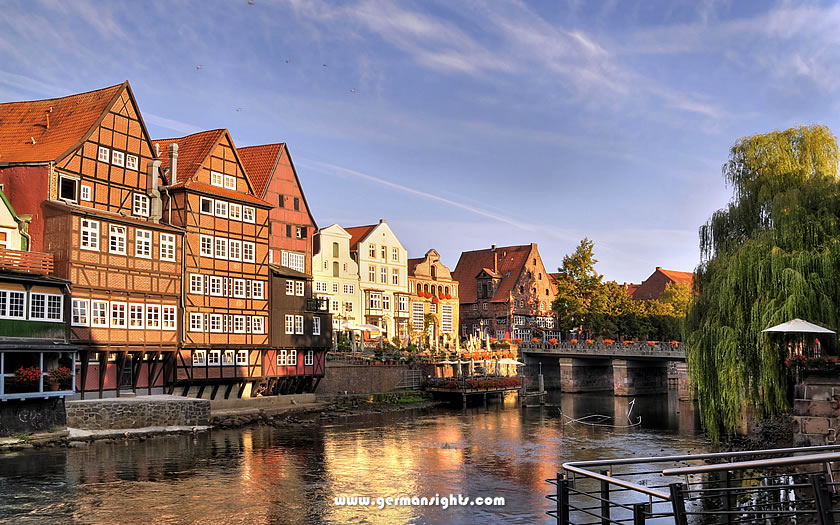
Historic buildings in Lüneburg
Walk through the centre today and you will see what medieval prosperity looked like. The merchants' houses lean at odd angles - the ground has shifted due to salt mining hollowing out the earth below. Church spires pierce the skyline. Gabled facades in deep red brick line the cobblestone squares.
But Lüneburg isn't stuck in the past. The energy from the thousands of students at Leuphana University is evident in the cafés, bars and restaurants that occupy historic buildings.
Many travellers use Hamburg as their base for exploring northern Germany. Lüneburg offers a different experience: it is more compact and architecturally interesting, and less focused on tourism. While you can see the main sights on a day trip from Hamburg, staying overnight lets you experience the town after the day-trippers leave.
The evening light on the brick buildings alone makes it worthwhile.
Lüneburg is located in the state of Lower Saxony, on the North German Plain, between the cities of Hamburg and Hanover. The town marks the northern edge of the Lüneburg Heath.
The Ilmenau River, which flows through the town, provided a transport route for shipping salt to the Baltic Sea via Lübeck. It was this geography that made the town wealthy.
The surrounding Lüneburg Heath is also worth a visit. If you happen to be there in late summer (August–September), you can see the heather blooming purple across the large nature reserve of heathland and forests. Several areas of the heath can be visited on day trips from the town.
Hamburg Airport (HAM) is the closest and largest international airport to Lüneburg and is only 60 km away from the town. Take the S-Bahn to Hamburg Hauptbahnhof, then a regional train to Lüneburg.
Other airports near Lüneburg:
Hannover Airport (HAJ) - approx. 113 km
Bremen Airport (BRE) - approx. 123 km
Direct regional trains connect Lüneburg to Hamburg every 30 minutes. The journey takes 30-35 minutes from Hamburg Hauptbahnhof. Trains also run regularly to Hanover and other regional centers. The train station is east of the old town - a 20-minute walk or short bus ride.
The A39 autobahn runs just to the east of Lüneburg, providing access to the A7 (Hamburg–Hanover route) and the A250 Hamburg ring road. Parking in the old town is limited and expensive. Use the park-and-ride facilities on the outskirts instead.
If you know when you are planning to go but haven't decided on accommodation, then use the map below to get an idea of which properties are available and to compare prices during the period you wish to travel.
Enter your proposed dates and use the '+' to zoom in on a location and reveal more properties. Click on the price above a property to see more information.
(Please note that this selection will also include some guesthouses, pensions and self-catering apartments for those who are interested in that form of accommodation!)
The story of Lüneburg begins underground. A massive salt dome, a geological formation consisting of compressed salt deposits, sits beneath the town. Natural brine springs have bubbled to the surface here for millennia, creating one of the most valuable resources in Northern Europe.
Humans recognised this value early on. Archaeological evidence indicates that salt production in the area dates back to the 10th century, and possibly even earlier. The Benedictine monastery of St Michael was founded around AD 956, and a settlement grew up around it.
Sophisticated salt-mining techniques had been developed in Lüneburg by the 12th century. Workers pumped brine from deep wells and boiled it in large pans to produce high-quality salt crystals. The Saline Lüneburg, or salt works, became one of the largest industrial operations in medieval Europe. At its peak, it produced 40,000 tonnes of salt each year.
Salt was a symbol of wealth. Before the advent of refrigeration, salt was used to preserve food, cure meat and process fish. It was essential for survival during the winter months. Lüneburg salt was particularly prized for its purity, and merchants paid premium prices for it.
This wealth transformed the small settlement into a powerful city. The magnificent Brick Gothic buildings you see today, including the churches, town hall and merchants' houses, were all constructed using profits from the salt trade.
Lüneburg joined the Hanseatic League, the powerful trading confederation that dominated Baltic and North Sea commerce, in 1356. While the town was already wealthy, Hanseatic membership provided it with access to an extensive trading network stretching from London to Novgorod.
Lüneburg's role was specific and crucial: it supplied salt. The Hanseatic cities on the Baltic coast - Lübeck, Wismar, Stralsund and Danzig - needed vast quantities of salt to preserve the herring they caught. Lüneburg provided it. The salt travelled by river and canal to Lübeck, and from there it was shipped throughout the Hanseatic world.
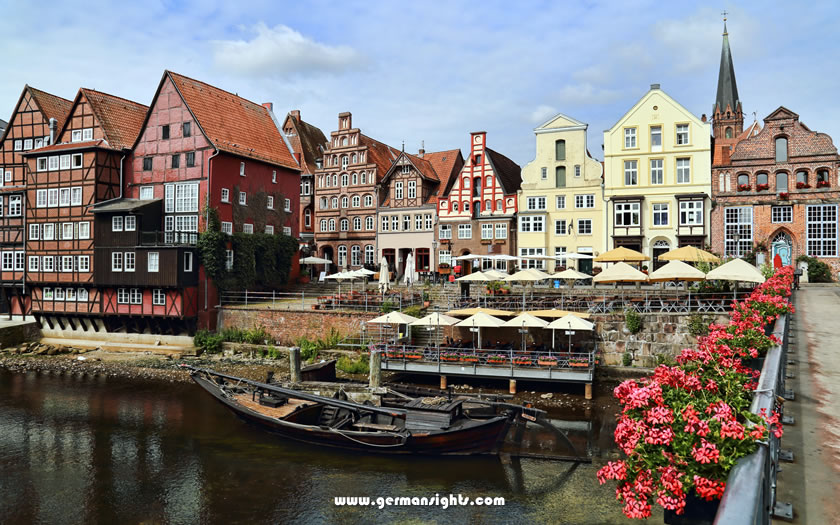
The old harbour at Lüneburg
This trade made Lüneburg one of the wealthiest towns in northern Germany. Its population grew to around 14,000 by the 15th century, which was large for a medieval city. The town's merchants built increasingly elaborate houses to display their wealth. These patrician families not only controlled trade, but also the salt works themselves, creating dynasties that lasted for generations.
The town held political as well as economic power. It minted its own coins, maintained its own army and negotiated on an equal footing with princes and kings. The town hall, which was expanded several times between the 13th and 16th centuries, symbolised this independence.
But nothing lasts forever. By the 17th century, competition from alternative sources of salt and the decline of the Hanseatic League had reduced Lüneburg's dominance. While the town remained prosperous, it never regained its medieval peak.
Lüneburg's greatest stroke of luck was what didn't happen: the city was never bombed.
Most German cities suffered devastating aerial attacks during the Second World War. Just 50 kilometres north, Hamburg was nearly destroyed in Operation Gomorrah in 1943. Berlin, Dresden and Cologne are just a few of the many cities whose city centres were obliterated. Medieval architecture across Germany was wiped out in firestorms.
Lüneburg escaped. The town had no major industries or significant military installations, so it was not a strategic target. Although Allied bombers flew over on their way to Hamburg and other targets, they did not drop their payloads here.
The result is what you see today: one of the most intact medieval town centres in Germany. The buildings are not reconstructions or careful post-war rebuilds. They are original. The Brick Gothic churches, the merchants' leaning houses and the town hall with its centuries of additions all survived.
Ironically, Lüneburg played a small yet significant role in bringing the war to an end. On 04 May 1945, German forces in north-west Germany, Denmark and the Netherlands surrendered to British Field Marshal Bernard Montgomery at a location on the Lüneburg Heath, just outside the town. This was one of several partial surrenders that preceded Germany's unconditional surrender on 08 May.
The salt that built Lüneburg finally ran out - or rather, it became uneconomical to extract. The Saline Lüneburg, which had been in operation for over a thousand years, closed in 1980. The last salt was pumped from beneath the town, bringing an era to an end.
However, Lüneburg did not become a museum town. Founded in 1946, the University of Lüneburg merged with other institutions in 2005 to become Leuphana University. Today, it enrols around 10,000 students in a town of 77,000 inhabitants.
The influx of students has transformed the town. Cafés, bars and restaurants now occupy the medieval buildings. The cultural scene is thriving, with theatres, music venues and festivals. The town has managed to maintain its architectural heritage while functioning as a living city and not a preserved relic.
Am Sande, Lüneburg's showpiece, is a vast market square that demonstrates exactly what salt money could buy. Its name means 'on the sand', referring to the sandy ground on which the square was built.
The 100-metre-wide square is lined on all sides by 15th- to 17th-century brick merchants' houses. These buildings are not uniform. Each merchant competed to display his wealth through architecture. The result is a stunning collection of stepped gables, ornate façades and decorative brickwork - each house is slightly different from its neighbours.
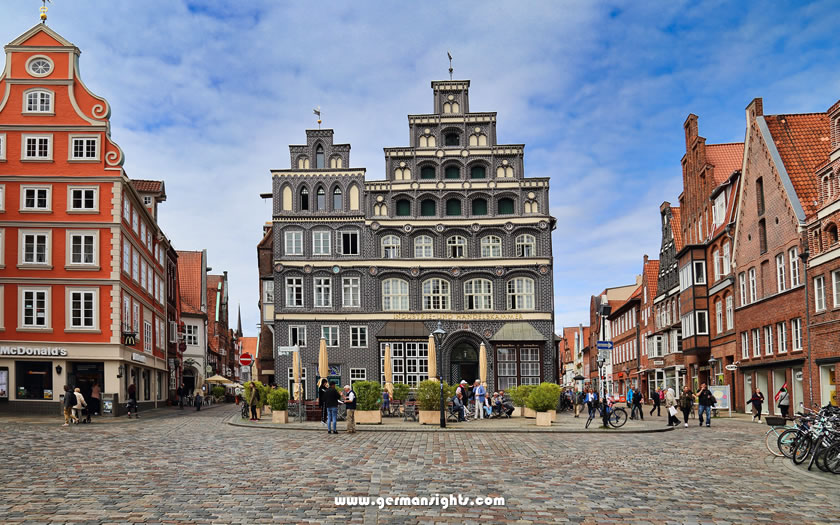
Distinctive architecture on Am Sande in Lüneburg
Take a closer look at the buildings and you'll notice that many of them lean at noticeable angles. This isn't due to poor construction, but to geology.
As salt was mined from beneath the town, underground cavities formed and collapsed. The ground shifted. Buildings tilted. Some lean towards each other and some lean away. The effect is both disorienting and fascinating.
The Lüneburg Town Hall is one of the most important secular medieval buildings in northern Germany. Rather than being a single structure, it is a complex that grew over the course of five centuries, with each generation of city councillors adding to what came before.
Construction began around 1230. The oldest parts, the council chamber and the great hall, date from the 13th century. As Lüneburg's wealth and power grew, the town expanded the building throughout the 16th century, adding wings, halls, and decorative elements.
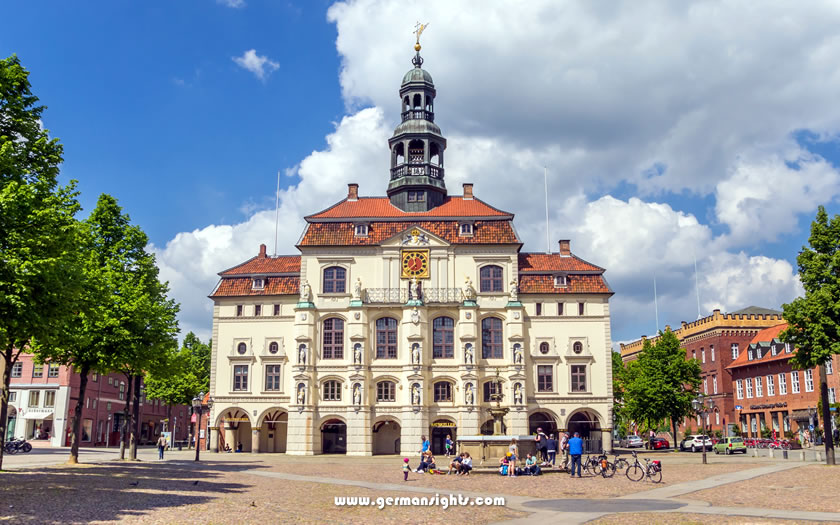
The town hall in Lüneburg
The result is an architectural 'layer cake', with each period visible in the brickwork and design.
You can only visit the town hall on a guided tour, and it is highly recommended that you do so. Tours are conducted in German, but English audio guides are available.
The Alter Kran, a wooden crane that loaded salt barrels onto ships for 400 years, sits on the Ilmenau River at the old harbour. Although it is a simple structure - a large wooden arm on a pivot, operated by a treadwheel - it symbolises the mechanics of Lüneburg's wealth.
The current crane dates from 1797 and replaced earlier versions in the same location. Workers would walk inside a large wheel, using their weight to lift heavy loads.
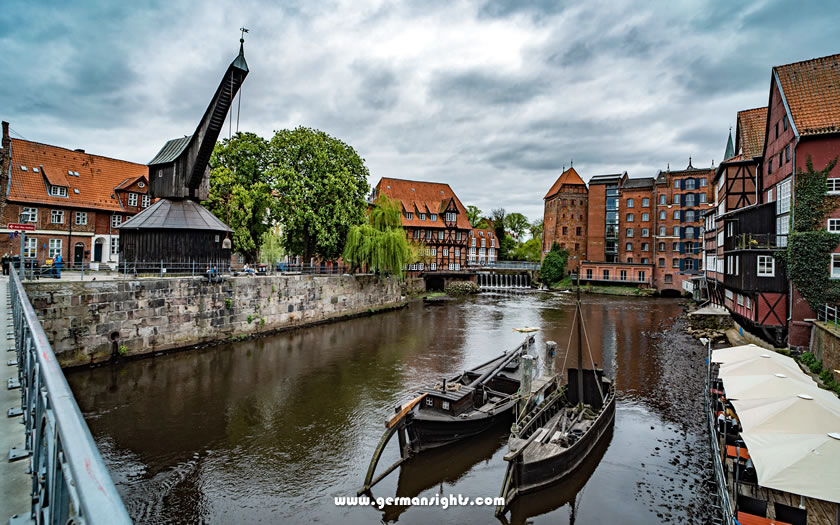
The old crane in Lüneburg
Today the harbor is quiet. Pleasure boats and small craft moor where salt ships once loaded. The crane stands as a monument, no longer working but carefully preserved. It's photogenic—the dark wood against the brick warehouses and the river makes for classic Lüneburg imagery.
The Stintmarkt (smelt market) surrounds the crane. This used to be the harbour district, where fish merchants would sell their catch and sailors would drink in taverns. The colourful, gabled houses along the waterfront date from the 16th and 17th centuries. Many now house restaurants and cafés with outdoor seating overlooking the river.
Take a stroll along the Ilmenau from here. The river path leads past old warehouses and under willow trees, offering a different perspective of the town. You'll see the backs of buildings, private gardens and the waterside life that tourists often miss.
To understand Lüneburg, you must understand salt. The German Salt Museum illustrates this connection.
It occupies the old saltworks buildings — the industrial complex where brine was pumped and boiled for centuries. The machinery is still there, including massive wooden pumps, brick boiling pans, storage facilities and the technical infrastructure of a medieval industry. It's industrial archaeology at its finest.
Allow 90 minutes to two hours for a thorough visit. The museum is well-labeled in German and English. Audio guides provide additional detail.
Website: www.salzmuseum.de
St. Johannis dominates the southern end of Am Sande, with its spire reaching 108 metres - the tallest church tower in Lower Saxony. A masterpiece of Brick Gothic architecture, it was built between 1289 and 1470.
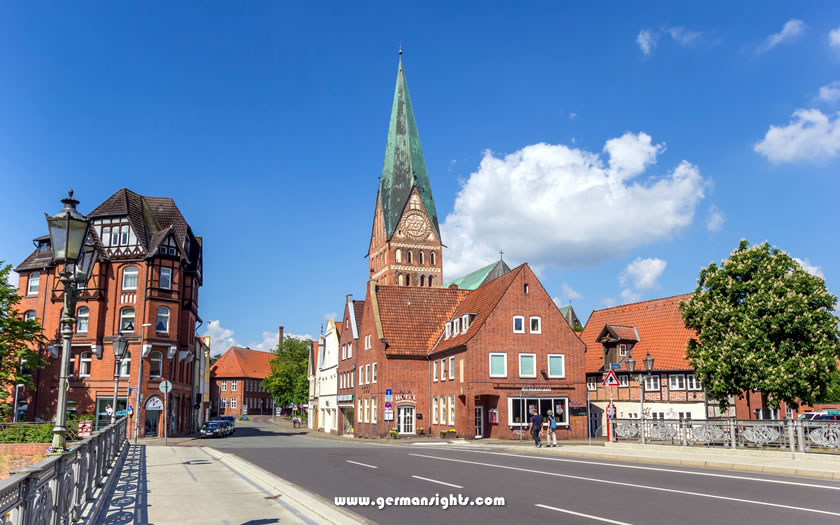
St. Johannis church in Lüneburg
The exterior is impressive, with its massive brick walls, pointed arch windows, flying buttresses and soaring spire. However, it is the interior where St. Johannis truly reveals its treasures.
The vast, light-filled nave contrasts the white-painted walls with the red brick columns. The star-vaulted ceiling draws the eye upwards. The church is surprisingly bright for a Gothic building, with large windows and white walls creating an airy atmosphere.
St. Nicolai is located in the eastern part of the old town, near the harbour. Although smaller than St. Johannis, it is equally important historically. This was the church of the salt workers and sailors - the working classes rather than the merchants.
Built between 1407 and 1440, St. Nicolai is an example of Brick Gothic on a human scale. The church is 87 metres long, and its tower reaches 104 metres. Its proportions are elegant and the brickwork is refined.
The interior has a different character to that of St. Johannis. It's darker and more intimate. The brick columns are exposed rather than painted. The vaulted ceiling creates a sense of enclosure. It feels more like a neighbourhood church than a cathedral.
The Lüneburg Heath, a vast landscape of heather, juniper, birch groves and sheep pastures, stretches south and west of the town. It is one of the largest heathlands in Central Europe and provides the perfect counterpoint to Lüneburg's urban brick architecture.
The heath exists because of human activity. Medieval farmers cleared the forests to make way for timber and grazing. Sheep prevented the land from becoming forested again. This land was used for agriculture for centuries.
Today, much of it is protected as the Lüneburger Heide Nature Park, which was established in 1921 as one of Germany's first nature reserves.
If you visit in late summer, specifically from late August to early September, you'll understand why people make special trips here. The heather blooms in purple waves across the landscape.
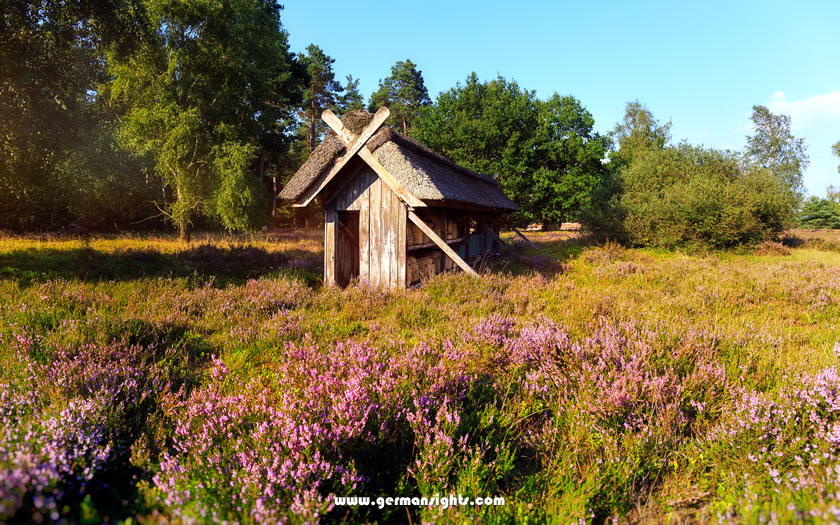
Beehive on Lüneburg heath
The heath is still beautiful outside this window - golden in autumn, stark in winter and fresh green in spring - but it's not the same spectacle.
The core of the nature reserve, which covers an area of about 230 square kilometres, is completely car-free. No roads cross it. There are no car parks. This is rare in Germany, making the heath feel genuinely wild.
This car-free policy requires planning. You can't just drive into the heath. You park in one of the gateway villages and walk or bike in, or you take a horse-drawn carriage from designated points.
Undeloh is the classic gateway village. It is located on the northern edge of the nature reserve, approximately 30 kilometres south of Lüneburg. The village itself is picturesque, with traditional farmhouses sporting thatched roofs, a small church, cafés and guesthouses.
Perhaps most importantly, it is the starting point for walks into the heath.
A well-marked path leads from Undeloh five kilometres south to Wilseder Berg, the highest point in the heath at 169 metres. This may not sound impressive until you realise that the surrounding landscape is almost completely flat. The walk from Undeloh to Wilseder Berg takes about 90 minutes each way.
There is limited public transport (local bus) to Undeloh, but the easiest way is either by car, with parking in the village, or on a guided day trip from Lüneburg.
The Lüneburg tourist information office is located in the town hall on the Markt square (not the Am Sande open area). The tourist office is open seven days a week in the summer, with shorter hours on weekends and holidays. In the main winter months it is closed on Sundays and has shorter opening hours on the Saturdays.
Website: www.lueneburg.info