
Tucked away in a steep valley in the Eifel region of Germany, Monschau is one of those rare places where the architecture, landscape and atmosphere come together to create a unique setting.
Narrow cobblestone lanes wind between slate-roofed, half-timbered houses; the River Rur flows through the centre; and the surrounding hills provide just enough backdrop to make the whole scene feel entirely self-contained.
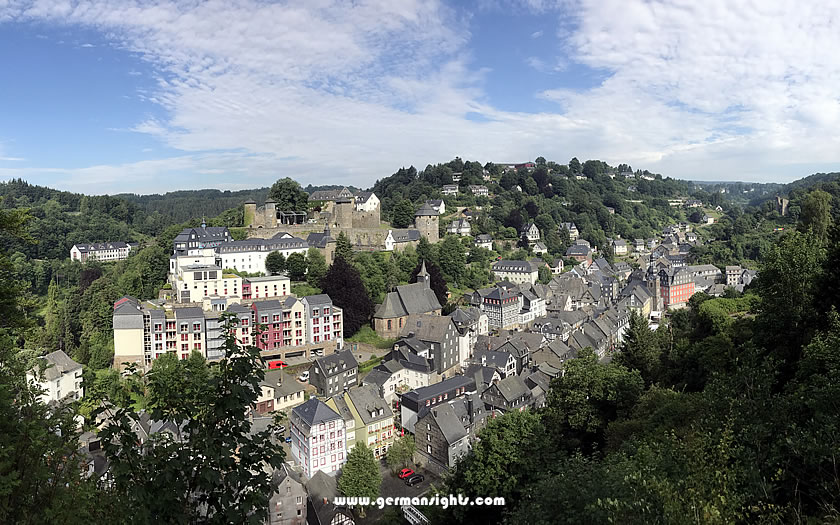
View over Monschau in the Eifel region
Monschau is, in the best possible sense, a town that the Industrial Age largely overlooked. This near-miss is precisely what makes it so compelling today.
The lack of a railway connection in the 19th century meant there was no pressure to demolish and rebuild, resulting in a medieval streetscape that has remained virtually unaltered for 300 years.
Visitors arriving from the busy Rhine-Ruhr area will immediately notice a change of pace in Monschau. Whether you're planning a leisurely weekend road trip through the Eifel region or a focused day trip from Aachen or Cologne, Monschau is an ideal destination.
Monschau is located in a narrow valley in the North Eifel hills, where the Rur River flows through the landscape. This corner of North Rhine-Westphalia, Germany's most populous state, feels remote by comparison.
The Belgian border is so close that some of Monschau's outlying villages are effectively enclaves within Belgian territory - a quirk resulting from boundary changes after the First World War.
The High Fens, known in German as the Hohes Venn and part of a nature reserve, start almost immediately to the west. This vast upland plateau of raised bogs, heath and woodland stretches across the border into the Belgian Ardennes.
Cologne/Bonn Airport (CGN) is the closest international gateway at roughly 90 kilometres from Monschau. Düsseldorf Airport (DUS) is a viable alternative at around 110 kilometres. Both airports connect to Cologne or Aachen by train, from where you can take the bus or hire a car.
Monschau has no train station and the nearest rail hub is Aachen Hauptbahnhof. A regional bus runs directly from there to Monschau and takes approximately one hour. Services run regularly throughout the day, though less frequently in the evening and on Sundays. Check the current timetable via the VRS or AVV regional transport networks before travelling.
Driving is by far the easiest way to reach Monschau, and enjoying the journey is all part of the experience.
From Aachen, head south on the B258 through the rolling Eifel countryside. Depending on traffic, the journey takes around 30 to 40 minutes. From Cologne, allow roughly 90 minutes.
The roads narrow and wind on the descent into the valley, and the first glimpse of the town from above is really striking. The historic centre of Monschau is car-free, so use one of the car parks on the outskirts, then walk down into the Altstadt. The walk takes around ten minutes.
The historic centre contains several guesthouses and smaller hotels housed in traditional buildings. Booking ahead is always recommended and essential during the Christmas market period.
If you know when you are planning to go but haven't decided on accommodation, then use the map below to get an idea of which properties are available and to compare prices during the period you wish to travel.
Enter your proposed dates and use the '+' to zoom in on a location and reveal more properties. Click on the price above a property to see more information.
(Please note that this selection will also include some guesthouses, pensions and self-catering apartments for those who are interested in that form of accommodation!)
The town was known as Montjoie until 1918, when the German emperor officially changed its name to Monschau. The French name reflects centuries of cross-border influence, as well as the town's time as part of the Roer department under French rule in the late 18th century. The French name still appears on older signage and in historical writing.
The Altstadt is Monschau's main attraction and is easy to explore. Burg Monschau sits on a hillside above the town, the Rotes Haus showcases the area's textile history, and Haus Troistorff adds architectural variety to the compact town centre.

View over Monschau in the Eifel region
The best way to experience the Altstadt is to simply walk around without a fixed plan. Lanes branch off unpredictably, stone bridges span the Rur at several points and half-timbered houses loom overhead.
The view from the main bridge looking upstream, with the castle visible on the ridge above and its reflection in the water below, is the image most associated with Monschau. Early morning is the best time for photography, before the day-trip coaches arrive. The cobblestones are uneven in places, so consider wearing comfortable footwear.
The Rotes Haus, or Red House, was completed in 1768 for Johann Heinrich Scheibler, the merchant who brought the Monschau cloth industry to its peak. This double house features an extraordinary free-standing oak staircase spiralling through its interior, which is the most impressive decorative feature in the town.
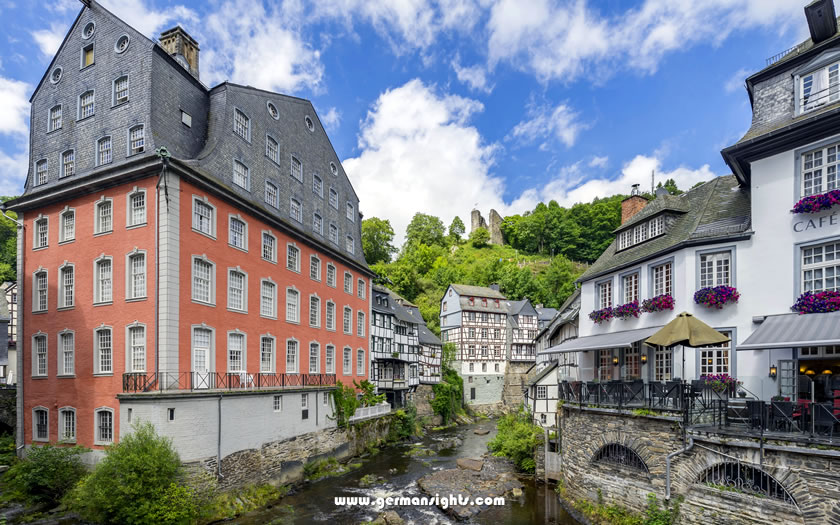
The "Red House" museum in Monschau
Today, it functions as a museum, showcasing domestic life from the eighteenth and nineteenth centuries, as well as the story of Monschau's worsted wool trade.
Monschau Castle dates back to the 13th century and is located on a crag directly above the town. The interior now operates as a youth hostel, so access to the rooms is limited.
However, the courtyards and the hillside path leading up to them are open to the public and offer the best elevated views of the Rur valley and the rooftops below. The walk up takes around 10 to 15 minutes from the centre and is steep.
As well as its picturesque streets, Monschau boasts a number of working craft venues and specialist museums.
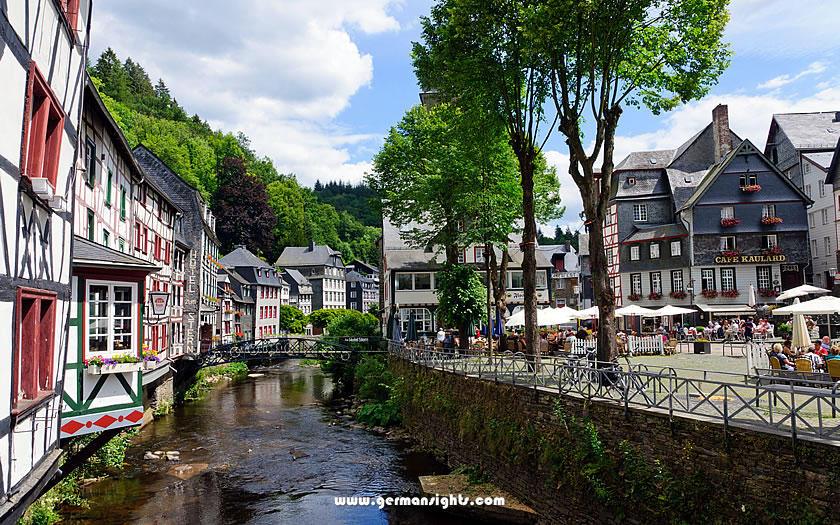
The river and historic timber-framed houses in Monschau
The Senfmühle Monschau has been in operation since 1882, making it one of the oldest mills still producing mustard in Germany today. It uses traditional stone-grinding methods, and visitors can watch the process and sample mustards ranging from mild and sweet to intensely sharp.
The Glashütte Monschau is a glassblowing workshop where artisans shape molten glass into decorative and functional objects. The studio produces handmade glass goods which are sold on site.
The Erlebnismuseum Lernort Natur uses taxidermy displays and interactive exhibits to focus on the natural environment of the Eifel region. Designed to be an educational experience for families, it covers local wildlife and the ecosystems of the Hohes Venn and the surrounding highlands.
Monschau's location within the Eifel Nature Park, close to the Eifel National Park, makes it an ideal base for outdoor activities. To the east, the Rursee reservoir adds a lakeside dimension, providing a contrast to the upland bog and forest scenery.
The Eifel National Park is located approximately 15 kilometres northeast of Monschau and encompasses some of the most picturesque walking trails in western Germany. The park is characterised by dense beech forests, volcanic lakes and peaceful river valleys.
Monschau is an ideal base for a multi-day stay, with the park's main entry points just under 20 minutes' drive away. The Urftsee and the area around Gemünd are popular starting points for longer trails.
👉 Find out more about the Eifel National Park
The Hohes Venn, located immediately to the west of Monschau, offers a landscape that is completely different from the wooded Rur Valley. Boardwalk trails cross the raised bogs, providing access to the plateau while protecting the fragile peat surface.
Closer to town, a trail through the Rur valley starts from the Burgau car park and offers a scenic loop combining riverside walking with hilltop views.
The Rursee is a large reservoir formed by damming the River Rur, located around 20 kilometres northeast of Monschau. It offers boat trips, cycling paths and lakeside walks, making it an ideal destination for a half-day excursion from town.
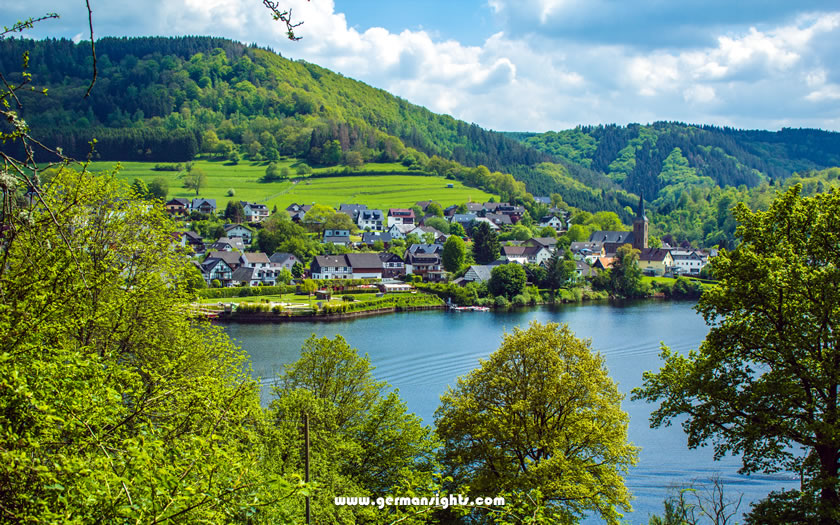
The Rursee in the Eifel Mountains
The impressive Urfttalsperre dam, located at the southern end of the reservoir, is well worth a visit. Several picturesque villages lie along the route between Monschau and the Rursee.
The Monschau tourist information office is located on Stadtstraße not far from the church and the bridge across the Rur. The tourist office is open every day in summer but has shorter opening hours on the winter weekends.
Website: www.monschau.de