
Many travellers pass through Aachen en route to Cologne or Brussels without stopping. They miss out on the city where Charlemagne ruled an empire stretching from the Atlantic to the Adriatic.
This border city, home to 250,000 people, sits where Germany, Belgium and the Netherlands meet. German kings travelled here for their coronations for 600 years. The cathedral still contains Charlemagne's throne, a plain marble seat which was used by emperors from 936 to 1531.
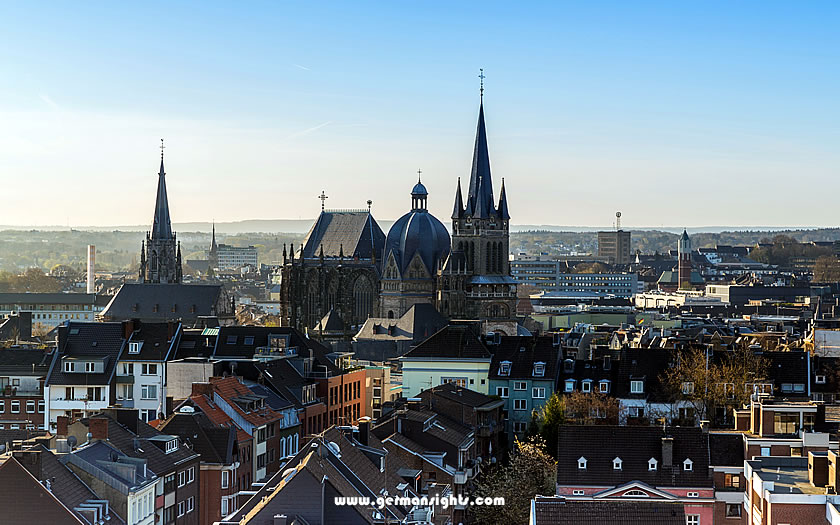
View of Aachen cathedral
But Aachen has more to offer than just medieval history. The Romans discovered the hot springs here 2,000 years ago. Today, the city combines its thermal spa tradition with a university population that ensures the cafés are full and the streets are lively after dark.
Aachen works best as a day trip from Cologne or a two-day stop on a Rhine region itinerary. The old town is compact, so you can walk from the cathedral to the town hall in just five minutes. All the main sights are within a kilometre of each other.
Aachen won't overwhelm you with options. That's exactly why it works.
Aachen is located in the far west of North Rhine-Westphalia. The city lies in a basin surrounded by wooded hills on the northern edge of the Eifel region.
Aachen is Germany's westernmost major settlement. The Belgian border is just 5 kilometres from the city centre. The Netherlands lies just 6 kilometres to the north. The Dreiländer Eck, the three-country border point, is just a 20-minute bus ride away.
The geography of Aachen has shaped its history. The valley traps the heat from the thermal springs that originally attracted the Romans. The surrounding hills provided Charlemagne's palace complex with protection. Its central European location also made it a natural meeting point for medieval rulers.
This border position means languages are mixed. You'll hear Dutch and French spoken in the streets, as well as German. Shop signs are sometimes written in all three languages. The university attracts students from across the region, who cross borders daily.
Maastricht Aachen Airport (MST) is the closest airport to Aachen, but it mainly serves seasonal and charter flights.
Cologne/Bonn Airport (CGN) is the most convenient option for most visitors. The S-Bahn from the airport to Cologne Hauptbahnhof takes 15 minutes, followed by a direct regional service to Aachen, which takes between 45 and 60 minutes. A Flixbus service also connects the airport to Aachen.
Düsseldorf Airport (DUS) offers a greater variety of international connections. Various regional train routes reach Aachen in around 100 minutes.
Brussels Airport (BRU) is a good option if you're planning to visit Belgium. High-speed trains connect Brussels to Aachen in 90 minutes.
Maastricht Aachen Airport (MST) - approx. 30 km
Cologne/Bonn Airport (CGN) - approx. 85 km
Düsseldorf Airport (DUS) - approx. 85 km
Brussels Airport (BRU) - approx. 125 km
Aachen Central train station is located around a kilometre (15 minutes' walk for most) south of the old town.
The train station has good regional connections to Cologne and Düsseldorf as well as high-speed ICE links to Brussels and Frankfurt.
There are four other train stations in the city, all of them on various regional rail lines.
The A4 motorway connects Aachen to Cologne, while the A44 passes via Aachen from Düsseldorf on its way into Belgium.
Much of the city centre is pedestrianised so it is better to use one of the Park & Ride locations further out of town and ride in via public transport.
Most accommodation in Aachen is concentrated in two areas: the city centre, which is within walking distance of the cathedral, and the district around the Hauptbahnhof railway station. The city centre is the better choice for first-time visitors, as it puts the main sights on the doorstep and reduces the need for public transport.
The city centre has a variety of mid-range hotels, several of which are housed in historic buildings. Budget options are available near the station and in the outlying districts. It is advisable to book several weeks ahead for stays during December and the CHIO weekend.
If you know when you are planning to go but haven't decided on accommodation, then use the map below to get an idea of which properties are available and to compare prices during the period you wish to travel.
Enter your proposed dates and use the '+' to zoom in on a location and reveal more properties. Click on the price above a property to see more information.
(Please note that this selection will also include some guesthouses, pensions and self-catering apartments for those who are interested in that form of accommodation!)
The Romans discovered the hot springs in Aachen in the first century AD. They constructed bathhouses around the sulphur-rich waters that bubbled up at 74°C (165°F), some of the hottest in northern Europe. They named the settlement Aquae Granni, meaning "waters of Grannus", after a Celtic god of healing.
The springs weren't just hot. Their medicinal properties came from their mineral content, which included sulfur, sodium and chloride. Roman soldiers recovering from campaigns along the Rhine frontier came here to ease their aches and pains. A small garrison town grew up around the baths.
Everything changed with the accession of Charlemagne to the throne of the Franks in 768. He visited Aachen, fell in love with its hot springs and decided to build his winter palace there.
Between 790 and 800, Aachen underwent a transformation as Charlemagne constructed a palace complex. The centrepiece was the Palatine Chapel - an octagonal marvel which still forms the core of Aachen Cathedral today.
He modelled it on Byzantine churches, bringing marble columns from Rome and Ravenna. The message was clear: this was the new Rome.
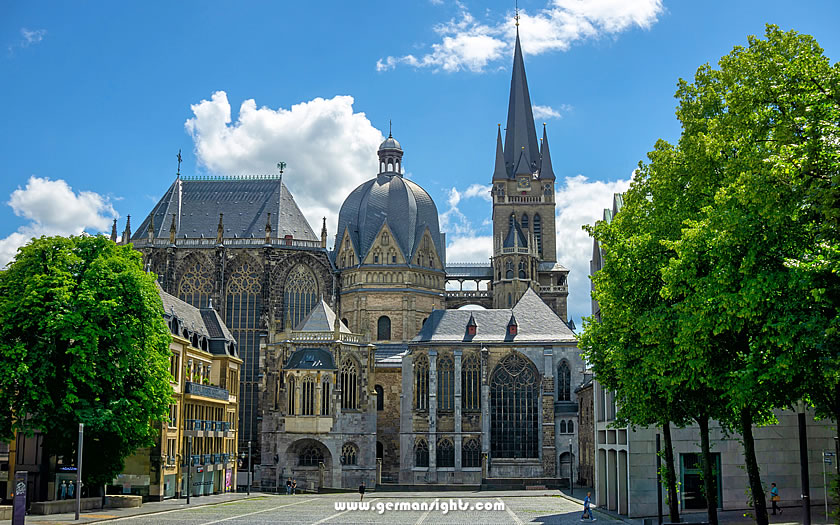
Aachen cathedral
After 794, Charlemagne spent every winter in Aachen. From here, he governed an empire stretching from northern Spain to Denmark and from the Atlantic to Hungary. Pope Leo III crowned him Emperor of the Romans on Christmas Day in 800. The city became the capital of what would later be known as the Holy Roman Empire.
Charlemagne died in 814 and was buried in the Palatine Chapel. His throne remained.
Otto I was crowned King of Germany in Aachen in 936, taking his seat on Charlemagne's throne. This established a tradition that would last for six centuries.
Thirty German kings were crowned in Aachen Cathedral between 936 and 1531. The coronation ceremony followed a set ritual: the king-elect would enter the cathedral and climb to Charlemagne's throne in the gallery. He would then descend to be crowned at the altar. Each new king claimed legitimacy through his connection to the first emperor.
The coronation route became sacred. Kings would process from the city hall to the cathedral, accompanied by crowds lining the streets.
This helped make Aachen wealthy. Each coronation brought nobles, bishops, and merchants. The city gained trading privileges and imperial protection. Guilds flourished. The city expanded beyond its Roman core.
The tradition came to an end in 1531 with the coronation of Ferdinand I in Aachen. After that, coronations moved to Frankfurt. Although Aachen remained important, it lost its unique status.
The following centuries saw a period of decline. The Thirty Years' War (1618–1648) devastated the region. Plague struck repeatedly. The city was occupied multiple times by French armies. Aachen had become a provincial spa town by 1700, clinging to its former glory.
The Congress of Aachen in 1818 briefly brought international attention back to the city. European powers met here to discuss the post-Napoleonic order. However, it was industry that brought the city back to life.
The 19th century saw the arrival of textile mills, needle factories and engineering works. The railway arrived in 1841. Aachen became an industrial centre, producing machinery, textiles and steel.
Aachen was the first major German city to be captured by the Allies in October 1944. Following intense urban fighting, large parts of the city were left heavily damaged. The cathedral itself survived relatively intact, though the surrounding area was badly affected.
Much of what you see outside the historic core today was shaped by reconstruction. The city was rebuilt according to the practical priorities of the post-war period, meaning the modern town is a mixture of genuine medieval buildings in the old centre and mid-20th-century architecture elsewhere.
The historic centre is compact enough to cover on foot in a single morning, yet dense enough in significance that rushing it would be a mistake. Aachen Cathedral, the Rathaus, and the Centre Charlemagne are within a short walk of each other, linked by narrow medieval lanes and the broad square between them.
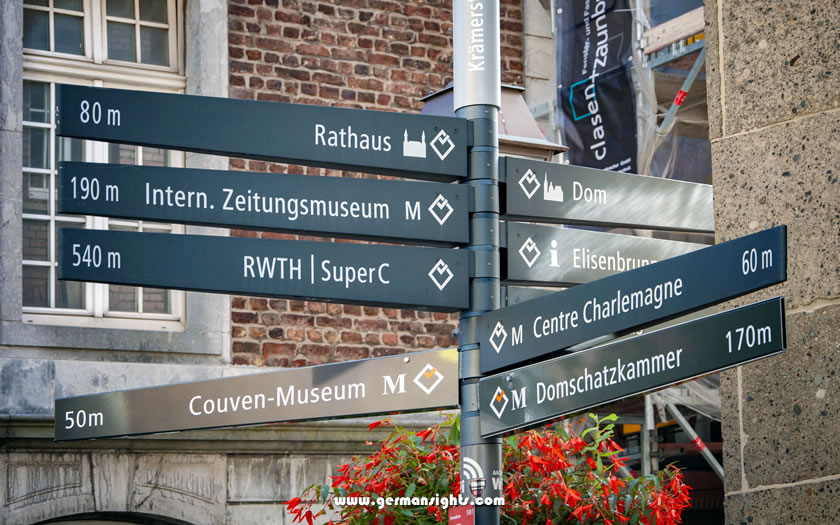
Signposts for the sights in Aachen city centre
Buses cover the city well for outer neighbourhoods and the Carolus Thermen spa. Local transport in Aachen is part of the AVV network, which also covers routes into Belgium and the Netherlands - useful if you want to cross the border without a car!
The Aachener Dom is the perfect starting point for any visit, and rightly so. The cathedral became Germany's first UNESCO World Heritage Site in 1978.
Charlemagne is buried here. His tomb, the Karlsschrein, is a gilded shrine located inside the cathedral and visible to visitors. It is genuinely difficult to grasp that the core of this structure is over 1,200 years old when standing inside the octagonal Carolingian nave and looking up at the mosaic ceiling.
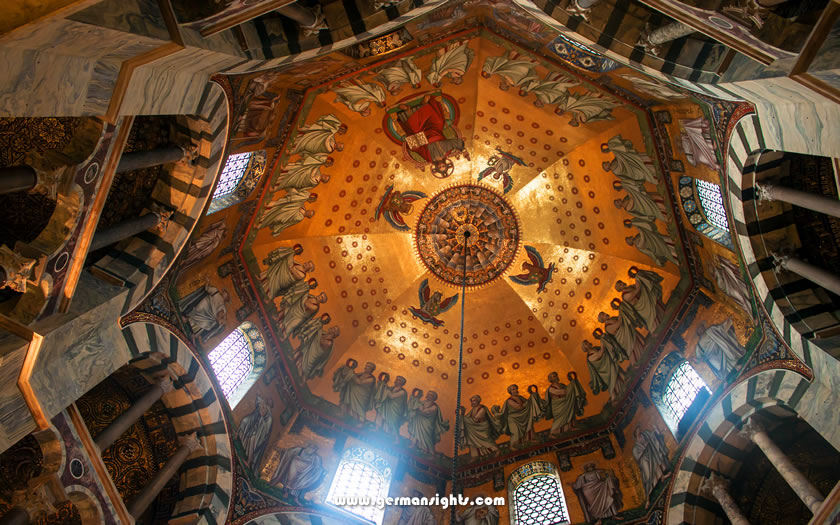
Geometric mosaic decoration in Aachen cathedral
The Palatine Chapel is at the heart of the cathedral complex. Built between 796 and 805 AD, its design drew on late Roman and Byzantine styles in a way that was unprecedented north of the Alps at the time.
The sixteen-sided outer wall, octagonal dome and marble columns all suggest that Charlemagne intended to create a seat of power to rival Constantinople.
For anyone interested in early medieval architecture, this is one of the most significant buildings in northern Europe. Even those without a specialist interest in the subject will be impressed by the scale and quality of the stonework inside.
The Cathedral Treasury, which occupies rooms next to the main building, holds one of the world's most important collections of medieval ecclesiastical art.
Key pieces include the Bust of Charlemagne, a reliquary containing part of his skull which dates to around 1349; the Lothar Cross, a processional cross set with a cameo of Emperor Augustus which dates to around 1000 AD; and the Persephone Sarcophagus, a Roman marble piece which once held Charlemagne's remains.
The Aachen City Hall (Rathaus) stands on the Markt, a short walk from the cathedral. It was built on the site of Charlemagne's original palace. The current Gothic structure dates primarily from the 14th century.
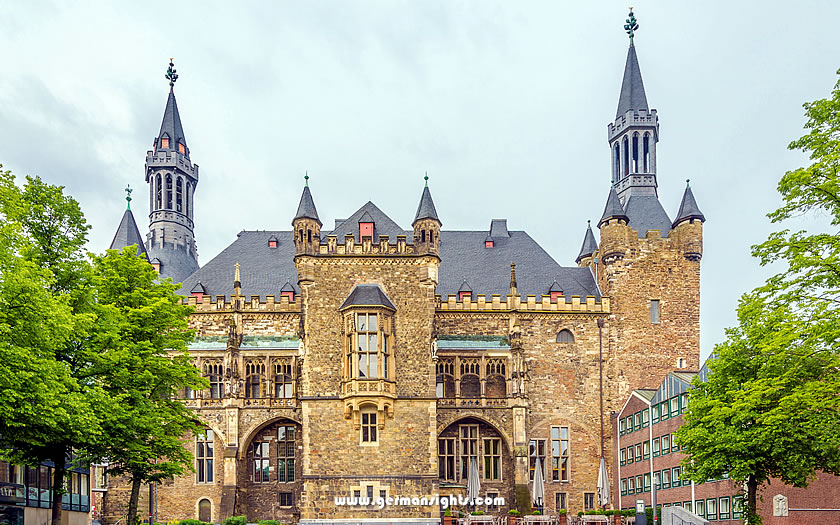
Aachen city hall (Rathaus)
The main attraction is the Coronation Hall, located on the upper floor. Some of the ceremonies surrounding the coronation of German kings took place here. The hall contains 19th-century frescoes depicting scenes from the life of Charlemagne.
As the building also serves as a venue for civic events, check the opening times before visiting.
The Centre Charlemagne on Katschhof Square is the place to go to put the cathedral and the town hall into context before or after a visit. The centre covers Aachen's history from the Neolithic period to the present day, paying particular attention to the Carolingian era.
The Granus Tower, which forms part of the original Roman and Carolingian structures, has been incorporated into the site. The exhibits have clear layouts that are easy to understand even without German language skills, though audio guides are available.
The hot springs that attracted the Romans to Aachen remain an integral part of city life. The city also has a culinary speciality in the form of the Aachener Printen.
The Elisenbrunnen is the most prominent reminder of Aachen's spa heritage in the city centre. This neoclassical pavilion, completed in 1827, is located on Friedrich-Wilhelm-Platz and sits atop two of the city's thermal springs. Visitors can taste the mineral water directly from the taps inside the pavilion.
The Kurpark, the formal park behind the pavilion, provides a place to relax after the tasting.
For a modern bathing experience rather than a historical one, the Carolus Thermen is Aachen's main spa complex. It makes use of the city's thermal waters and offers indoor and outdoor pools, a sauna area and various treatments. It is more popular with locals than tourists, which helps to keep the atmosphere fairly relaxed.
The complex is a short bus ride from the city centre. Entry prices vary depending on the duration of the visit and whether or not sauna access is included. It is worth booking ahead at weekends.
Aachener Printen is a type of gingerbread that is harder and spicier than the soft Lebkuchen found elsewhere in Germany. It is the city's best-known food speciality and is protected by a geographical indication that restricts its production to the city of Aachen. It comes in both hard and semi-soft varieties, plain or chocolate-coated.
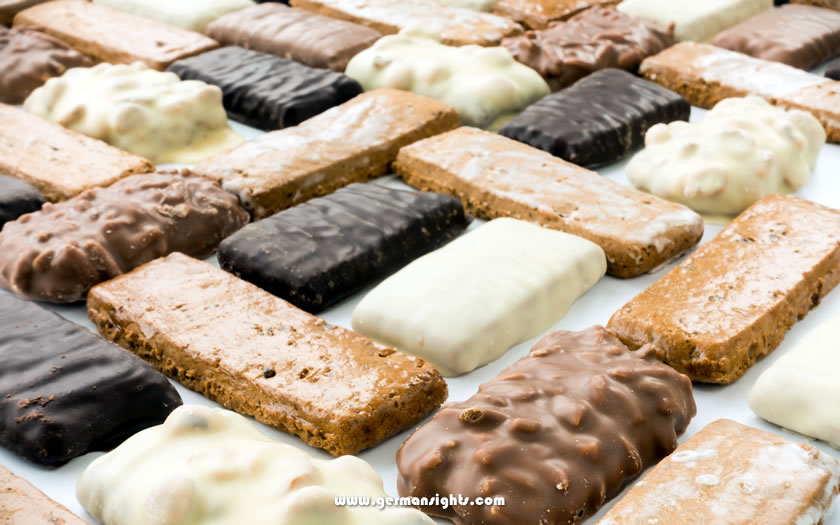
Selection of Aachener Printen
Several bakeries and confectioners in the Old Town sell them all year round, although they are particularly popular around the Christmas market period. They keep well, making them a practical gift to take home.
The Aachen Christmas market, located around the Katschhof area between the cathedral and the town hall, is one of the most renowned markets in western Germany. The cathedral provides an impressive backdrop at night, and the market attracts visitors from the border triangle region.
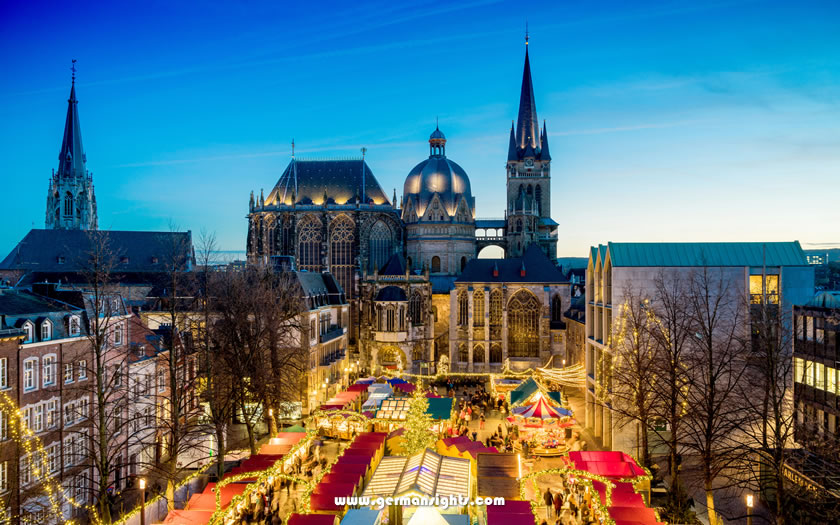
The Christmas market in front of Aachen cathedral
Outside of December, spring and early autumn are the best times to visit. Summer sees the annual CHIO Aachen, one of the world's most prestigious equestrian events, held in late June and early July.
The cathedral quarter tends to get most of the attention, and quite rightly so. However, there is plenty more to see and do in Aachen to occupy an extra half-day. The medieval gates, a handful of specialist museums and the Frankenberger Viertel neighbourhood all offer something different.
Two of Aachen's medieval city gates have survived. The larger and better preserved of the two is the 14th-century Ponttor gatehouse in the northwest of the old town, which gives a clear sense of the city's former defensive scale. The Marschiertor, located to the south, is smaller but still intact.
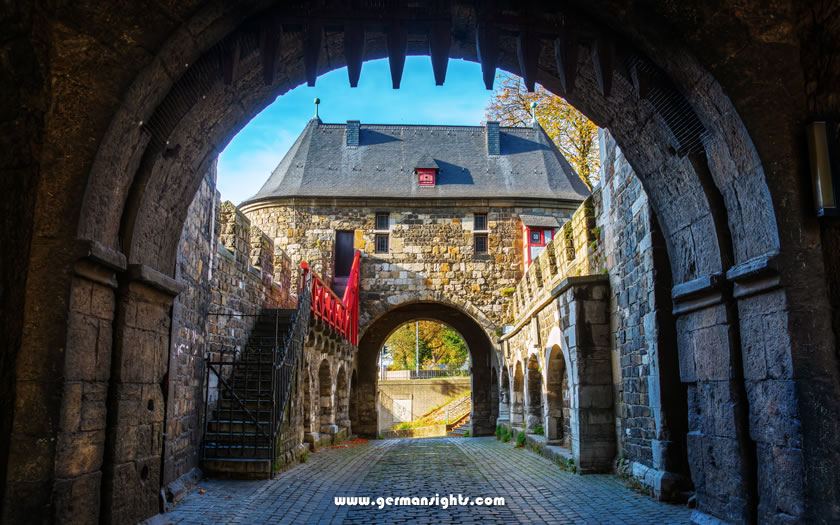
The Ponttor gatehouse in Aachen
Neither attraction takes much time, but both are worth a short detour if you are already exploring the city. They are free to view from the outside, tucked away in quiet corners away from the main tourist areas.
The International Newspaper Museum boasts a collection of historical newspapers and press artefacts from around the globe, with items dating back centuries.
If the cathedral treasury has sparked an interest in the region's art history, the Suermondt-Ludwig Museum, which covers applied arts and fine art from the medieval period onwards, is worth considering.
The Frankenberger Viertel, to the north of the main station, is home to a significant part of Aachen's daily café culture. Less visited than the old town, it has a cluster of independent restaurants, wine bars and shops that reflect the city's student and young professional population.
The streets surrounding the university campus in the western part of the city also have a lively yet relaxed atmosphere, especially on weekday evenings.
The Aachen tourist information office is located close to the Elisenbrunnen on Friedrich-Wilhelm-Platz. The tourist office is open all week but has shorter hours on Sundays and in the winter period from January to March.
Website: www.aachen-tourismus.de