
Cologne is at the heart of one of Europe's most extensive rail networks. Its Hauptbahnhof station handles over 280,000 passengers daily and provides direct access to the city's main attractions.
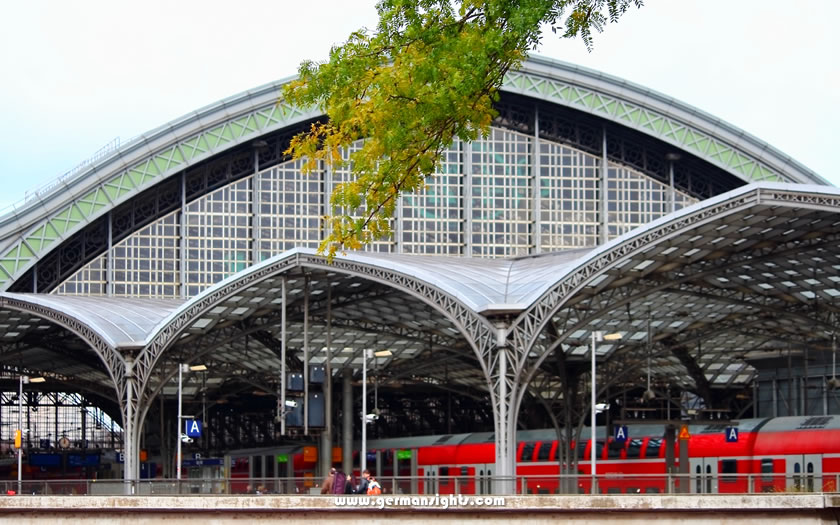
The main train station in Cologne
This location is important for day-trippers. Regional RE and RB trains depart every 20–30 minutes for numerous destinations across North Rhine-Westphalia and beyond. There is no need to rent a car or book tours. Most worthwhile destinations are 30–90 minutes away by direct train.
The Deutschland-Ticket costs €63 per month (at the time of writing) and covers virtually all regional trains (RE, RB, S-Bahn) run by Deutsche Bahn, trams, and buses nationwide. It requires a subscription but users can cancel monthly. Someone spending a week or more in Germany and taking multiple day trips will find this ticket pays for itself quickly. (Note that the validity is for a calendar month, so a ticket purchased half-way through a month will only be valid until the end of the month.)
For 24 hours of travel within North Rhine-Westphalia, the NRW-Ticket costs around €40 for a single person (prices adjust yearly). An alternative 5-person NRW-Ticket covers up to five people for €60. The ticket is valid for 24 hours from first use on all regional transport within the state and replaces the former SchönerTagTicket NRW.
Both tickets exclude ICE and IC trains. Separate tickets are required for destinations such as Frankfurt or those beyond the borders of North Rhine-Westphalia. Book these in advance through bahn.de for better prices.
The trips below focus on destinations reachable within two hours, with most under 90 minutes.
Distance from Cologne: 75 km west | Train time: 45 minutes direct
Aachen is located between Belgium and the Netherlands. At the Drielandenpunt marker, you can touch three countries at once. The city's architecture reflects this position on the border. The gabled houses lean closer to Flemish styles than Rhineland traditions, and the café culture feels more Belgian than German.
Charlemagne built his palace here in the late 8th century and established it as the capital of his empire. He is buried in the cathedral, which was the coronation site for 30 German kings over a period of 600 years. This historical significance is genuine, not just tourist packaging.
The compact old town covers an area of around 800 metres. You can walk from the train station to the cathedral in 12 minutes, and see the main sights in 4–5 hours. Allow extra time for a proper lunch and you'll still be back in Cologne in time for dinner.
Aachen Cathedral (the Dom) - Germany's first UNESCO World Heritage Site, designated in 1978. The octagonal Palatine Chapel dates back to 796 AD and has remained largely unchanged. Charlemagne's marble throne is located in the upper gallery. The Gothic choir hall, which was added in 1414, contains his gilded shrine. Entry to the main cathedral is free.
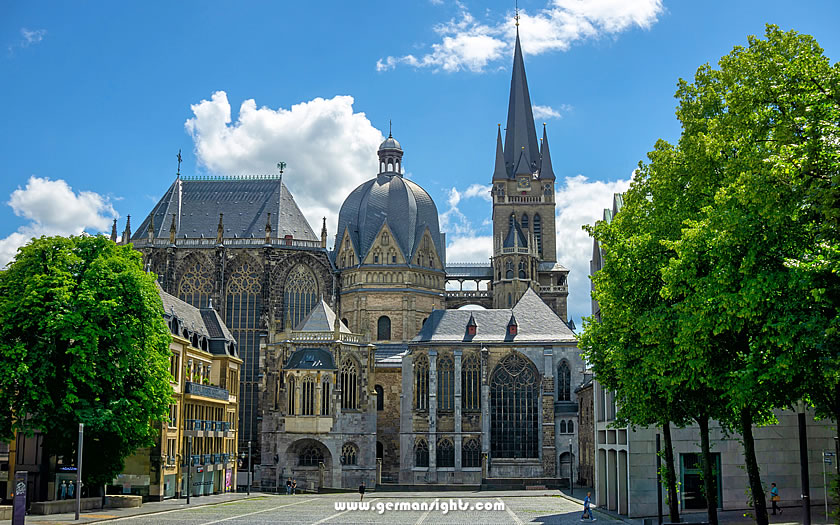
The historic cathedral in Aachen
Rathaus (City Hall) - Built on the site of Charlemagne's palace in the 1300s. Upstairs, the coronation hall displays 19th-century frescoes depicting Charlemagne's life. There is a small admission fee, but the building is more notable for its location and exterior Gothic details than for its interior.
Elisenbrunnen - A neoclassical colonnade sheltering two hot springs. The water emerges at 52°C and has a strong sulphur odour. Locals fill bottles here, while tourists take one sip and regret it. The water has a high mineral and sulfur content - therapeutic if you believe in spa treatments, undrinkable if you don't. The building itself is photogenic.
Getting There: RE trains run every 20–30 minutes between Cologne and Aachen. The journey takes around 45 minutes. The NRW-Ticket and Deutschland-Ticket are valid on RE trains.
Timing: Aachen is open every day, but the cathedral is closed to tourists during services. Most shops are closed on Sundays. The Christmas market, which runs from late November to December, attracts huge crowds.
Food: Aachen's signature dish is Printen, a hard gingerbread biscuit spiced with cinnamon and aniseed. For lunch, the streets around the town hall are lined with dozens of cafés serving Flemish-influenced food.
👉 For comprehensive coverage of what to see and do, visit our Aachen guide.
Distance from Cologne: 30 km south | Train time: 20-30 minutes direct
Bonn served as the capital of West Germany from 1949 to 1999. The government chose this small university town precisely because it seemed like a temporary solution - nobody wanted to legitimise the division of Germany with a grand capital city. However, the arrangement lasted 50 years.
Although the federal ministries moved to Berlin after reunification, Bonn retained six ministry headquarters and thousands of civil servants. The city still has a governmental feel to it, with its orderly parks, wide boulevards and villas in the diplomatic quarter. It's noticeably quieter and wealthier than Cologne, with an entirely different rhythm.
It's a 25-minute train journey. Trains depart every 10–15 minutes throughout the day. The main sights are concentrated in two areas that are easy to explore on foot: the old town around the Münster church and the museum mile along the Rhine. It takes 5-6 hours to cover both areas, or focus on one area for a shorter visit.
Beethoven-Haus - The birthplace of the composer at Bonngasse 20. The museum occupies the original 1770 building and the adjacent houses. Highlights include his final piano, the ear trumpets he used as his hearing deteriorated, and original manuscripts. Visiting the museum takes 60–90 minutes.
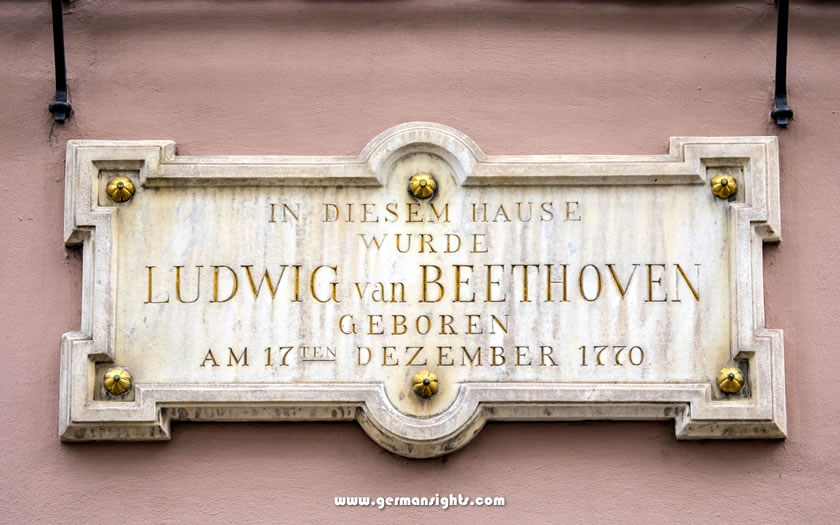
Commemorative sign on the Beethoven house in Bonn
Haus der Geschichte (House of History) - Germany's museum of contemporary history, covering the period from 1945 to the present day. The permanent exhibition takes visitors on a journey through the post-war division, the economic miracle, reunification and modern challenges. The museum does not shy away from difficult topics such as terrorism, immigration debates and Stasi surveillance. Plan for a minimum of 2–3 hours. English audio guides are available.
Poppelsdorf Palace (Poppelsdorfer Schloss) - This 18th-century Baroque palace now houses the university's mineralogy museum. The palace exterior and formal gardens are the main attractions. The building is arranged in the shape of a circle around a courtyard. Behind it, the botanical garden contains 10,000 plant species in greenhouses and outdoor beds.
The Münster Basilica is an 11th-century Romanesque church with five towers. Entry is free. The cloister is peaceful and, while the interior is not particularly notable, the church is an important landmark.
Museum Mile - Several museums line the Rhine to the south of the old town. As well as the Haus der Geschichte, there is the Kunstmuseum (modern art), the Bundeskunsthalle (rotating exhibitions) and the Museum Koenig (natural history). Each museum takes 1–2 hours to explore. Don't attempt to visit them all in one day.
Getting there: Regional RE and RB trains run every 10–15 minutes between Cologne Hbf and Bonn Hbf, taking 20–30 minutes.
Getting around: Bonn's old town is compact and easy to explore on foot. The Museum Mile is located 2 km south of the city centre. Either walk along the Rhine promenade, which takes 25 minutes, or take a 10-minute bus ride from the Hauptbahnhof.
Food: The old town around the Marktplatz is home to traditional German restaurants and cafés. Bonn is slightly more expensive than Cologne. The university district, near Poppelsdorf Palace, offers cheaper, more student-oriented options.
Distance from Cologne: 40 km north | Train time: 30 minutes direct
The centuries-old rivalry between Cologne and Düsseldorf is both genuine and petty. It began with trade competition in medieval times, escalated due to religious differences - Cologne remained Catholic while Düsseldorf became Protestant - and now manifests itself in beer wars and football matches.
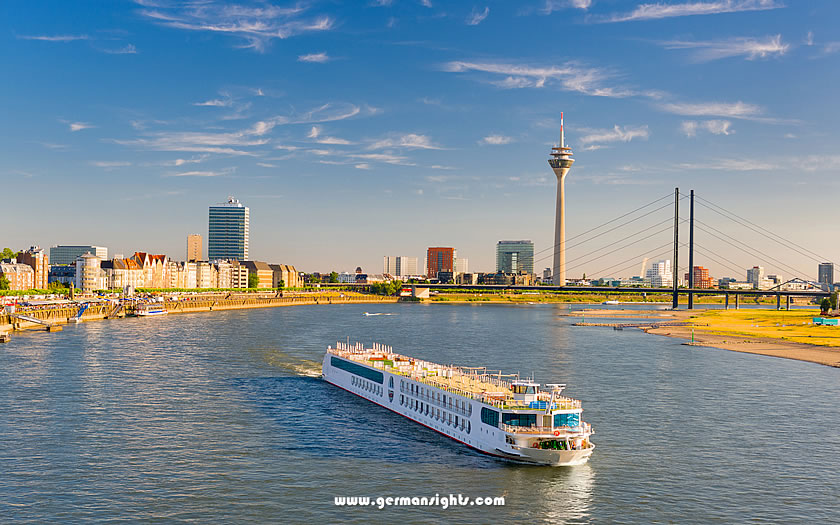
The Rhine river at Düsseldorf
Cologne locals will tell you that Düsseldorf is soulless and pretentious. Düsseldorf residents, meanwhile, consider Cologne to be dirty and provincial.
Visit both cities and decide for yourself. Despite being only 40 km apart, the cities feel completely different.
Trains run every 10–15 minutes. It takes less time to get there than it does to reach Cologne's outer suburbs.
Düsseldorf is wealthier. Its GDP per capita is 30% higher than Cologne's. You'll notice the difference immediately: cleaner streets, more luxury cars and better-maintained buildings. While Cologne focused on media and industry, Düsseldorf rebuilt itself as a banking and fashion centre after WWII.
Königsallee (or Kö) is a tree-lined boulevard split by a canal and running one kilometre through the city centre. Every luxury brand has a flagship store here: Chanel, Hermès, Tiffany and Gucci, to name a few.
The boulevard itself is beautiful, with chestnut trees, swans on the canal and art nouveau buildings. Walk along it even if high fashion doesn't interest you. The northern end of the boulevard (Kö-Bogen) features a modern glass shopping complex designed by Daniel Libeskind.
MedienHafen (Media Harbour) - The old commercial harbour was converted into an architectural showcase in the 1990s. Frank Gehry designed three warped buildings that appear to be melting. Other structures designed by renowned international architects line the waterfront.
Dozens of restaurants and bars occupy the ground floors, so expect to pay higher prices than in the Altstadt. The area is at its best in good weather, when you can stroll along the promenades. Photography enthusiasts could easily spend an hour here.
Altstadt (Old Town) - The historic quarter along the Rhine is home to over 260 bars and restaurants within an area of just half a square kilometre. Locals call it 'die längste Theke der Welt' ('the world's longest bar'). Most of the architecture has been recreated, as 90% of the old city was destroyed in WWII bombing raids. What matters here is the Altbier culture.
Altbier vs. Kölsch: this is where the rivalry becomes more specific. Düsseldorf's traditional beer is Altbier, which is darker, more bitter and slightly stronger than Cologne's Kölsch. It is served in the same size glass as Kölsch. Waiters (known as Köbes) bring unordered refills until you place your coaster on top of your glass, just like in Cologne. Try the Uerige, Füchschen or Schumacher breweries. (Don't order Kölsch in Düsseldorf! You'll be served, but you will be judged.)
The Rhine Promenade is a wide pedestrian walkway running several kilometres from the Altstadt north past the MedienHafen. It is popular for walking, cycling and relaxing on the grassy embankment. The view of Oberkassel is pleasant, though not spectacular. The promenade gets very busy on summer weekends.
Getting there: Regional RE trains run every 15 minutes and take 30 minutes. All are covered by the NRW and Deutschland tickets.
Timing: The Altstadt is open every day, but is busiest on Thursday to Saturday nights, when the bars tend to be filled to capacity. Sunday mornings are quiet, with most bars not opening until noon. The MedienHafen looks better in daylight. Shopping on the Kö follows German opening hours - closed Sundays and with shorter opening hours on Saturdays.
Getting around: Düsseldorf's city centre is compact. Walk from the Hauptbahnhof to the Altstadt in 15 minutes, then follow the Rhine to MedienHafen in 20 minutes. The Kö runs parallel to this route, one block inland. Trams and the U-Bahn connect the outlying areas, but they aren't necessary for the main sights.
Food: The Altstadt offers traditional German cuisine at tourist prices. For better value, head to the Carlsplatz market, a covered market hall with food stalls and restaurants. The Flingern neighbourhood, to the east of the Hauptbahnhof, offers cheaper and more diverse options, but is a 10-minute tram ride away.
Distance from Cologne: 90 km southeast to Koblenz | Train time: 90 minutes
This is the Germany of postcards and river cruise brochures. The Middle Rhine Valley, stretching from Koblenz to Bingen, boasts the highest concentration of castles in Europe, with over 40 fortresses within a 65-kilometre radius. Steep vineyards climb the valley walls. Small wine towns are clustered at the river's edge. The entire area is a UNESCO World Heritage Site.

A view of Bacharach and Burg Stahleck from the Rhine river
The landscape is the result of medieval economics. Each local lord built a castle and charged tolls to passing river traffic. The Rhine was Europe's main north-south trade route. By the 14th century, boats encountered a toll castle every few kilometres.
Most of these castles fell into ruin after Napoleon abolished the toll system in 1803. However, the ruins remained picturesque, and it was the 19th-century Romantics who turned the valley into a tourist destination.
There are several ways to approach this. The quickest option is to take a direct train to Koblenz (one hour), explore the city, and then return. A more rewarding option is to combine Koblenz with a river cruise or a scenic train ride through the castle valley. This takes 8–10 hours, so an early start is recommended.
The Classic Route: Train to Koblenz → explore the city → river cruise south to Boppard or Bacharach → train back to Cologne along the scenic riverbank line. This covers the best castles, gives you a river perspective and includes time in smaller towns.
Deutsches Eck (German Corner) - The pointed headland where the Moselle flows into the Rhine. A massive equestrian statue of Kaiser Wilhelm I dominates the plaza. The location is more important than the monument, with its view of the two rivers merging. Allow 20–30 minutes for the riverside walk.
Ehrenbreitstein Fortress — a Prussian fortress perched on a cliff above the Rhine, opposite the old town. It is one of Europe's largest preserved fortresses. It can be reached by cable car from near the Deutsches Eck, and the five-minute ride provides excellent views of the valley. The fortress houses museums dedicated to regional history and photography, but the real attraction lies in walking along the ramparts and bastions.
Old Town (Altstadt) - The historic centre located between the Rhine and the train station. Eighty-five per cent of the buildings were destroyed in WWII; what you see today is mostly 1950s reconstruction with some medieval fragments.
The 50 km stretch of land to the south of Koblenz has the highest concentration of castles. Most of them are in ruins, but a few have been converted into hotels or museums. The valley narrows here, forcing the river to wind its way through it. Vineyards cover every south-facing slope.
The KD Line (Köln-Düsseldorfer) operates daily cruises from April to October. (It does have a restricted winter programme as well.) The main route runs from Koblenz to Bingen, covering the entire valley in 5.5 hours one way, with stops at major towns along the way. You can board at any stop and travel any part of the route.
Practical cruise options from Koblenz:
- Koblenz to Boppard: 2 hours. This covers the northern castle section.
- Koblenz to St. Goar: 2.5 hours. Includes Lorelei Rock.
- Koblenz to Bacharach: 4.5 hours. The best single-segment option.
Boats are slower than trains. The upside is continuous valley views and outdoor seating on the deck. The downside is the time it takes - a cruise to Bacharach and a return by train takes 6–7 hours in total.
Two rail lines follow the Rhine through the valley:
Getting there: Direct RE trains run hourly from Cologne Hbf to Koblenz Hbf, taking 55–65 minutes. These are covered by the NRW-Ticket and the Deutschland-Ticket.
Timing: July and August bring crowds and higher prices. May and June, as well as September, offer a better balance of good weather and fewer crowds. The valley is beautiful in autumn (late September–October), when the leaves on the vineyards turn colour.
Food: Every town on the Rhine has wine taverns serving local Riesling and simple food such as cheese boards, sausages and pretzels. Prices increase with tourist numbers - St Goar and Rüdesheim are the most expensive. Bacharach and Boppard offer better value for money. The KD cruise boats have cafeterias serving standard tourist food at high prices.
Wine: The Middle Rhine region is known for its Riesling production. The steep slate slopes give the wine its distinctive mineral flavour. Wine tastings are available in most towns - look out for signs saying 'Weinprobe' or 'Weingut'.
Distance from Cologne: 40 km south | Train time: 25-35 minutes to Königswinter
This is the most accessible castle - it is closer than the Middle Rhine Valley, easier to reach and manageable as a half-day trip. Schloss Drachenburg is located halfway up the Drachenfels hill, overlooking the Rhine near Bonn. It's not a medieval fortress, but rather a late 19th-century villa built to resemble one. Imagine a Disney castle with authentic historical craftsmanship.
The location offers everything visitors expect from a Rhine castle: a dramatic hilltop position, views of the river, romantic architecture and forested slopes. Combine it with a hike, a ride on the rack railway and lunch in Königswinter for a 4–5-hour excursion.
Baron Stephan von Sarter, a Paris-based banker and stockbroker, commissioned the castle in 1882. He never lived in it, however. Over the decades, the building served various purposes before falling into disrepair. A complete restoration from 1995 to 2010 returned it to its original condition.
What to see: the interior is in the historicist style that was popular in the 1880s, with each room referencing a different historical period. The music salon is in the style of the Renaissance, the dining hall is Gothic and the library is Baroque. The craftsmanship is exceptional, with hand-painted ceilings, carved wooden panelling and stained glass windows depicting Rhine legends. The castle contains original furnishings and art from the period.
Guided tours run every 30–60 minutes, depending on the season. Tours are conducted in German only, but English information sheets are available. The tour takes 45 minutes and covers the main rooms.
The park: The castle is set in landscaped grounds featuring terraces, fountains and a small vineyard. The North Terrace offers the best views of the Rhine. From here you can see the Siebengebirge hills across the river valley and up and down the river.
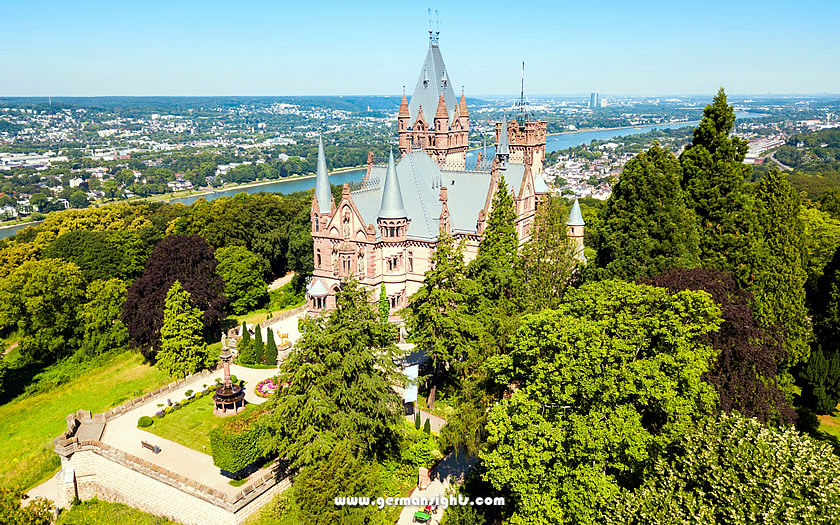
Schloss Drachenburg sits above the Rhine river
Drachenfels (Dragon Rock) rises 321 metres above the Rhine. The summit is home to the remains of a 12th-century castle, which was built by the Archbishop of Cologne. According to legend, Siegfried slew the dragon from the Nibelungenlied here and bathed in its blood to become (almost) invincible.
The castle ruins are minimal, consisting of just a few walls and foundation stones. The real attractions are the view and the hike. When the weather is good, you can see Cologne Cathedral, which is located 30 km north.
Option 1: Hiking
A well-maintained path winds 3 km from Königswinter to the summit, passing Schloss Drachenburg halfway up. The climb takes 45–60 minutes at a steady pace. The trail is paved in sections and gravel in others, with some steep sections. Normal walking shoes are suitable. The path gets crowded at weekends, so start early or go on a weekday.
Option 2: The Drachenfels Railway (Drachenfelsbahn)
Germany's oldest rack railway, which has been operating since 1883. The narrow-gauge train climbs from Königswinter to the summit in 10 minutes, stopping at Schloss Drachenburg halfway. Trains run every 30 minutes from March to November and on weekends only in winter. The railway itself is a historical attraction, with original stations and a vintage feel, not to mention the engineering feat of climbing a 20% gradient.
The best option is to take the railway up and hike down (this is easier on the knees and allows you to stop at the castle on the way).
This small Rhine town exists primarily to serve the Drachenfels tourist industry. The Rheinpromenade, the town's waterfront promenade, runs alongside the river and is lined with cafés and restaurants. The town itself is pleasant but unremarkable, with half-timbered buildings, a few churches and tourist shops selling dragon-themed souvenirs.
Getting there: Regional trains run from Cologne Hbf to Königswinter every 30 minutes, taking 30–40 minutes. These are covered by the NRW-Ticket and the Deutschland-Ticket. Drachenfelsbahn station is a five-minute walk from the train station.
Opening times: The castle is open all year round with shorter hours in the winter months. It is closed on Mondays, except on public holidays. The Drachenfelsbahn runs similar hours. The trail is open all day, every day, as it is not gated.
Distance from Cologne: 15 km south | Train time: 10 minutes
Brühl is the easiest day trip in this guide, so close to Cologne that it barely qualifies as leaving the city. Two UNESCO World Heritage palaces are located within a landscaped park just a five-minute walk from the train station. Visit both palaces, explore their interiors, stroll through the gardens and have lunch, all within 4–5 hours.
The palaces are prime examples of German Rococo. Augustusburg is a former residence of a prince-archbishop with one of Europe's most celebrated staircases, while Falkenlust is an intimate hunting lodge designed for small parties and falconry.
Both were built in the 1720s–1740s and survived World War II intact.
Clemens August of Bavaria, the Prince-Archbishop and Elector of Cologne, commissioned the palace in 1725 to be his main residence. He hired some of the era's leading architects and artists: François de Cuvilliés designed the interiors, Balthasar Neumann created the staircase and Italian stucco masters executed the decorative work.
The result is a Rococo masterpiece - lighter, more playful and more ornate than the heavy Baroque style it replaced. While Baroque architecture emphasised power and grandeur, Rococo focused on elegance, wit and refined pleasure.
The Staircase (Treppenhaus) is the centrepiece of the palace and one of the most important Rococo interiors in Europe. The grand staircase appears to float beneath a 20-metre vault with no visible supports and is topped by a ceiling fresco depicting the four continents and the glory of Clemens August.
Neumann intentionally devoted the entire central section of the palace to this space. It served as a theatrical stage where the prince-archbishop could make dramatic entrances. Visitors still stop and stare even 300 years later.
Guided tours of the State Rooms cover 10–12 of the palace's approximately 50 rooms. Highlights include the Yellow Silk Music Room, which features a fresco of Apollo and the Muses; a ceremonial State Bedroom with a bed in an alcove behind a balustrade; a Mirror Cabinet covered entirely in mirrors and gilded decorations; and a Garden Room that opens onto the terrace.
Much of the period furniture is not original due to looting during the French Revolution, but the stucco, frescoes and wood panelling remain largely intact.
When to visit: The palace is open from Tuesday to Sunday. The staircase alone justifies a visit - if you only have time to visit one palace in the Cologne area, make it this one!
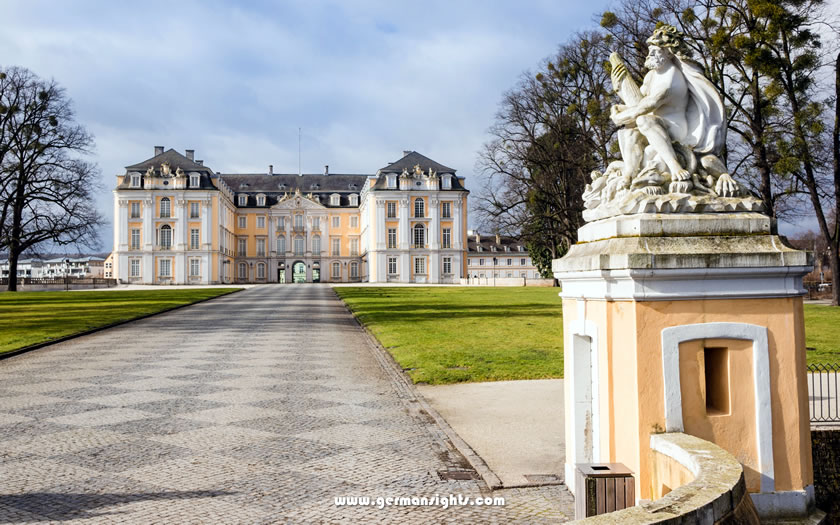
Augustusburg Palace near Cologne
An enjoyable 10-minute walk through the gardens from Augustusburg brings visitors to Falkenlust ("Falcon's Delight"), a small hunting lodge built between 1729 and 1740. François de Cuvilliés designed it specifically for falconry, a sport that Clemens August was obsessed with.
The lodge is intimate, with only 15 rooms across two floors. Its size feels more human compared to the grandeur of Augustusburg. It was intended for small hunting parties, private dinners and relaxation away from the formality of court life.
Opening times are the same as at Augustusburg Palace. The lodge is often less crowded than the main palace.
The gardens were designed by a student of the man who created Versailles and connect the two palaces in a formal French-style layout. The original eighteenth-century design incorporated geometric parterres, fountains, sculptures and a canal system.
Much of the formal garden was simplified in the 19th century, when tastes in landscape design shifted towards the English-style natural park. The result is a hybrid of formal areas near the palaces and more naturalistic woodlands.
The Gardens Today: Free access during daylight hours. The gardens are popular with local joggers, dog walkers and families. Although the grounds are well-maintained, they are not as meticulously manicured as those in Versailles or other major palace gardens.
Getting there: Regional trains run from Cologne Hbf to Brühl every 10–20 minutes. The journey takes 10 minutes and is covered by the NRW Ticket, the Deutschland Ticket and even the Cologne city transit day pass (which extends to Brühl). The trains run frequently and reliably, so there is no need to plan around specific departure times.
Leave the station and Augustusburg is directly ahead, a five-minute walk across a small park. The palace gates are impossible to miss. Falkenlust is a further 10 minutes' walk away through the gardens.