
The Spessart region is located in the heart of Germany and is often overlooked by visitors who head straight for the main cities of Bavaria or the Rhine Valley.
This forested region straddles the states of Hesse and Bavaria to the east of Frankfurt. The Spessart offers peace and quiet, ancient woodlands and a handful of historic sites that are well worth a visit.
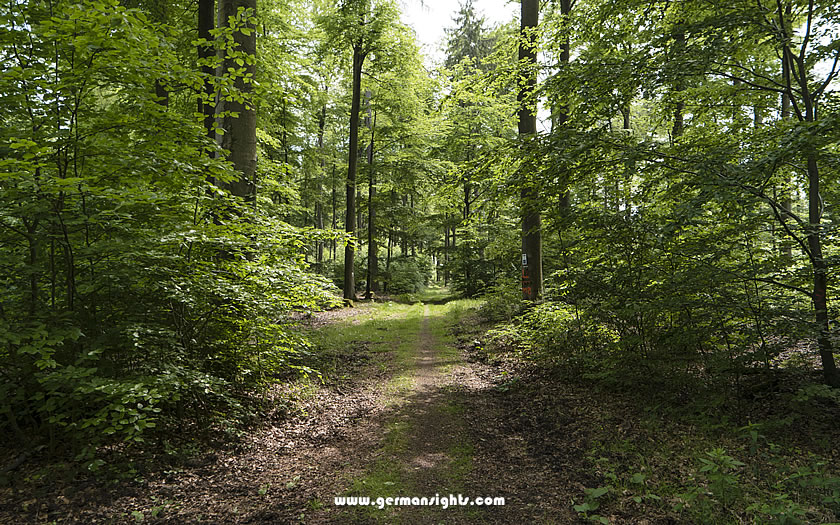
Hiking the Spessart trail
The region's name can be traced back to Spechtshardt, combining the German word for 'woodpecker' with an old term for 'hilly forest'. Spanning around 2,440 square kilometres, the Spessart is home to what is often described as the largest continuous area of mixed deciduous forest in Germany.
Those who want to walk through genuine forests, visit moated castles and explore small towns in the Main Valley without having to fight for a parking space will find that the Spessart repays a few days of their time.
The defining feature of the Spessart is its forest.
The Hochspessart, the central upland zone, contains around 70,000 hectares of woodland which has survived for centuries despite being in an area that was once protected as a noble hunting ground. These protections have ended, yet the forest remains.
The story of the Wirtshaus im Spessart, in which travellers are held up by the local bandits known as the Spessarträuber, became part of German popular culture through Wilhelm Hauff's 1827 novella and a subsequent series of popular West German films.
The legend fits the landscape well. To this day, parts of the Spessart remain genuinely remote, with long stretches of road passing through unbroken forest.
The Spessart is an interesting place for independent travellers. Although it is close to Frankfurt, it feels completely separate from the city.
The Spessart occupies a roughly triangular block of upland terrain, enclosed by rivers on most sides and bordered by neighbouring upland ranges. It sits immediately east of Frankfurt, making it one of the more accessible forested regions in central Germany.
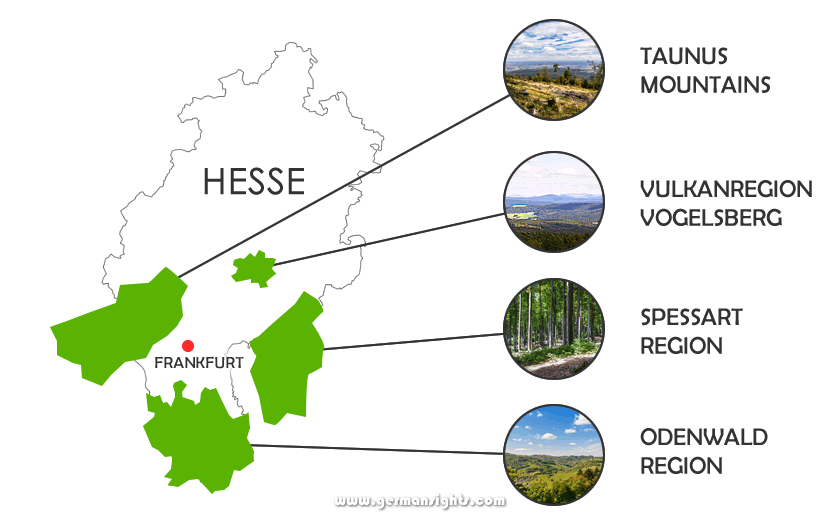
Four hiking areas around Frankfurt
The Spessart straddles two German federal states. The larger portion, around 75 percent of the total area, falls within Bavaria, specifically the Lower Franconia region. The remaining quarter lies in Hesse.
The state boundary runs through the middle of the forest, but for most visitors the division is pretty much invisible on the ground. Both sides are covered by nature park designations: the Naturpark Bayerischer Spessart and the Naturpark Hessischer Spessart together account for the full extent of the range.
The Spessart is defined by three rivers.
The Main runs along the southern and western edges, the Kinzig marks the northern boundary, flowing from Schlüchtern towards Hanau, and the Sinn forms the north-eastern limit.
The Main valley is of particular importance to visitors as it carries the main road and rail connections, linking several of the region's key towns, including Miltenberg and Aschaffenburg.
The highest point in the range is Geiersberg, which stands at 586 metres. The Odenwald lies to the southwest and the Rhön to the northeast.
The Spessart's position near the Rhine-Main conurbation means transport connections are better than the quiet interior might suggest. Frankfurt is the obvious arrival point for most international visitors.
Aschaffenburg has direct ICE and IC connections to Frankfurt and Würzburg.
The Main-Spessart railway line runs along the Main valley from Aschaffenburg to Gemünden and on to Würzburg, connecting several smaller towns in the south of the region.
The A3 Autobahn runs directly through the Spessart, connecting Frankfurt and Würzburg. There are several junctions providing access to the surrounding area. This is one of the busiest motorways in Germany and can be slow during holiday periods. Local roads are generally in good condition once leaving the A3, but can be narrow in forest villages.
The history of the Spessart is shaped more by what kept people out than by what drew them in. The forest interior remained sparsely settled and tightly controlled for centuries, which is precisely why so much of it survived.
Large portions of the Spessart were claimed as hunting reserves from the medieval period by the Archbishops of Mainz and other noble families with territorial interests in the region. This protection from logging and agricultural clearance meant that the forest was preserved to a degree that was unusual for central Europe.
The villages that developed in the forest interior were largely sustained by industries related to the woodlands.
Glassmaking was particularly significant in the Bavarian part of the Spessart, where timber for fuel and silica sand from the sandstone provided the necessary raw materials. Charcoal production and timber harvesting also supported small communities throughout the early modern period.
The red sandstone underlying much of the area was quarried and used in the construction of notable buildings, including the great cathedrals of the Rhine Valley, such as Mainz Cathedral.
The Spessart Räuber (Spessart bandits) were a real presence in the region throughout the eighteenth and early nineteenth centuries. They exploited the forest's cover and the isolation of travellers on the main routes through the area.
Wilhelm Hauff drew on this history for his 1827 novella, and the concept of the 'Wirtshaus im Spessart' (forest inn) where travellers faced uncertain fates passed into broader German folklore. Later film adaptations turned this into something more comic than threatening, but the underlying history of a forest used by outlaws was genuine.
The Spessart is not a region with a concentration of sights. Its appeal is spread across the landscape, with specific places worth seeking out rather than one obvious highlight. Most of what visitors actually spend their time doing is walking, visiting river towns and exploring a few interesting individual destinations.
Most visits to the region effectively begin in Aschaffenburg. Situated at the western edge of the Spessart, the town has good rail and road connections from Frankfurt.

The Johannisburg palace on the banks of the River Main
The main sight is Johannisburg Palace, a large Renaissance sandstone palace on the river Main, which is worth a couple of hours of anyone's time. The town also has a reasonable range of accommodation and restaurants, making it a practical base if somewhere with more facilities is preferred.
Mespelbrunn castle is the most photogenic sight in the Spessart region. The castle sits on a small island in a pond at the end of a narrow valley, surrounded by forest. The moated setting is genuinely striking, and visitors can explore the interior to get a sense of aristocratic life in the region across several centuries.
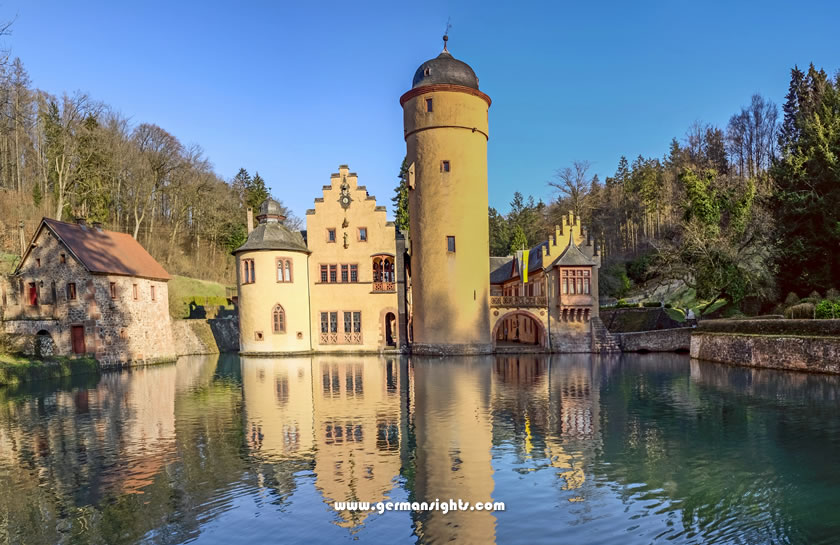
Mespelbrunn castle in the Spessart region
It gets busy on summer weekends, so arriving early makes a significant difference. The valley road leading to the castle has limited passing places.
Lohr am Main, the largest town in the Bavarian Spessart, is situated at a bend in the River Main. The old town is compact and easy to explore, and features a local museum and the usual collection of half-timbered buildings. Lohr is sometimes associated with the Snow White story, though this connection is disputed.

Timber-framed houses in Miltenberg
Further southeast along the Main is Miltenberg, which has one of the most intact medieval market squares in Bavaria. It is the most visited town in the region.
The Eselsweg, or 'Donkey Trail', is one of the most well-established long-distance walking routes through the Spessart. It runs for around 100 kilometres through the heart of the forest, and was historically used to transport goods across the area before road improvements rendered it obsolete.
Now it offers a genuine forest walking experience, with some sections feeling truly remote. There are well-marked shorter day walks throughout both the Bavarian and Hessian parts of the region, and the trails are generally of a good quality.
The Naturpark Bayerischer Spessart and the Naturpark Hessischer Spessart together cover the entire Spessart range. The parks contain no major towns, only forest and scattered settlements.
The Rohrberg nature reserve is home to some of the region's oldest oak and beech trees, with individual specimens well over 400 years old.
Bad Orb in the Hessian north of the Spessart is a traditional spa town that makes an ideal quiet base. It has thermal facilities, walking trails and a modest but adequate range of accommodation. It attracts a largely German domestic visitor base, which keeps the atmosphere low-key and the prices reasonable.
Towns like Bad Orb or the smaller settlements around Lohr am Main offer a practical alternative to staying in Aschaffenburg for visitors who want forest access without driving into the interior each day.
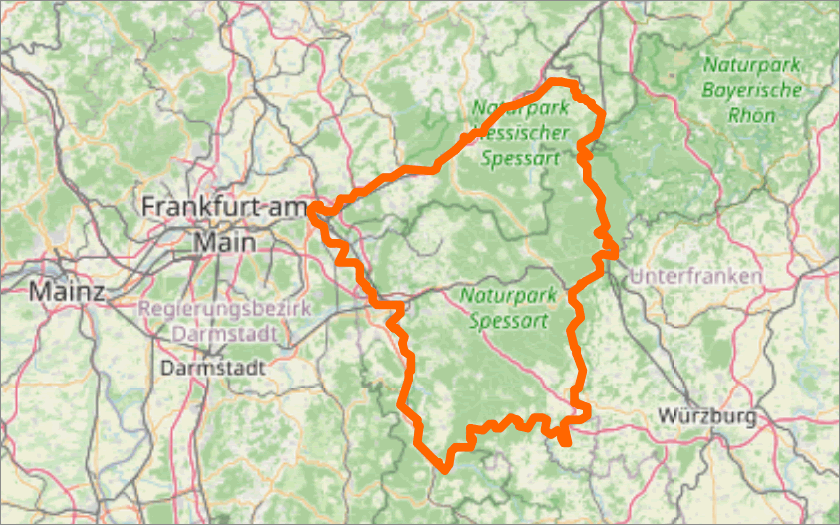
Map of Spessart Region
(courtesy of OpenStreetMap)