
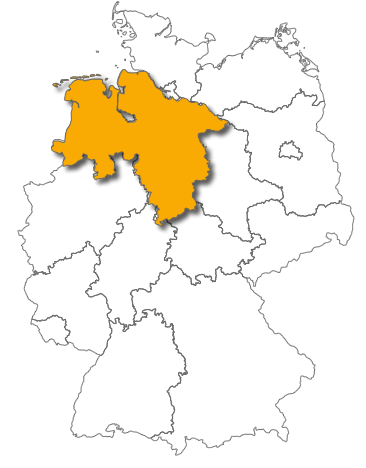
Lower Saxony is located in north-western Germany and acts as a vital link between the country's major regions.
North Rhine-Westphalia, Germany’s most populous state, lies to the west, while Hamburg and Schleswig-Holstein border it to the north. Significant cultural and economic centres such as Bremen are located within or near its borders, with Berlin to the east and the Netherlands to the west.
Hanover, the state capital and a major transportation hub, is strategically positioned on Germany’s high-speed rail network. It hosts major trade fairs and events. Although Bremen is officially its own city-state, it integrates closely with Lower Saxony and serves as a gateway to the North Sea.
The state has a well-connected rail system, including high-speed links to Hamburg, Berlin and the Rhine-Ruhr area. The extensive network of motorways and regional railways makes travelling within Lower Saxony straightforward, while the international airports in Hanover and Bremen provide convenient access for travellers from around the world.
Lower Saxony is served by several airports offering connections to domestic and international destinations. Although it does not host one of Germany’s largest international hubs, the range of regional and nearby airports provides travellers with convenient options.
Hanover Airport (HAJ) is the main gateway to Lower Saxony. It is located just 10 kilometres north of Hanover city centre and offers a variety of international flights to major European hubs such as Frankfurt, Amsterdam and Istanbul. The airport is well integrated into the transport network, with regional and S-Bahn trains providing direct access to Hanover and beyond. It is efficient and often less crowded than larger German airports, resulting in shorter waiting times.
Website: www.hannover-airport.de
Although Bremen Airport (BRE) is officially outside Lower Saxony, it is a convenient option for visitors heading to the state’s northwestern regions. The airport primarily serves European destinations and budget airlines, offering direct flights to cities such as London, Vienna and Madrid. A dedicated tram line connects the airport to Bremen’s central train station in under 15 minutes.
Website: www.bremen-airport.com
Hamburg Airport (HAM) is a major international airport located roughly 90 minutes by train from parts of Lower Saxony. It provides a wide range of flight options and with connections to intercontinental destinations such as New York, Dubai and Singapore, it is ideal for those seeking long-haul flights. The airport is also well connected by high-speed trains to cities such as Hanover and Braunschweig, making it a convenient option for visitors to northern and central regions of the state.
Website: www.hamburg-airport.de
Frankfurt Airport (FRA) is Germany's busiest and most globally connected airport. It is around three to four hours away from Lower Saxony by train. It offers flights to almost every major destination worldwide, making it the obvious choice for travellers looking to fly long-haul. Direct high-speed ICE services connect Frankfurt with major cities in Lower Saxony, such as Hanover and Göttingen, ensuring a seamless onward journey. The airport's extensive flight network and efficient rail links make it a reliable option despite the longer journey time.
Website: www.frankfurt-airport.com
Further afield, Leipzig/Halle Airport (LEJ) is an option for travellers heading to eastern Lower Saxony, such as Wolfsburg. It offers connections to numerous European destinations and is a good option for those seeking a quieter airport experience.
Website: www.mdf-ag.com
Thanks to its location and accessibility, Hanover Airport is the most central and convenient choice for travel to and within Lower Saxony. Meanwhile, Bremen Airport offers easy access to northwestern areas, and Hamburg provides a broader selection of international flights to the north. Frankfurt Airport remains the go-to option for intercontinental arrivals, offering unparalleled global connectivity and excellent rail links.
Lower Saxony is in a prime location within Germany’s rail network, with major Intercity Express (ICE) and Intercity (IC) lines crossing the state and providing efficient connections to other regions.
The main east-west route links Berlin and Cologne, passing through Hanover. The high-speed ICE line between Hanover and Berlin takes just under two hours, while the journey to Cologne takes approximately three hours.
A significant north-south corridor passes through Lower Saxony as part of the Hamburg-Hanover-Göttingen-Frankfurt-Munich line, linking the state to northern, central, and southern Germany.
Hanover is the largest and most important rail hub in Lower Saxony. The city also functions as a junction for several regional rail services.
Smaller towns and cities throughout Lower Saxony rely on an extensive network of regional trains operated by Deutsche Bahn and private operators like Metronom and WestfalenBahn. These services connect rural areas with major stations, ensuring accessibility to even the state’s more remote attractions, such as the Harz Mountains or coastal North Sea towns.
Travelers can benefit from Germany’s special fare system for longer-distance services by booking ICE or IC tickets in advance, significantly reducing travel costs.
Regional Day Ticket: Niedersachsen-Ticket
One of the most economical ways to travel around Lower Saxony is via the Niedersachsen-Ticket, a regional day pass that offers unlimited travel on regional trains from 09.00 until 03.00 the following morning (or all day starting at midnight on weekends). The ticket is valid on regional trains, trams, and buses across Lower Saxony, as well as in neighboring Bremen and Hamburg.
At the time of writing, the single-person fare is 29 Euros. Additional passengers can be added for only 8 Euros each, up to a maximum of five people per ticket. This means five people can travel together for 61 Euros, making it an excellent choice for groups and families exploring the region. Note that Intercity Express and Intercity trains are not included with this pass.
An alternative option is the slightly more expensive Niedersachsen-Ticket + Ostharz. This includes the eastern Harz region in Saxony Anhalt and opens up towns like Wernigerode and Quedlinburg.
For further details on schedules and fare options, visit www.bahn.de
Lower Saxony boasts an extensive and well-maintained motorway network that provides seamless connections between its major cities and links the state with other key regions across Germany.
The A2 motorway is the main east-west route, running through the north of the state and connecting its cities with destinations such as Berlin in the east and North Rhine-Westphalia in the west. This busy, six-lane motorway passes through Hanover, making it an important trade and transport route across Germany.
The A7, Germany’s longest motorway, runs from north to south through Lower Saxony. Starting near the Danish border, it runs through Hamburg, Hanover and Göttingen before continuing towards Bavaria in southern Germany. The A7 provides quick access to major cities in Lower Saxony and opens up routes to destinations in the north, such as Hamburg, and in the south, such as Frankfurt and Munich.
The A1, another north-south route, winds along the north-western border of the state, serving highly populated areas such as Osnabrück and Bremen. It also connects drivers to the metropolitan area of Hamburg to the north. Those heading to Lower Saxony from western Germany, particularly Düsseldorf or Cologne, often use this route.
The A27 runs through the northern part of Lower Saxony, connecting the coastal city of Cuxhaven with the cities of Bremen and Hanover. This important motorway provides access to the North Sea coast and is a key route for travellers heading to seaside towns and maritime regions.
The A31, also known as the 'Emden Autobahn', runs from the western edge of Lower Saxony, passing through cities such as Emden and Leer, to North Rhine-Westphalia. This quieter motorway is popular for trips to the Emsland region and the Dutch border.
The A36 provides visitors heading to the Harz Mountains with convenient access through the south-eastern part of Lower Saxony, linking the region with Saxony-Anhalt. The motorway provides easy access to the outdoor attractions of the Harz, making it popular with tourists.
Several smaller motorways and federal roads also enhance connectivity and facilitate travel to both urban and rural destinations within the state. Examples include the A39 (linking Lüneburg and Wolfsburg) and the A38 (connecting Göttingen in Lower Saxony to Leipzig in Saxony).
The German automobile club is called ADAC and it offers information on traffic and road conditions on its website (German only):
Website: www.adac.de

Map of Lower Saxony
(courtesy of OpenStreetMap)